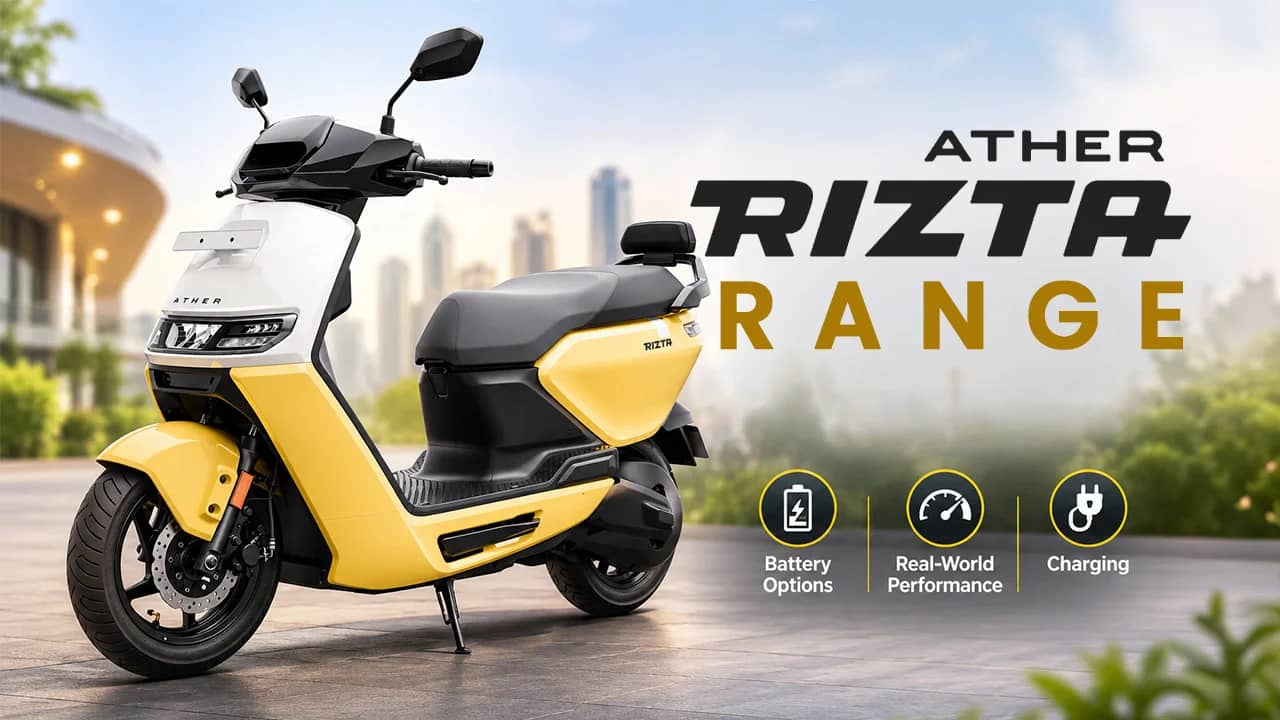
Ather Rizta Range: Battery Options, Real-World Performance and Charging
Overview
Thinking about buying the Ather Rizta? This guide explains the range you can expect from its 2.9 kWh and 3.7 kWh battery variants, how real-world performance differs from certified figures, and how long charging takes. It also breaks down electricity consumption and monthly charging costs for different daily distances, compares the Rizta with the Ampere Nexus, TVS iQube and Bajaj Chetak, and covers ownership considerations and practical ways to preserve battery range.
The Ather Rizta delivers roughly 105 km on the 2.9 kWh battery and about 120 to 125 km on the 3.7 kWh battery in real-world riding. Both are well below the certified figures of 123 km and 159 km. For most daily commutes, either battery covers a full day without a midday top-up. Check the live specifications on the Drivio Ather Rizta page.
Battery options and charging time
The Rizta comes with a 2.9 kWh or a 3.7 kWh lithium-ion battery. The larger pack reaches 0 to 80 percent in about 4 hours 30 minutes on a home charger, and a full charge takes roughly 6 hours. The 2.9 kWh pack takes about 6 hours 10 minutes for a full charge, though listings vary. Top speed is 80 km/h on both. Ather reconfigured some pack sizes in mid-2026, so confirm the exact battery and charger specification of the variant you are buying.
Claimed range versus real-world range
Certified figures come from standard test conditions. Real riding involves traffic, rider weight, terrain, riding mode and weather, so the lower numbers are the sensible planning basis. The 3.7 kWh pack retains about 79 percent of its claimed range in real use, and the 2.9 kWh pack about 85 percent.
City, highway and mixed-use range
Separate tested figures for city, highway and interstate touring are not available, so none are quoted here. The real-world numbers above are best read as mixed-use ranges. With an 80 km/h top speed and a maximum range of about 125 km, the Rizta is built for urban and suburban use rather than long interstate touring. Riders who sustain high speeds should expect less than the mixed-use figure.
Monthly charging cost: the transparent method
Electricity tariffs and public charging rates vary by city and state, and no verified rates are available for this article, so rupee totals are not stated. The calculation below shows exactly what to multiply by your own tariff.
Energy per kilometre (3.7 kWh): 3.7 kWh ÷ 125 km = about 0.0296 kWh/km.
Monthly energy = daily km × 30 days × 0.0296.
Monthly charging cost = monthly kWh × your tariff per unit. The cost per kilometre is 0.0296 × your tariff. Charger losses are not included because a verified efficiency figure was not provided, so the real draw from your socket will be somewhat higher. A 100 km daily routine sits close to the 3.7 kWh pack’s real-world limit and is not practical on the 2.9 kWh variant without mid-day charging.
Complete monthly ownership costs
Charging, maintenance, insurance and EMI should be budgeted separately. Verified maintenance and insurance figures were not available, so they are left out rather than estimated. Obtain a quote for your city. For EMI, one listing shows a starting figure of ₹1,770 per month for the Rizta range, which depends on the down payment, tenure and interest rate. Battery warranty terms and replacement costs should be confirmed with the dealer, as pack revisions have been reported in 2026. Ex-showroom prices reported around mid-2026 run from about ₹1.21 lakh for the Rizta S 2.9 kWh to about ₹1.54 lakh for the Rizta Z 3.7 kWh. City-specific listings are higher.
How the Rizta compares with rivals
Prices come from different listings and dates, so compare them on a single city’s on-road quote. On outright range, the Rizta 3.7 kWh leads this group. The Ampere Nexus offers better range per rupee, while the Rizta stands out for 34 litres of under-seat storage and app features.
Cost per kilometre and annual savings
The Rizta 3.7 kWh uses about 0.0296 kWh per kilometre. Annual running cost is that figure × your tariff × yearly distance. Comparable consumption figures for rivals and petrol scooters were not available, so a rupee savings estimate is not claimed. To compare, apply your local tariff and local petrol price to each scooter’s consumption.
Drivio mileage comparator integration
Drivio’s existing mileage comparator can be adapted for electric scooters. Useful inputs include battery capacity, real-world range, daily distance, local tariff and charger efficiency. Outputs would include energy per kilometre, monthly kWh, charging cost, annual cost against a petrol scooter and a combined cost with EMI. Link the tool from the Rizta page and from comparison pages.
Tips for better range and charging
Use the eco-style mode for routine commuting and reserve faster modes for overtaking.
Keep tyres at the recommended pressure and avoid carrying unnecessary load.
Ride smoothly. Hard acceleration drains the pack faster.
Charge before the battery gets very low, and avoid regularly leaving it at 100 percent for long periods.
Park in shade in summer, since heat affects battery health.
Plan trips so that your daily distance stays inside the real-world range with a buffer.
Conclusion
The Rizta 2.9 kWh suits city commuters and families covering up to about 60 to 80 km a day. The 3.7 kWh version suits heavier daily use of 80 to 100 km, or riders who want a range buffer. Compared with rivals, it favours buyers who value storage, comfort and connected features over the lowest purchase price. Explore the Drivio Ather Rizta page, and add your own Drivio links for electric scooter listings, vehicle comparison, the range/mileage comparator and financing.
The Ather Rizta offers a claimed 123 km on the 2.9 kWh battery and 159 km on the 3.7 kWh battery. Road tests and owner reports suggest roughly 105 km and 125 km respectively. A home charger takes about 4.5 hours to reach 80 percent on the larger pack. This guide explains energy use per kilometre, monthly charging calculations, ownership-cost components, rival scooter comparisons, Drivio comparator ideas and practical tips for protecting range, helping commuters and families decide which Rizta variant suits their daily distance and budget.