Honda SENSING RIDE Explained: What Radar-Based Rider Assist Means for India
Overview
Honda SENSING RIDE is the brand’s first radar-based rider-assist system for motorcycles. It debuts on the 2027 CRF1150L Africa Twin Adventure Sports with ten functions, from adaptive cruise control to blind-spot alerts. Honda hasn’t confirmed an India launch, but expect roughly ₹18–21 lakh ex-showroom. This guide covers what the system does, how it compares with BMW’s radar, and who in India should care.
Honda SENSING RIDE, the radar-based rider-assist system revealed at EICMA 2026 in Milan, debuts on the 2027 CRF1150L Africa Twin Adventure Sports. India has no launch date yet. The outgoing Africa Twin started at ₹15.97 lakh ex-showroom, and the new range is expected to land between ₹18 lakh and ₹21 lakh. For anyone who spends weekends on NH48 behind trucks, it is the most interesting safety story of the year.
Is Honda SENSING RIDE coming to India?
Honda hasn’t said. Its press release names one bike, the Africa Twin Adventure Sports DCT, where the system is an option, and promises more models later without listing them. No India plan has been announced for any of the new Africa Twins. One listing site pencils in an August 2027 arrival at ₹21 lakh, while Autocar India expects about ₹18 lakh for the cheaper Enduro Sports. Our working number for the radar trim is ₹21 lakh ex-showroom. That is an estimate, not a Honda figure.
It would also be a steep climb. The Africa Twin launched in India in 2017 at ₹12.90 lakh and was last listed at ₹15.97 lakh. Add roughly 8 per cent for RTO and insurance in Delhi, the margin the outgoing bike carried, and the radar trim lands near ₹22.8 lakh on-road. Mumbai and Chennai will cost more.
What the radar actually does
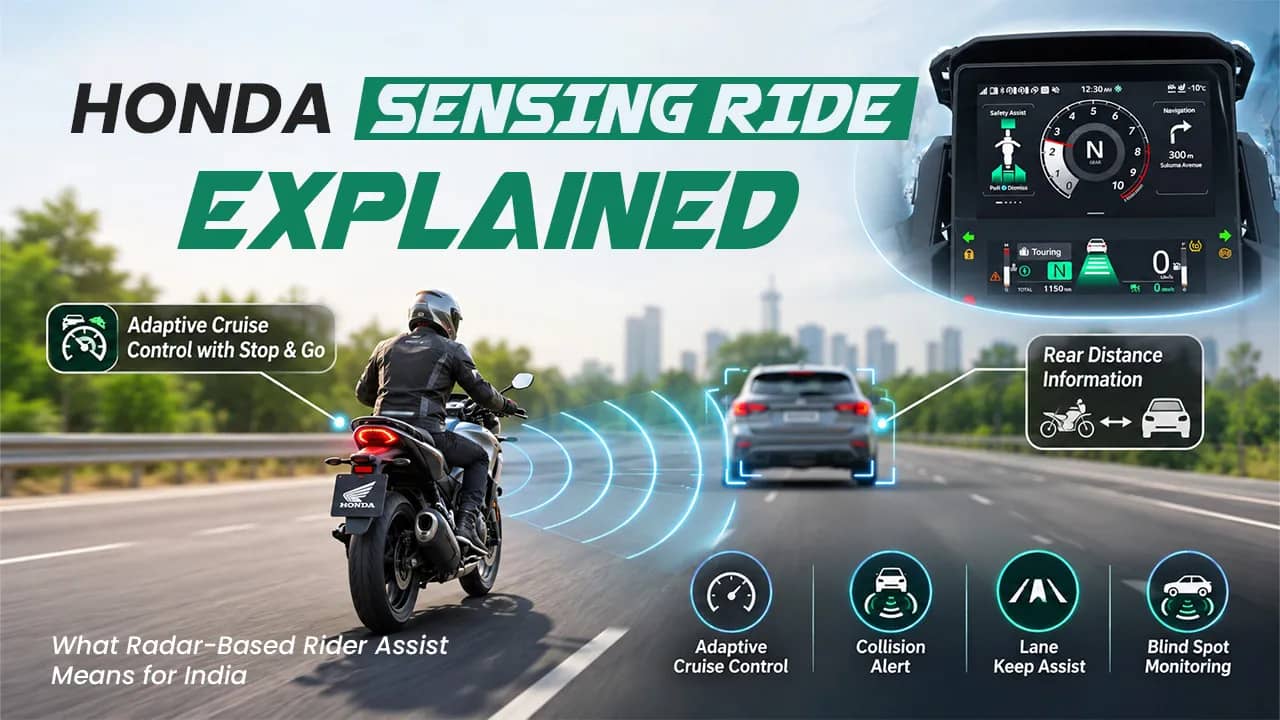
Two millimetre-wave radar units, one at each end of the bike, feed ten functions. Up front sit adaptive cruise control, a Stop & Go version of it, Group Ride Assist, Distance Assist, Forward Collision Warning, Brake Pulse and Emergency Brake Assist. At the rear, Blind Spot Information lights the mirror, Rear Distance Information flags approaching traffic on the dash, and Rear Collision Warning flashes the indicators at a tailgater.
Stop & Go is the headline, and it needs Honda’s DCT. In crawling traffic the bike brakes to a halt behind the vehicle ahead, then pulls away on its own using the gearbox’s clutchless shifts. Group Ride Assist holds spacing in a staggered formation, which any Sunday highway ride group will recognise.
Emergency Brake Assist is narrower than the name suggests. It adds braking only when the rider is already on the lever. It doesn’t take over. Honda itself warns that every function has limits and the rider must keep watching the road.
How it compares with the BMW R 1300 GS
Radar isn’t new to the class. BMW and Ducati already sell it, and the BMW R 1300 GS is the obvious rival for Indian buyers. Honda’s additions are the rear-facing warnings and a DCT that makes Stop & Go feel natural rather than bolted on.
On paper the BMW has the better engine and carries roughly 19 kg less. It also costs at least ₹2.5 lakh more than our Honda estimate, and BMW keeps its radar to the pricier variants. Honda’s case rests on price and the DCT, not outright performance.
What it will cost to live with
Start with ₹22.8 lakh on-road in Delhi. Put 20 per cent down (₹4.56 lakh), finance the rest over 60 months at 11 per cent, and the EMI is about ₹39,700.
Fuel is the smaller bill. Ride 1,000 km a month at 20 kmpl, the figure listed for the outgoing 1,084cc bike, and you burn 50 litres. At ₹103 a litre that is ₹5,150. Together you are near ₹44,800 a month before insurance renewals and servicing. Honda’s roughly 24-litre tank should give about 480 km between fills at that rate.
The radar’s weight penalty is small. The radar trim is 256 kg, the standard DCT is 255 kg and the manual is 245 kg, so the sensors add 1 kg while the DCT adds 10.
Will it work on Indian roads?
Nobody knows yet, and that is the honest answer. Radar reads vehicles ahead and behind well on an expressway like Mumbai–Pune. Honda hasn’t published how it copes with scooters threading between lanes, autorickshaws drifting across them or a bus braking without warning. Honda’s own pitch is less rider stress and fatigue on long runs, and Stop & Go should matter most in stop-start highway queues. First-ride impressions are due early next year.
Buy now or wait?
There is nothing to buy yet. Riders who want an Africa Twin today can still find the outgoing bike, last listed at ₹15.97–17.51 lakh. Those who want a Honda adventure bike without the radar premium have the NX500 at about ₹7.43 lakh, which Drivio has covered.
Honda SENSING RIDE earns the wait only if you routinely ride 500 km days with a pillion and luggage. If most of your riding is city commutes or weekend trails, the extra cost buys you very little. Everyone else should let the India price and the first reviews settle before spending ₹21 lakh. When Honda confirms the launch, check the on-road price and EMI for the Honda Africa Twin in your city on Drivio.
Wait. The radar trim makes sense only for riders who cover 500 km highway days, and Honda has set no India date or price yet. At a likely ₹21 lakh ex-showroom, the EMI works out near ₹39,700 a month. City commuters and weekend trail riders can skip it. Long-distance tourers should hold off until first-ride reports arrive early next year.