Can College Students Get a Bike Loan in India? Here's What Actually Works
Overview
Can College Students Get a Bike Loan in India? Here's What Actually Works highlights how competitive interest rates, flexible tenure options, and instant approvals enable buyers to purchase new or pre-owned two-wheelers while effectively managing monthly budgets.
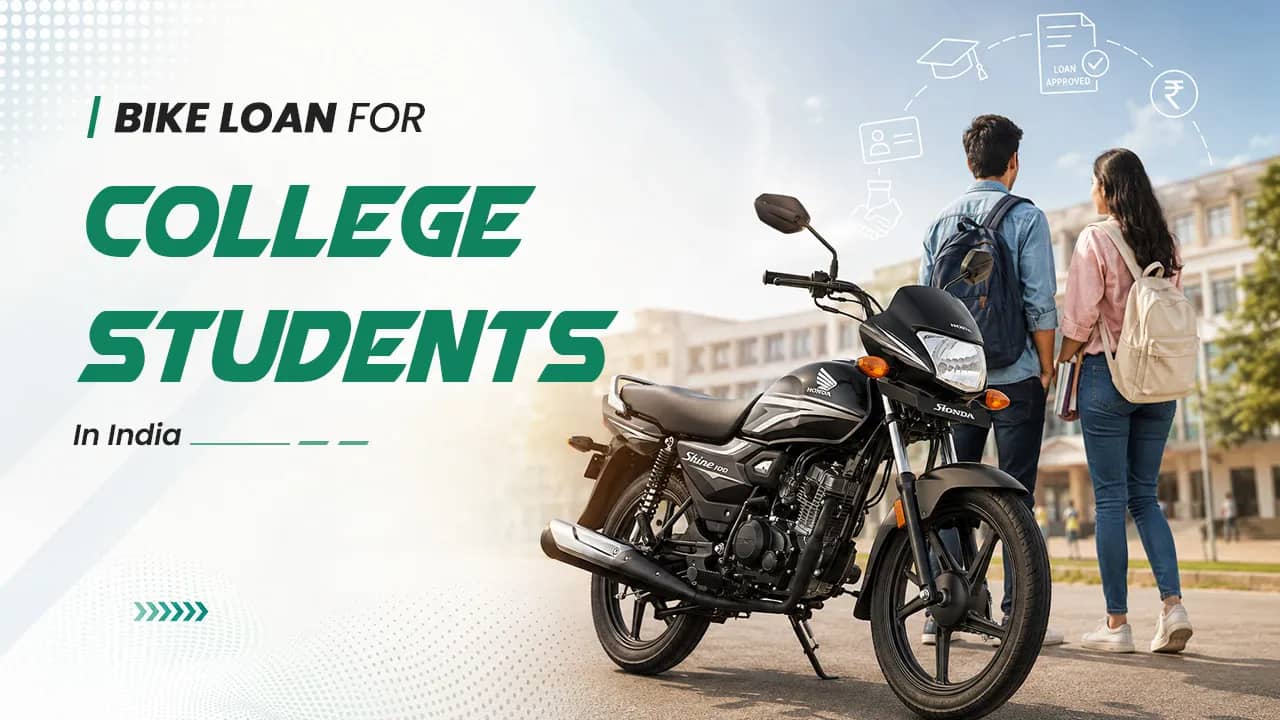
A bike loan for college students in India doesn't require a job, a salary slip, or a credit history of your own. Take the Honda Shine 100 — priced at ₹68,767 ex-showroom in Delhi, around ₹78,000 on-road — and most lenders will finance it the moment a parent or guardian signs on as co-applicant. That single detail changes the equation for anyone tired of crammed DTC buses or an auto driver who won't switch on the meter.
Who Actually Qualifies for a Student Bike Loan
Most banks set the minimum age for a two-wheeler loan at 21, because that's roughly when income kicks in. Students don't fit that mould, so lenders built a separate track around them. Shriram Finance, Tata Capital, and several NBFCs will approve applicants as young as 18, provided someone with a steady income — usually a parent — comes in as co-applicant or guarantor. The lender is really underwriting the co-applicant's salary slip, not the student's college ID.
There's a quieter eligibility trap that catches a lot of first-time applicants: address proof. Your hostel room or the flat you share near campus doesn't count. Lenders want the permanent address on your Aadhaar card, the one linked to your family home. Skip this detail and your file gets stuck at verification even after the co-applicant's income checks out fine.
Documents and the Co-Applicant's Role
The paperwork itself is short. Students need an Aadhaar card, a PAN card (or Form 60 if they don't have one yet), a passport-size photo, and college ID as secondary proof of enrolment. The co-applicant carries the heavier load — salary slips or ITR for the last two years, bank statements, and their own PAN and Aadhaar.
A co-applicant's existing debt matters more than most people expect. Lenders calculate what percentage of the co-applicant's monthly income is already committed to other EMIs — car loans, home loans, personal loans. If that number crosses roughly 50-60%, the bike loan gets rejected outright, regardless of how clean the student's own profile looks. It's worth checking this before walking into a dealership, not after.
Financing, Down Payment, and the Real Interest Rate
Here's where student bike loans actually differ from a regular two-wheeler loan: coverage. Most lenders finance 85-95% of the on-road price for student applicants, against roughly 5-15% as down payment. On a ₹78,000 on-road Shine 100, that's a down payment somewhere between ₹4,000 and ₹12,000 — genuinely manageable for a family budgeting around tuition and hostel fees.
| Lender type | Typical rate range | What to expect |
| Public sector banks (SBI, Bank of India) | 7.6%-8.5% p.a. | Lowest rates, stricter paperwork, slower approval |
| Private banks (HDFC, ICICI, Axis) | 10.25%-15.5% p.a. | Faster processing, higher rates than PSU banks |
| NBFCs (Hero Fincorp, Tata Capital, Shriram) | 9%-16% p.a. | Flexible on student profiles, quicker disbursal |
The advertised rates you'll see on comparison sites — "0.99% p.a. onwards," "6.65% p.a. onwards" — are teaser rates for borrowers with strong credit history and existing banking relationships. A first-time student applicant with a moderate-income co-applicant should budget for somewhere closer to 11%, not the number in the headline.
What the EMI Actually Looks Like
Numbers make this real faster than percentages do. On that ₹78,000 on-road Shine 100, with 20% down (₹15,600) and a ₹62,400 loan financed over 60 months at 11% interest, the EMI works out to roughly ₹1,357 a month. Over the full tenure, total interest paid comes to around ₹19,000 — not nothing, but manageable against three years of bus passes and shared autos.
Some lenders push a 36-month minimum tenure specifically for student loans, which raises the EMI to closer to ₹2,000-2,200 a month on the same loan amount but cuts total interest paid by nearly a third. Longer tenure means lower monthly pressure on a family budget; shorter tenure means less paid to the lender overall. Which one makes sense depends on whether the co-applicant would rather smooth the outflow or close the debt fast.
Running Costs Nobody Mentions Upfront
The loan is only half the monthly commitment — fuel and servicing are the other half, and they're where most students underestimate the real cost of ownership. The Shine 100 returns a real-world 55-60 kmpl. For a student riding roughly 900 km a month between college, tuitions, and errands, that's about 16 litres of petrol, or ₹1,650 a month at ₹103/litre. Add the EMI and running cost together and a Shine 100 costs a student household somewhere around ₹3,000 a month all-in — less than most shared cab or auto budgets over the same distance.
Servicing a 100cc commuter is cheap by design; Honda's authorized service intervals for the Shine 100 keep labour and parts costs low through the first 10,000 km, which is part of why it remains the default recommendation for first-time riders on a budget. Drivio's coverage of the Hero Splendor Plus and TVS Raider 125 covers similar-segment alternatives if a slightly more powerful 110-125cc commuter fits better than a pure 100cc bike.
Bank, NBFC, or Wait a Year?
There's no version of this where waiting until graduation to buy a bike on cash makes sense for most families — three years of bus fares and auto fares will likely cost more than the interest on a loan taken today. The stronger question is bank versus NBFC. If the co-applicant already banks with SBI or has a clean relationship with a private bank, start there; the rate difference over 60 months is real money. If speed and flexibility on a moderate-income co-applicant profile matter more, an NBFC like Tata Capital or Hero Fincorp will move faster and ask fewer questions.
Either way, the maths favours acting now rather than later, provided the permanent address proof and the co-applicant's paperwork are in order before the dealership visit — that's the step that actually determines how fast this gets approved. Check the on-road price and EMI for the bike you're considering in your city on Drivio.
A bike loan for college students in India doesn't require a job, a salary slip, or a credit history of your own. Take the Honda Shine 100 — priced at ₹68,767 ex-showroom in Delhi, around ₹78,000 on-road — and most lenders will finance it the moment a parent or guardian signs on as co-applicant.