Overview
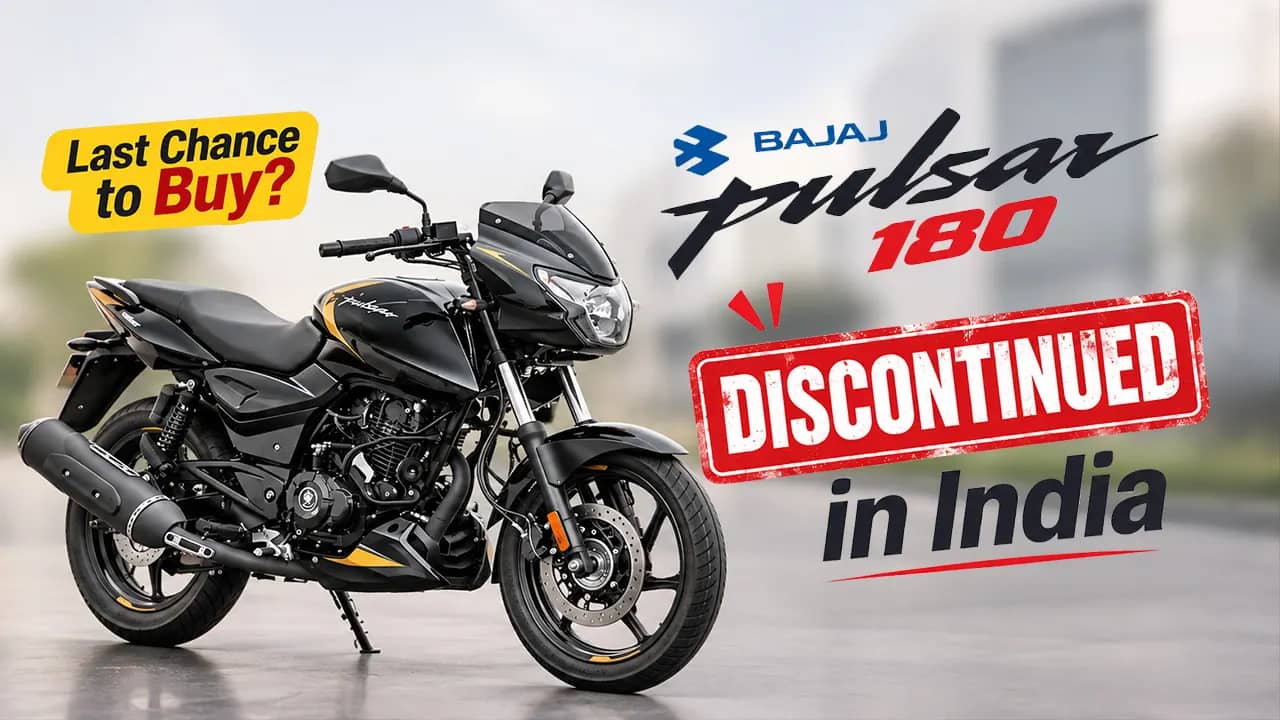
Bajaj has quietly dropped the Pulsar 180 in India, just months after reviving it at ₹1.22 lakh (ex-showroom). This piece covers what is known about the delisting, how the bike compares with the TVS Apache RTR 180 and the new Pulsar 150, and what owning one would cost. It is written for riders eyeing the last units at dealerships.
With the Bajaj Pulsar 180 discontinued in India barely seven months after its April relaunch at ₹1.22 lakh (ex-showroom), anyone who wanted the biggest air-cooled Pulsar is on a clock. Bajaj has not issued a statement. The bike has simply vanished from the company’s revamped website, while the Pulsar 125, 150 and 220F are still listed. Dealers will sell whatever stock they hold. After that, it is gone until Bajaj decides otherwise.
Bajaj Pulsar 180 discontinued: what we know and what we don’t
The sequence is short. Bajaj revived the 180 in April 2026, after dropping it in 2022, and the move was widely read as a shot at the TVS Apache RTR 180. Then Bajaj and KTM refreshed their India websites, and the 180 was missing from the “Original” Pulsar range. No press note followed. Autocar India reported the delisting on 16 November and said Bajaj had not confirmed it.
So the honest status is this: delisted, being phased out, unconfirmed on paper. It is also the second Pulsar to go this year, after the N125 in June.
The 180 is no newcomer. It launched in 2001 alongside the Pulsar 150 and has been pulled and revived more than once. Bajaj does bring models back when demand returns. This time, though, the 180 is not getting the platform overhaul the 125 and 150 received in August, which makes a quick comeback unlikely.
Why the 180 keeps losing its place in the Pulsar line-up
The price ladder explains most of it. The new Pulsar 150, launched on 24 August at ₹1,15,233 (ex-showroom, Delhi), costs roughly ₹7,000 less than the 180. For that money you get a new engine, a single-cradle frame, a monoshock and, on the upper variants, a 5-inch TFT with Google Maps navigation. The 180 gets none of it. It still runs a 178.6cc air-cooled single making 17hp at 8,500rpm and 15Nm at 6,500rpm through a five-speed gearbox, the older hardware Bajaj has now moved away from on its smaller bikes.
TVS squeezes it from the other side. The Apache RTR 180 costs ₹1.26 lakh, only about ₹4,000 more, and adds an oil-cooled motor, Urban, Rain and Sport modes and Bluetooth. A buyer standing between those two showrooms had little reason to pick the older Pulsar. The Bajaj Pulsar 180 discontinued story is really about the 150 and the Apache, not about nostalgia.
Pulsar 180 vs Apache RTR 180: what the spec sheet says
On paper this is a dead heat. Both make about 17hp, and neither torque figure will change how you ride a Delhi-NCR flyover. The TVS wins on equipment and a claimed 40-45kmpl. The Pulsar wins on sticker price and on being the plainer machine.
What the Pulsar 180 really costs to own
The Pulsar 180 on-road price in Delhi likely lands between ₹1.35 lakh and ₹1.45 lakh once RTO and insurance are added. That is an estimate, so confirm it with your dealer. Take ₹1.40 lakh. Put 20 per cent down (₹28,000), finance the remaining ₹1.12 lakh over 60 months at 11 per cent, and the Pulsar 180 EMI works out to roughly ₹2,440 a month.
Fuel is the second bill. Owners usually report around 40kmpl, a likely figure rather than a tested one. At 1,000km a month and petrol at ₹103 a litre, that is 25 litres and about ₹2,575. Add the two and you are near ₹5,000 a month before a single service. The Apache, at its claimed 45kmpl, would burn about ₹2,290 for the same distance, roughly ₹285 less. Small, but it repeats every month for five years.
Should you still buy a Pulsar 180?
Only if the dealer’s discount does the work. A last-piece 180 can make sense for a rider who wants an air-cooled, no-electronics bike and plans to keep it for years. Spares should not be a problem, since Pulsar parts are widely shared. Resale is the real risk: a delisted model usually loses value faster, and the next buyer will see “discontinued” in the listing.
For everyone else, the answer is simpler. Most riders should look at the new Pulsar 150, which trims the EMI by roughly ₹150 a month and brings a newer platform. Those who insist on 180cc should test the Apache RTR 180. The Pulsar 180 is a stock-clearing deal, nothing more, and with the Bajaj Pulsar 180 discontinued there is no reason to pay full price for it.
If a dealer near you still has a unit, check the on-road price and EMI for the Pulsar 180 in your city on Drivio before you start negotiating.
The smarter buy is the new Pulsar 150 at ₹1,15,233 (ex-showroom, Delhi), which undercuts the 180 and brings a fresher platform. Pick the Apache RTR 180 if 180cc matters to you. The Pulsar 180 makes sense only as a heavily discounted last unit, with an EMI near ₹2,440 on a likely ₹1.40 lakh on-road price in Delhi.