Pirelli Angel GT III Unveiled: New Touring Tyre Targets Wet Grip and Longer Life
Overview
The fourth-generation Pirelli Angel GT III is a touring radial meant for mid- and large-capacity tourers, crossovers and nakeds, with a global launch in early 2027. India pricing is unannounced, but the outgoing Angel GT II costs roughly ₹46,500 for a front-and-rear pair. This piece covers what changes in wet grip, wear and rear-tyre design, what you can expect to pay, and whether to wait before replacing worn rubber.
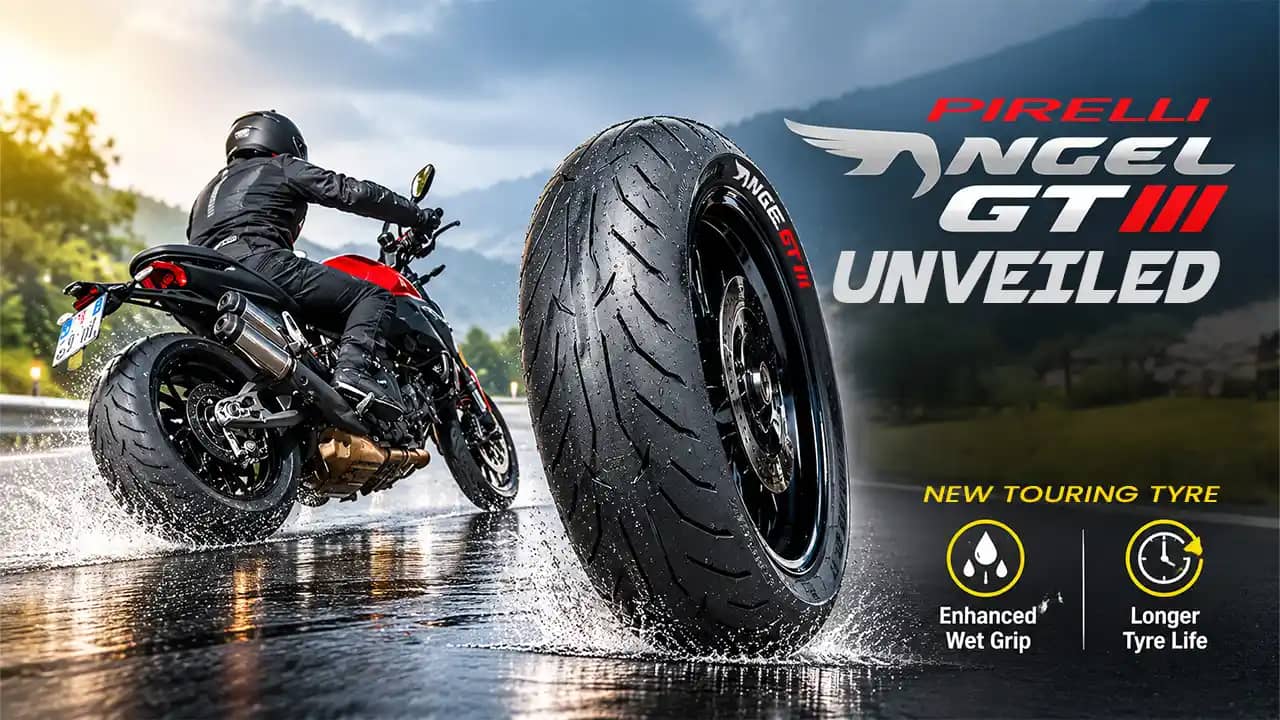
The Pirelli Angel GT III, announced on 4 November 2026, is the fourth-generation touring radial from the Italian maker and goes on sale globally in early 2027. Pirelli has not released an India price, but the outgoing Angel GT II costs about ₹46,500 for a front-and-rear set here, and that number is your yardstick. If you ride a heavy tourer and a tyre change is coming, the timing of this launch matters.
Pirelli Angel GT III price in India: what to expect
Nothing is official yet: no sizes, no price, no mileage claim. Pirelli’s own launch note stops at “early 2027.” Past listings give a rough guide. Angel GT II tyres in India run ₹21,294 to ₹23,308 each on one marketplace, and a 120/70 ZR17 plus 180/55 ZR17 pair sits at ₹46,500 at an online retailer after a cut from ₹52,500. A new generation usually opens a little above the outgoing one, so a pair in the ₹48,000 to ₹52,000 range is a fair expectation. That is an estimate, not a leak.
Pirelli’s premium bike tyres have mostly reached India through import channels, so launch timing here will likely trail Europe. Nobody should plan on finding the new tyre on a Delhi or Mumbai shelf in February.
What Pirelli says has changed
Three claims come out of the launch note, and none has been tested on the road yet. The first is easier handling. Pirelli’s phrase is “soft handling,” meaning the bike should tip into a corner with less effort at the bars. On a 230 kg tourer in Bengaluru traffic, that matters more than lap times.
The second is better wet behaviour. The third is more uniform character as the tyre wears, which goes after the classic touring complaint: a tyre that feels sharp at 2,000 km and vague, squared-off rubber by 8,000. Pirelli has put no figure on any of it. Treat all three as direction, not data.
The rear tyre gets a new tread
The rear is where the Pirelli Angel GT III visibly departs from older Angels. Pirelli has drawn a new tread pattern aimed at longer life and less rolling noise. Noise sounds trivial until you spend nine hours on a highway run with a tank bag and a full-face helmet. No mileage target has been published, so the durability promise stays a promise for now.
The tyre is meant for mid- and large-displacement sport tourers, crossovers and nakeds. In India that means the Triumph Tiger 900 and Kawasaki Versys 650 crowd. Watch the size chart when it appears: the Angel GT II covered 17- and 19-inch fronts, and adventure tourers need that 19-inch option to survive.
Why wet grip matters more here than the brochure admits
Pirelli lists wet-weather behaviour among its headline goals, and it’s the claim Indian riders should scrutinise hardest. Our monsoon is not a drizzle. The first heavy downpour in Mumbai lifts an oily film off the tarmac, junction paint turns slick, and metal manhole covers sit in the middle of your braking line. A loaded touring bike can overwhelm a tyre that grips happily in the dry.
The Angel GT II was itself launched on a wet-grip pitch, so the bar is already high. The new tyre has to beat its own predecessor, not a generic tyre. Wait for independent wet-braking tests from European magazines before believing any percentage.
Tyre cost per kilometre, worked out
Take the Angel GT II as the baseline. At ₹46,500 a set and an assumed 12,000 km (a typical sport-touring figure, not a Pirelli claim), you pay about ₹3.9 per km. A rider covering 1,500 km a month, a mix of commute and weekend runs, burns roughly ₹5,800 of tyre life monthly.
Now the fuel side. At about ₹103 a litre and a middleweight tourer returning 20 kmpl, those 1,500 km cost around ₹7,700. Tyres add close to three-quarters of your fuel bill. That is why a 10% gain in life beats a small price rise. Stretch 12,000 km to 13,200 and the per-kilometre cost falls by about ₹0.35, worth roughly ₹530 a month at the same riding. A ₹2,000 higher sticker price costs you only about ₹0.17 per km. Durability, not the price tag, decides what this tyre really costs you.
How the new tyre stacks up against Michelin Road 6 and Metzeler Roadtec 02
Pirelli is aiming at the same riders who buy the Michelin Road 6 and Metzeler Roadtec 02 abroad. Until independent tests arrive, there is no honest ranking. The Angel line has more than 15 years in this segment, so the newcomer builds on a long record instead of starting cold.
Whichever brand you pick, the buying problem in India is the same. A tyre that has moved through a grey import chain can be older than it looks. Read the four-digit DOT date code on the sidewall, which gives the week and year of manufacture. I would refuse anything more than two years old.
Buy now or wait?
If your tyres have more than 4,000 km left, wait. Sizes, an India price and the first independent tests will all land before you need them. If you need rubber before spring, buy the Angel GT II now. It is a proven set at about ₹46,500, and Pirelli’s own description makes the new generation sound incremental: easier, quieter, more consistent, not a different animal. Outgoing stock often softens in price when a successor arrives, so a discount is possible, though that is a pattern and not a promise.
My call on the Pirelli Angel GT III is simple. It is worth waiting for if your current set still has life, and not worth riding a worn rear for. Rubber is a recurring cost that sits on top of the EMI, so work out both together: check the on-road price and EMI for the touring bike you’re eyeing in your city on Drivio.
Hold your next purchase if the current tyres have a few thousand kilometres left. Anyone who needs rubber before spring should buy the proven Angel GT II at about ₹46,500 a set and not gamble on an unpriced newcomer. The number to watch is cost per kilometre: roughly ₹3.9 today over 12,000 km, so every extra 1,000 km of tyre life is worth real money.