Best Scooters for Diwali 2026: Petrol Picks and EV Alternatives in India
Overview
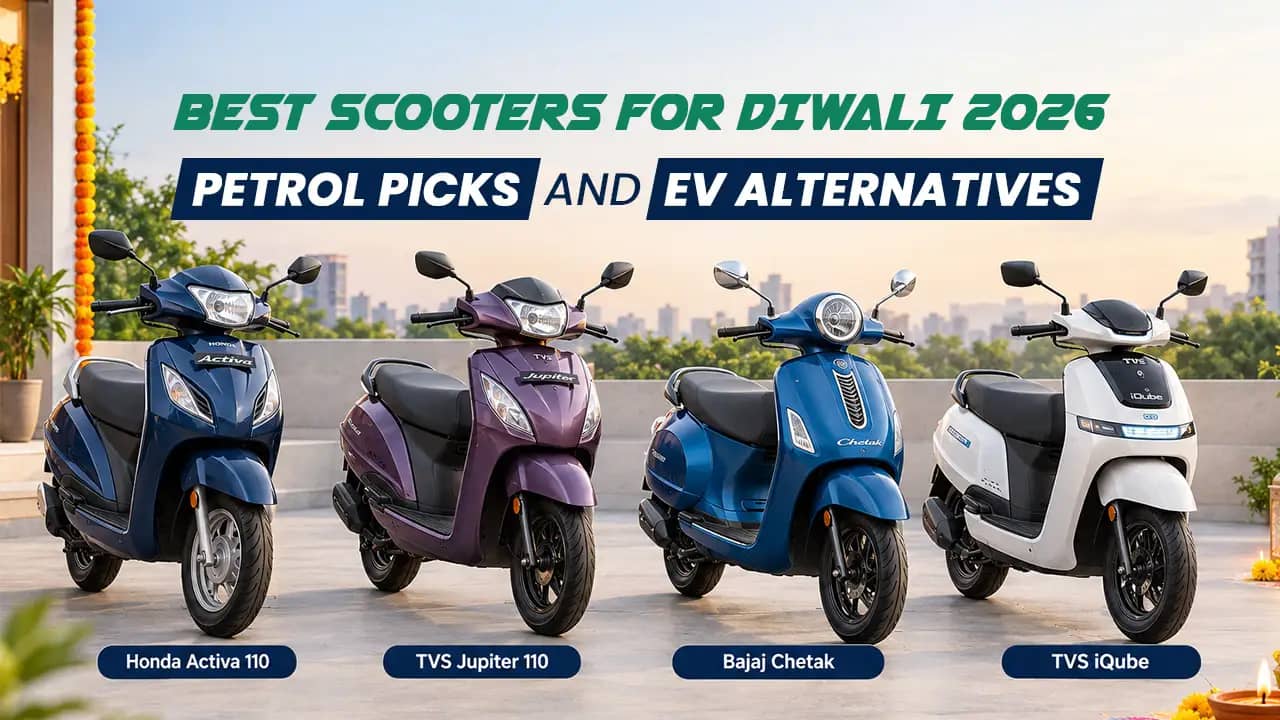
Choosing a scooter this festive season means picking between trusted petrol names and fast-improving electrics. This guide compares the Honda Activa 110 and 125, TVS Jupiter 110 and 125, Suzuki Access 125, Bajaj Chetak and TVS iQube on price, claimed mileage, running cost and ownership math in India. It explains how the 18% GST on petrol scooters and the end of the central e-scooter subsidy change the deal, lists Diwali buying checks, and shows a sample EMI so you can plan your budget.
Shopping for a scooter in India this festive season? Petrol models like the Honda Activa 110 start around ₹74,369 ex-showroom, while the Bajaj Chetak electric starts from ₹91,390. Since the September 2025 GST cut on petrol scooters, the decision depends less on tax and more on running cost and charging access. Here is how the popular options compare.
Best scooters for Diwali 2026: the quick verdict
For a safe petrol pick, the Honda Activa is still the default. The Activa 110 (₹74,369–₹91,000 ex-showroom, claimed 47–59 kmpl) suits value buyers, and the Activa 125 (₹88,900–₹95,600 ex-showroom, 47 kmpl claimed; Delhi on-road about ₹1,04,966) gives more punch. The TVS Jupiter 110 matches it on everyday practicality and often wins on seat comfort and features. The Suzuki Access 125 has the strongest equipment list among the 125cc scooters, with single-channel ABS on the Ride Connect ABS and TFT ABS editions, a first for the model.
On the electric side, the Bajaj Chetak and TVS iQube both have proper dealer networks and suit family use.
Petrol two-wheelers up to 350cc now sit at 18% GST, while electrics sit at 5%. That gap is why EVs deserve a place on every festive shortlist.
Petrol head-to-head: Activa vs Jupiter vs Access
Activa 110 vs Jupiter 110 is the oldest fight in the segment, and it is still close to a draw. The Activa starts at ₹74,369–₹76,358 depending on portal and city. The Jupiter starts at ₹75,600 in Delhi, after the February 2026 revision that added ₹2,385–₹3,250 across the range. Claimed mileage is in the same band for both. What separates them is seat height, under-seat storage layout, how the scooter feels at parking speeds, and which service centre is closer to your home. A test ride tells you more than a spec sheet.
At 125cc the pitch changes. The Access 125 offers the most modern equipment at the top end, with ABS and a TFT dash on the newest editions. The Jupiter 125 leans on practicality, with about 50 kmpl claimed and a Delhi base on-road price of ₹94,337. The Activa 125 costs more for the Honda badge, at ₹1,04,966 on-road in Delhi.
All mileage figures here are manufacturer or portal claims, and portals disagree (the Activa 110 is quoted at both 47 and about 59.5 kmpl). Budget 10–15% below the claim. If you want more detail on either brand, see our Honda Activa 125 review and our TVS Jupiter 125 review.
When an electric scooter beats all three petrol picks
For city commuters with home charging, the maths is simple. Delhi petrol is about ₹103 per litre, and home electricity realistically costs ₹5–8 per kWh. A petrol scooter at 48 kmpl costs about ₹2.15 per km. A Chetak or iQube at 25–30 Wh/km and ₹6 per kWh costs about ₹0.15–0.18 per km. On a 25 km daily commute, that saves roughly ₹1,400–₹1,500 a month, or about ₹50,000 over three years in fuel alone, before lower drivetrain maintenance.
One correction to older guides: the central PM E-DRIVE subsidy for electric two-wheelers (₹2,500 per kWh, capped at ₹5,000) closed after 31 July 2026. Support for e-rickshaws, e-carts, trucks and buses continues to March 2028, but not for scooters. Check your state's EV policy for purchase incentives and road-tax waivers, which can be worth more than the old ₹5,000.
EVs lose where charging is hard. If you park in a shared basement with no socket, or your commute crosses 70 km a day with no workplace charger, a petrol scooter is the practical choice. Battery warranties are good (Chetak 3 years/50,000 km, iQube 3 years/30,000–50,000 km depending on the pack), but a warranty does not help if the scooter cannot charge overnight. Our Bajaj Chetak vs TVS iQube comparison covers range and charging in detail.
Diwali buying checks before you book
Before you book any of the best scooters for Diwali 2026, run through these checks:
Price after the GST cut: Every 2026 ex-showroom figure already reflects the September 2025 cut to 18%. If a dealer shows a "Diwali price drop" against a 2024 figure, that is the old tax regime. Ask for the current on-road quote and compare dealer to dealer.
Exact variant: Test-ride the variant you are buying, not the demo trim.
Delivery date in writing: Booking on Dhanteras (6 November) only works if the scooter can be registered and insured in time.
Total on-road price: Registration, insurance and accessories are where festive "discounts" often hide.
Also be careful with "subsidy ending" pressure from dealers. The central e-scooter subsidy has already closed, so any festive EV discount is dealer or brand money. Get it in writing.
Ownership math for a typical 3-year buyer
Take 750 km a month with petrol at ₹103 per litre and a claimed 48 kmpl. A petrol scooter costs about ₹1,610 a month in fuel. The same commute on an EV at ₹6 per kWh costs about ₹135. That is a gap of roughly ₹1,475 a month, or about ₹53,000 over 36 months.
Now add sticker prices. A mid petrol scooter is around ₹85,000–₹95,000 ex-showroom, and a mid EV is around ₹1,10,000–₹1,35,000. The fuel saving can close a ₹30,000–₹40,000 price gap in two to three years, but only if you charge at home and ride enough to earn it. Buyers riding under 400 km a month will need five years or more to break even, and for them the cheapest petrol scooter is still the rational buy.
Also factor in insurance (higher in absolute terms on EVs because the insured value is higher), tyre and brake wear (the same for both), and resale. Ask whether the battery warranty transfers to the second owner.
Financing your Diwali scooter
Here is a worked example using the Activa 125 at ₹1,04,966 Delhi on-road. A 20% down payment is about ₹20,993, leaving a loan of about ₹83,973. At 11% over 60 months, the EMI comes to roughly ₹1,826 a month, with total interest of about ₹25,600. Set your monthly budget first, then work back to the scooter. A festive offer that cuts the down payment but stretches the tenure can quietly add thousands in interest.
Look closely at festive finance offers. Zero-down-payment schemes usually price the "free" part into the rate or processing fee. Get exchange bonuses on your old scooter in writing, separately from the discount. Compare the total amount payable across at least two lenders before you sign.
Final verdict
For reliability without charging hassle, the Activa 110 or Jupiter 110 remain the default picks, and the Access 125 leads on equipment. If you ride 700+ km a month and can charge at home, the Chetak or iQube's fuel maths is hard to argue with, even without the central subsidy. The best scooters for Diwali 2026 depend on your commute and where you park. Check the on-road price and EMI for your city on Drivio before you book.
The Activa 110 and Jupiter 110 stay the safe petrol picks, while the Access 125 leads on equipment among 125cc scooters. Petrol scooters now carry 18% GST against 5% on electrics, but the central e-scooter subsidy ended on 31 July 2026. Even so, riders covering 700 km or more a month with home charging can recover the EV price gap in about three years. Low-mileage buyers or those without a charging point should stay petrol. Check the on-road price and EMI on Drivio before booking.