New Delhi


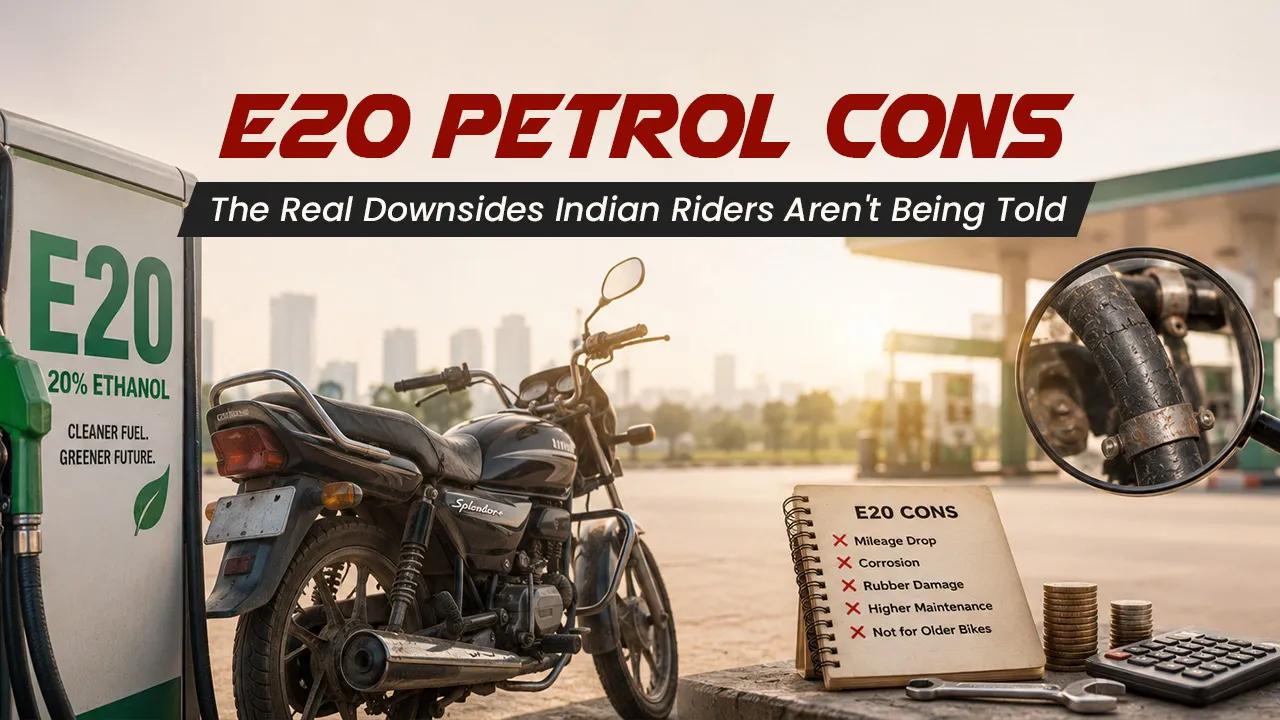

E20 Petrol Cons: The Real Downsides Indian Riders Aren't Being Told
Featured Stories by Drivio | 18 Jul 2026
E20 petrol cons are becoming a real conversation in India now that the fuel is mandatory at every pump, with no plain-petrol or E10 option left to fall back on. At roughly ₹103 a litre, the price hasn't changed much on paper, but for a meaningful chunk of the country's 24-crore-plus two-wheeler fleet, what you get for that money has. If your bike predates April 2023, this isn't a minor footnote — it's something that shows up in your mileage, your service bill, and possibly your fuel lines.
The Mileage Drop Is Real, Not Marketing Spin
Start with the number riders actually feel every week. Ethanol carries roughly 30% less energy per litre than petrol, and that shortfall doesn't disappear just because the blend is only one-fifth ethanol. Manufacturer-compliant bikes built after April 2023 report a 2-5% mileage dip, which is manageable. Older BS4 carbureted commuters — the Hero Splendor and Honda Shine variants sold before 2020, still numbering in the crores on Indian roads — have reported drops as steep as 15-20% in real-world use, since their fuelling systems weren't tuned to compensate for ethanol's lower calorific value.
Run the actual math. A rider covering 1,200km a month on an older 100cc commuter getting 60kmpl on pre-E20 fuel burns 20 litres, costing about ₹2,060. Push that mileage down 18% to roughly 49kmpl, and the same distance needs nearly 24.5 litres — a bill of ₹2,524. That's an extra ₹464 a month, or close to ₹5,500 a year, just from the fuel switch, with zero change in riding habits. Nobody selling you a bike mentions that number.
Rubber, Seals, and the Corrosion Problem
Ethanol is hygroscopic — it absorbs moisture from the air — and that moisture, combined with ethanol's solvent properties, attacks rubber and certain metals faster than plain petrol ever did. Fuel lines, carburetor gaskets, and O-rings on older bikes were never designed for this chemistry, and dealers are already reporting swelling, cracking, and premature leaks on carbureted models left standing for days at a time. It's worse for bikes that sit idle between rides, since separated ethanol-water layers can settle at the bottom of the tank and cause harder cold starts.
Royal Enfield is the only manufacturer that's responded with an actual fix: a retrofit kit for BS3 and BS4 Classic 350, Bullet 350, and Thunderbird 350 models, priced around ₹1,700 plus roughly ₹300 in fitting charges at authorised centres, with BS3 carburetor work running closer to ₹3,000-4,000. Hero, Honda, Bajaj, and TVS have no equivalent retrofit program for their older commuters, which means owners of a decade-old Splendor or Shine are largely on their own — budget for earlier-than-usual fuel line and seal replacement at your next 10,000km service, likely adding ₹800-1,500 to a bill that would otherwise be routine.
What This Means If You're Still Riding an Older Bike
SIAM has said manufacturers will continue honouring warranties on pre-2023 vehicles despite the fuel change, which takes the worst-case scenario off the table. But a warranty covers manufacturing defects, not fuel-related wear from something the bike wasn't built for — and that distinction matters if a carburetor jet or fuel pump fails two years from now. There's also a resale angle nobody's pricing in yet: a used BS4 commuter with a documented E20 conversion could eventually be worth more to a buyer than an identical bike without one, the same way a service history adds value today.
Compare that to newer buyers. Anyone shopping the TVS iQube or a fuel-injected 2024-onward commuter isn't dealing with any of this — those systems were built around ethanol tolerance from the factory, and the mileage penalty settles closer to 3%. That's the real split in the market right now: it's not petrol versus electric, it's pre-2023 versus post-2023, and the fuel pump doesn't care which one you're riding up to.
None of this makes E20 avoidable — it's the only fuel sold in the country now — but riding it blind on an older bike is the mistake. Get the retrofit conversation started with your service centre if your bike is BS4 or older, and check the on-road price and EMI for a newer, E20-ready commuter in your city on Drivio.