Electric Scooters This Diwali 2026: Chetak vs iQube vs Rizta vs Ola S1 (Price in India)
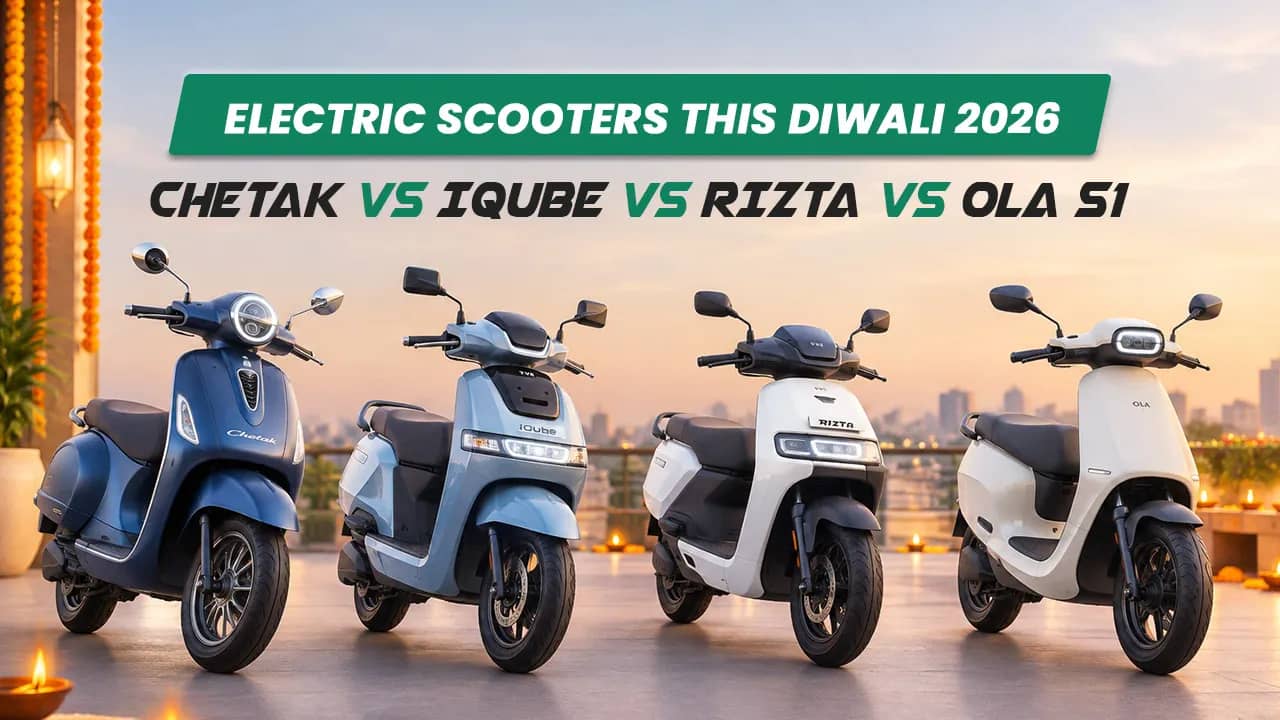
Overview
Diwali 2026 brings strong choices for anyone buying an electric scooter in India. This comparison covers the Bajaj Chetak, TVS iQube, Ather Rizta and Ola S1 X Gen 3 on verified ex-showroom prices, claimed versus real-world range, battery warranty, home-charging costs and finance. With GST on electric two-wheelers at 5% and the PM E-DRIVE subsidy running to March 2028, EVs remain cheaper to run than petrol scooters. Read on to match the right variant to your daily commute and festive-season budget.
Buying an electric scooter in India this festive season? Prices start at ₹84,999 for the Ola S1 X Gen 3 and ₹91,390 for the Bajaj Chetak, and climb to ₹1.76 lakh for the top TVS iQube. The Ather Rizta sits in between at ₹1.21–1.59 lakh. Here is how the four compare on price, real range, battery warranty, running cost and EMI.
Electric scooters Diwali 2026: how the prices stack up
These are ex-showroom figures. Festive marketing rarely quotes them clearly, so they make a fair baseline.
The Chetak range runs from the C25 01 (2.5 kWh, 113 km) to the 3501 (3.5 kWh, 153 km). The iQube base model is the 2.2 kWh with a 94 km claim, and Delhi ex-showroom prices sit well below the all-India average, so compare quotes in your own city.
Two tax facts matter here. Since 22 September 2025, GST on electric two-wheelers has stayed at 5%, while petrol two-wheelers up to 350cc moved to 18%. Today's price gap is therefore measured after the petrol-scooter tax cut, and EVs still carry the lower rate. The PM E-DRIVE subsidy (₹2,500 per kWh, capped at ₹5,000 per vehicle) now runs until 31 March 2028, not July 2026 as older guides say. It is usually already built into the ex-showroom price, so confirm this on the dealer invoice before comparing quotes.
Claimed range vs real-world range
Every range figure above is a manufacturer claim. The Rizta is the most transparent of the four: 123 km claimed on the 2.9 kWh with about 105 km true range, and 159 km claimed on the 3.7 kWh with about 125 km true range.
As a rule of thumb, city riding lands 15–25% below the claim. A Chetak 3001 (127 km claimed) is realistically a 95–105 km scooter. Size the battery to your commute:
Up to 30 km round trip: the base Chetak or iQube is comfortable
Around 50 km a day: look at 3.5 kWh-class variants
Family use with long weekend trips: the Rizta 3.7 kWh
Battery warranty: the hidden price difference
The battery is the costliest part of any EV, so warranty terms matter as much as the sticker.
Rizta: 5 years / 60,000 km as standard, extendable to 8 years / 80,000 km with the ₹4,999 Eight70 plan
Chetak: 3 years / 50,000 km, with paid extensions of +1 or +2 years
iQube: 3 years / 30,000 km on the 2.2 kWh, and 3 years / 50,000 km on larger packs
Ola S1: 3 years / 50,000 km, with paid top-ups up to 8 years / 80,000 km on eligible variants
Some festive discounts quietly move money from the warranty plan into the price. Read the warranty card, not just the offer sheet, and get extended-cover terms in writing.
Running cost: petrol vs home charging
Take a 750 km/month commute. A petrol scooter at about 50 kmpl burns 15 litres, which at ₹103/litre is roughly ₹1,545 a month. An electric scooter at 25–30 Wh/km and ₹6/kWh costs about ₹110–140. That is a saving of over ₹1,400 a month, so a higher sticker price can still be the cheaper three-year proposition.
Two caveats apply. Brakes, tyres and suspension still wear like a petrol scooter's, so only the drivetrain is cheaper to maintain. Public charging costs and queues also eat into the saving if you have no home or office socket, so flat-dwellers should confirm socket access first.
EMI for an electric scooter this Diwali
Two-wheeler loan rates currently run 7–18%, and processing fees are usually 1–3% of the loan. On a ₹1 lakh scooter with 20% down, a 60-month loan at 11% works out to an EMI of about ₹1,740. That is close to the monthly fuel saving above, so on a ₹1 lakh scooter the fuel savings can cover most of the EMI.
Finance the full on-road amount (registration, insurance, accessories), not just ex-showroom. Ask the lender whether the quoted EMI assumes any subsidy credit, and whether the extended warranty is financed or paid separately. Compare the total amount payable, not just the EMI.
Which one to pick
Chetak C25 01 or 3001: the lowest branded entry price and understated styling
iQube: the widest choice of battery sizes
Rizta: the family pick, with a flat floorboard, family-first seat and the longest standard battery cover
Ola S1 X Gen 3: the price leader, but compare the exact variant (2, 3 or 4 kWh) and check the service network in your city
Don't buy on the biggest claimed range alone, and don't sign without the warranty card. On some variants the PM E-DRIVE subsidy already absorbed in the price is worth more than any festive cashback.
Final verdict
The Chetak is the value entry, the iQube gives the most choice, the Rizta is the family pick with the strongest battery warranty, and the Ola S1 X is the price leader. Buy on verified variant specs, with 5% GST and the March 2028 subsidy horizon built into your numbers, and the best electric scooter for Diwali 2026 becomes clear.
Ready to decide? Check the on-road price and EMI of your shortlisted scooter on Drivio before you visit the showroom.
The Chetak is the value entry from ₹91,390, the iQube offers the widest battery choice, the Rizta suits families with a five-year battery warranty, and the Ola S1 X Gen 3 leads on price from ₹84,999. Real-world range typically falls 15–25% below claimed figures, so size the battery to your commute. Home charging costs roughly ₹110–140 a month against about ₹1,545 for petrol, and finance at 20% down over 60 months at 11% keeps EMIs near ₹1,740 for every ₹1 lakh of scooter price.