Overview
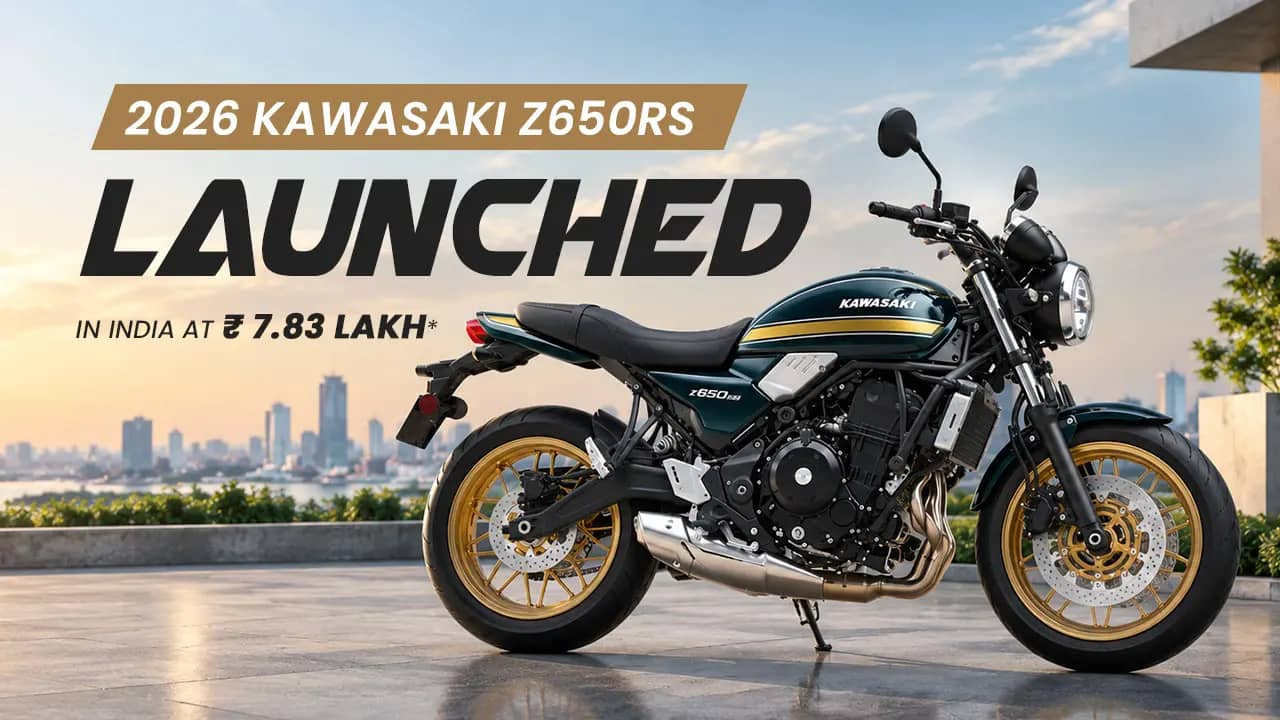
The 2026 Kawasaki Z650RS has been launched in India at ₹7.83 lakh (ex-showroom), a ₹14,000 hike over the MY25 version. The update brings a new Metallic Ocean Blue colourway but no feature changes, and is largely tied to E20 fuel and OBD2 compliance. Notably, output has dipped slightly to 66 PS/62.1 Nm from 68 PS/64 Nm. The 649cc parallel-twin engine, trellis frame, dual-channel ABS and KTRC traction control carry over unchanged from the previous model year.
The Kawasaki Z650RS has just got a MY26 update in India, landing at ₹7.83 lakh (ex-showroom), a ₹14,000 hike over the outgoing MY25 bike that sold at ₹7.69 lakh. If you've been eyeing this neo-retro middleweight, the price bump matters less than what's changed underneath — and there's a small catch buyers should know about before booking one.
What's Actually New On The MY26 Z650RS
Kawasaki hasn't touched the styling in any meaningful way. The bike swaps its Ebony paint for a new Metallic Ocean Blue, with the signature gold pinstripe on the tank and tail cowl carried over, along with the gold-finished 17-inch wheels. No new features, no updated console, no revised switchgear. This is a straightforward model-year refresh done mainly to keep the Z650RS aligned with India's E20 fuel and OBD2 emission norms, which is also why the price has moved up two years running now — MY25 to MY26 alone added ₹14,000, following a similar hike the year before.
Here's the part that'll actually affect how the bike feels: output has dropped. The MY25 Z650RS made 68 PS and 64 Nm; the MY26 version makes 66 PS and 62.1 Nm. It's not a number that shows up on a spec sheet comparison most readers will notice, but on a bike whose appeal has always been about a smooth, unhurried parallel-twin rather than outright speed, a couple of PS shaved off for compliance isn't going to change how it rides on Indian roads. Kawasaki hasn't officially detailed the tuning change, but it lines up with what other manufacturers have done while adapting older engines to E20-compatible fuelling.
The Engine, Frame And Everything Else Stays Familiar
Power still comes from the same 649cc, liquid-cooled, DOHC parallel-twin that's done duty in the Z650 and Ninja 650 for years, paired with a 6-speed gearbox and an assist-and-slipper clutch. The steel trellis frame, 41mm telescopic fork, and horizontal back-link monoshock haven't moved. Braking is handled by twin 300mm discs up front and a single rear disc, both working with dual-channel ABS, and Kawasaki's 2-mode KTRC traction control is standard. The instrument cluster keeps its analogue speedometer and tachometer with a small LCD screen wedged between them — a deliberate throwback that's aged well against the fully digital dashboards most rivals now use. Seat height sits around 820mm, and the 12-litre tank is on the smaller side for a bike this size, something worth factoring in if you're planning long highway stretches rather than city runs.
On-Road Price And What The EMI Actually Looks Like
Add RTO and insurance in Delhi and the Z650RS lands close to ₹9.1 lakh on-road — Kawasaki's own dealer pricing in some southern cities has it slightly higher, around ₹9.75 lakh, so expect some city-to-city variation depending on local RTO slabs. Financing it with a typical 20% down payment, a 60-month tenure and 11% interest works out to roughly ₹15,800 a month, with a down payment of around ₹1.82 lakh. That's not far off what you'd pay for a Trident 660 on similar terms, which tells you where Kawasaki has positioned this bike — as a lifestyle purchase, not a value one.
Running costs are the other half of the ownership picture buyers rarely get told upfront. Kawasaki claims 23 kmpl, but owners of the earlier Z650RS have reported real-world figures closer to 18-19 kmpl once you factor in spirited riding and city traffic. At ₹103/litre, that's roughly ₹5,400-5,700 a month if you're doing around 1,000km. Servicing costs on 650cc Kawasakis have typically landed in the ₹8,000-10,000 range for a 10,000km check-up, though this figure isn't officially published and can vary by dealership — worth confirming with your local service centre before you factor it into your budget.
Kawasaki Z650RS Vs Triumph Trident 660: Which One Actually Makes Sense
The Z650RS doesn't have a direct rival in India — nothing else does neo-retro at 650cc — but two bikes get cross-shopped against it constantly.
The Trident 660 costs more but out-guns the Z650RS comfortably with its triple-cylinder motor, and if outright performance is the priority, that's the bike to test ride first. The Interceptor 650 undercuts both by a wide margin and remains the sensible choice if retro styling matters more than outright polish or badge value. What the Z650RS sells is neither raw power nor value — it's the styling exercise done properly, with build quality and switchgear feel that neither rival quite matches at this price point.
Should You Buy The 2026 Z650RS Or Wait
If you already liked the MY25 bike, the MY26 update doesn't give you a compelling reason to pay more for less power — unless the new colourway is the one you wanted all along. First-time buyers walking into a showroom today won't notice the PS difference on a test ride, and the styling, ergonomics and everyday usability remain exactly what made this bike popular in the first place. It's a good buy on its own merits; just don't expect this year's version to be quicker than last year's. Check the on-road price and EMI for the Kawasaki Z650RS in your city on Drivio.
Kawasaki's MY26 Z650RS refresh costs more but delivers marginally less power than before, making it a cosmetic and compliance update rather than a performance one. On-road pricing lands near ₹9.1 lakh in Delhi, with EMIs around ₹15,800/month over 60 months. It remains unrivalled in India's neo-retro 650cc space, sitting between the value-focused Royal Enfield Interceptor 650 and the quicker, pricier Triumph Trident 660. Buyers drawn to its styling and build quality still get a compelling package, just not a faster one.