Ampere Nexus EX+ Launched at ₹1.30 Lakh With a 5 kW Motor: Price, Range and Running Cost
Overview
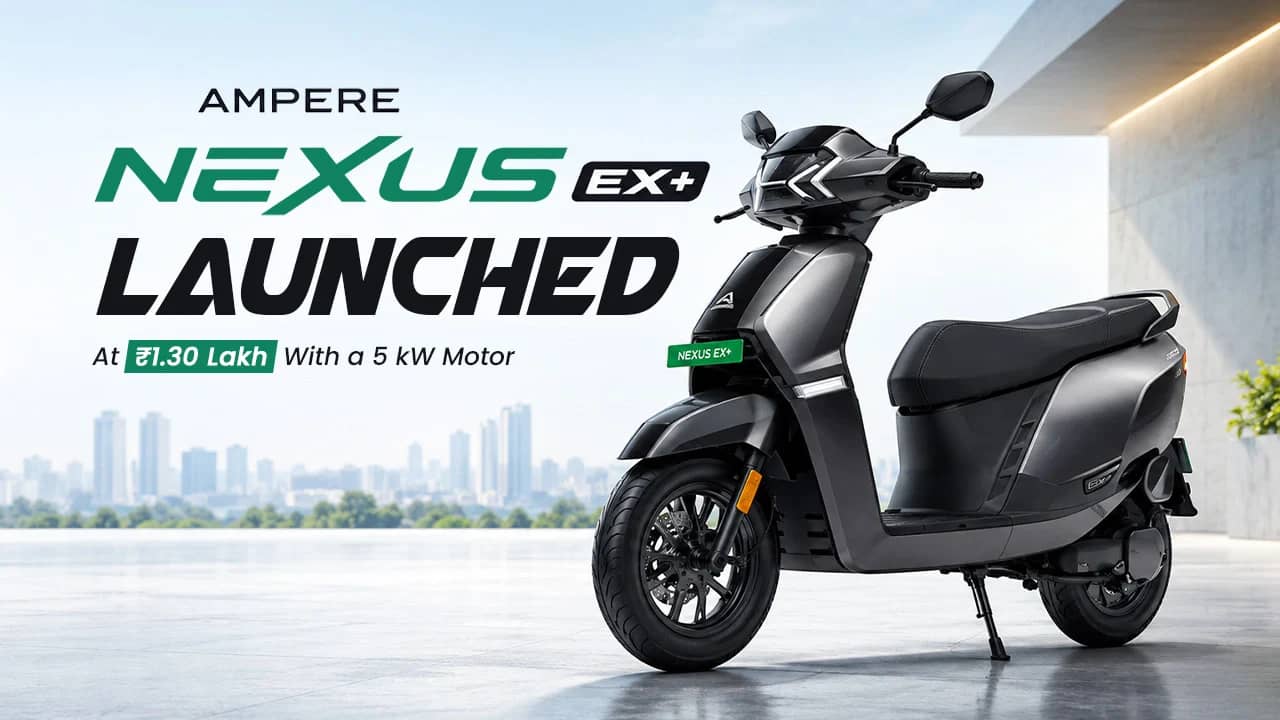
Ampere has launched the Nexus EX+ electric scooter in India at ₹1,29,999 (ex-showroom), with a connected Intellipack version at ₹1,35,999. The big update is a 5 kW motor making 202 Nm of wheel torque, paired with a 3 kWh battery, a claimed 136 km range and a 93 km/h top speed. The charger is now IP65-rated, and the battery carries a 5-year/75,000 km warranty. Delhi on-road price is around ₹1.36 lakh. This article covers price, EMI, real-world running cost and how it compares with the Ather Rizta.
The Ampere Nexus EX+ has launched in India at ₹1,29,999 (ex-showroom), and the headline change sits under the floorboard: a 5 kW motor making 202 Nm of peak wheel torque, up from the roughly 4 kW unit on the older Nexus. For anyone shopping for an electric scooter near ₹1.3 lakh this festive season, Greaves Electric Mobility's Ampere brand has just made the shortlist harder to ignore. A connected Intellipack version is also on sale at ₹1,35,999.
Ampere Nexus EX+ price in India and on-road cost in Delhi
Start with the number you will actually pay. The base scooter costs ₹1,29,999 ex-showroom, and the Intellipack version adds ₹6,000. In Delhi, where EVs are exempt from road tax, adding roughly ₹5,600 of insurance puts the on-road price near ₹1.36 lakh. Cities that charge registration fees will come in higher, so treat that figure as a floor.
The financing is simple. A 20% down payment is about ₹27,200, which leaves a loan of roughly ₹1.09 lakh. At 11% over 60 months, the EMI is about ₹2,366 a month, and you pay around ₹33,000 in interest over the term. Those are our illustrative terms, and your bank's actual rate will move the number.
What the 5 kW motor actually changes
Five kilowatts of peak power is about 6.7 bhp. That sounds modest next to a motorcycle, and it is. The number that matters on a scooter is the 202 Nm of wheel torque. It is measured after the gearing, so don't set it against the crank torque of a petrol scooter, which is under 10 Nm on a typical 110cc machine. In traffic it means an immediate shove off the line, which is what you want at a Delhi red light with an auto rickshaw crowding your elbow.
Top speed is 93 km/h. You will rarely see that on a city road, but you will notice it on a highway bypass. The 3 kWh battery carries a claimed IDC range of 136 km. Real-world figures run lower, and with a pillion in Delhi's summer heat we expect roughly 95-105 km between charges. A full charge takes about 3 hours 35 minutes, and the charger now carries an IP65 rating, so a dripping garage in July is no longer a worry.
Under-seat storage is 22 litres and the seat sits at 765 mm, low enough for most adult riders to reach the ground comfortably. The battery is covered for 5 years or 75,000 km, and the vehicle for 3 years or 30,000 km.
Real running cost against a petrol scooter
Take a rider covering 40 km a day, or 1,200 km a month. At a likely 100 km per charge and a home tariff near ₹7 a unit, the Ampere Nexus EX+ pulls about 3.4 kWh from the wall for every 100 km. That is around ₹24 per 100 km, or ₹285 a month. A petrol scooter returning 45 kmpl at ₹103 a litre burns about 27 litres over the same distance, roughly ₹2,750. The gap is close to ₹2,460 a month.
Set that beside the EMI and the saving on fuel nearly covers the ₹2,366 instalment by itself. The warranty also matches this usage: 75,000 km at 1,200 km a month lasts just over five years. These are our assumptions, not Ampere's claims. Change your daily distance or electricity slab and the answer moves with it.
Is the Intellipack version worth ₹6,000?
The Intellipack version connects to the Ampere Connect app and adds 30-plus connected features, including geo-fencing. It also gets over-the-air updates, which the base scooter does not. Spread across the same loan, the extra ₹6,000 costs roughly ₹105 a month.
If two family members will share the scooter, or it sleeps on a street where theft is a worry, geo-fencing earns that back. A solo commuter parking in a society basement can skip it and spend the money on a good helmet and a rain cover.
Nexus vs Ather Rizta: where the rivals sit
The closest direct rival is the Ather Rizta, and the numbers are tight enough to need a table.
The Rizta S is ₹9,000 cheaper but gives up 13 km of claimed range and 13 km/h of top speed. The Rizta Z costs ₹9,000 more than the Nexus and still offers less range. Ather's software and charging network are the counter-argument, and they are a real one. The Bajaj Chetak and TVS iQube, both covered on Drivio, are the other two names to cross-shop in this bracket. Chetak's metal body and iQube's dealer reach count for as much as anything on a spec sheet.
Buy or wait?
Buy if you want the most claimed range and the highest top speed under ₹1.4 lakh, and your daily ride is well inside 80 km. For a family scooter doing 30-50 km a day, the base Nexus is enough and the Intellipack is optional. Wait if you ride mostly on highways, or if a fast-charging network matters more to you than a bigger battery.
Ampere's dealer network is thinner than Ather's or TVS's outside the big metros, so ask about a service point near you first. Check the on-road price and EMI for the Ampere Nexus EX+ in your city on Drivio.
The Ampere Nexus EX+ is a strong pick for family riders covering 30-50 km a day. At ₹1.36 lakh on-road in Delhi, the EMI is about ₹2,366 a month on 20% down, 60 months at 11%. Running cost is roughly ₹285 a month against ₹2,750 for a petrol scooter, so fuel savings nearly cover the instalment. It offers more range and speed than the Ather Rizta, though Ather has the better charging network. Buy the base version, and check for an Ampere service point nearby before booking.