2027 Kawasaki Vulcan S Launched in India at Rs 8.23 Lakh — Price, EMI & What Changed
Overview
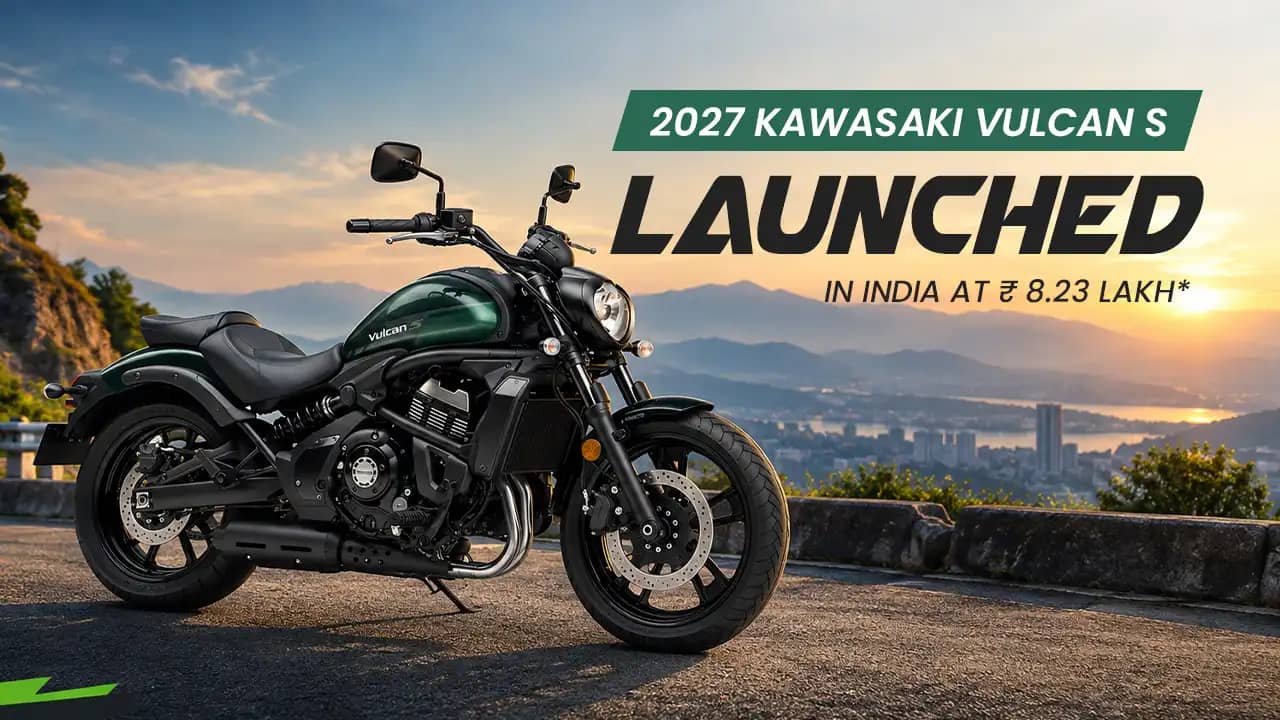
Kawasaki has launched the 2027 Vulcan S in India at Rs 8.23 lakh (ex-showroom), a Rs 10,000 increase over the 2026 model. The update brings peak torque up to 62.4Nm, up 1.4Nm from last year, while power holds steady at 61bhp. Both disc rotors have been downsized — front to 272mm, rear to 216mm — with dual-channel ABS carried over. The bike gets a new Metallic Carbon Gray paint option, replacing 2026's Flat Spark Black. All other mechanicals, including the 649cc parallel-twin engine, remain unchanged.
The 2027 Kawasaki Vulcan S is now on sale in India at Rs 8.23 lakh (ex-showroom), a bump of Rs 10,000 over the 2026 model that most buyers won't notice on paper but will feel slightly at the dealership counter. Kawasaki hasn't touched the fundamentals — this is still the same 649cc parallel-twin cruiser it's been since 2015 — but three changes are worth knowing before you sign the loan papers: a small torque bump, a new colour, and smaller brake rotors that Kawasaki insists won't hurt stopping power on India's traffic-clogged roads.
Kawasaki Vulcan S 2027 price and on-road cost in India
At Rs 8.23 lakh ex-showroom, the Vulcan S stays a one-variant, one-colour affair — Kawasaki has never bothered with trims on this bike, and 2027 doesn't change that. Factor in RTO, insurance and other charges and the on-road price in Delhi comes to roughly Rs 9.30 lakh, while in Mumbai it climbs closer to Rs 10.29 lakh thanks to Maharashtra's higher road tax slab. That gap alone is worth checking before you commit; it can swing your total outlay by nearly a lakh depending on where you register the bike.
What actually changed for 2027
Kawasaki has nudged peak torque up to 62.4Nm on the 2027 Kawasaki Vulcan S, a gain of 1.4Nm over the 2026 bike, which had dipped to 61Nm after the engine was retuned for E20 fuel compatibility last year. Power stays put at 61bhp, and the rpm points for both figures are unchanged. Don't expect a different personality on the road — this is the same smooth, low-revving twin doing the same job, just with a torque curve that's crept back to where it sat in 2024.
The bigger surprise is at the wheels. Kawasaki has shrunk both disc rotors — the front goes from 300mm to 272mm, and the rear drops from 250mm to 216mm. Dual-channel ABS carries over, so the safety net is still there, but smaller rotors typically mean less outright stopping power and more heat buildup on long descents, which matters more on a Ghats run than a flat Delhi commute. Kawasaki hasn't explained the change publicly, and until an independent brake test turns up, riders who do a lot of hill riding should weigh that before deciding.
Cosmetically, the Flat Spark Black from 2026 is gone, replaced by a new Metallic Carbon Gray with a faint bluish-green tint under direct light. Everything else — the 41mm telescopic fork with 130mm of travel, the preload-adjustable rear monoshock, the 705mm seat height, and the 235kg kerb weight — carries over unchanged.
EMI and running costs: what owning this actually costs monthly
Run the numbers on standard terms — 20% down payment and a 60-month loan at 11% interest — against the Delhi on-road price of Rs 9.30 lakh, and you're putting down Rs 1.86 lakh upfront and financing the remaining Rs 7.44 lakh. That works out to an EMI of roughly Rs 16,177 a month, with total interest over the five years landing near Rs 2.27 lakh. That's real money for a bike with no direct competitor to shop against, so check your own EMI for the 2027 Kawasaki Vulcan S on Drivio against your city's on-road price before finalizing anything.
Fuel costs are the smaller number here but still worth knowing. Kawasaki's claimed mileage sits at 20.58kmpl, though real-world riding in Indian city traffic typically brings that down to somewhere between 16 and 18kmpl once you factor in stop-start commuting on a 235kg motorcycle that doesn't love crawling through second gear. At 17kmpl and today's petrol price of ₹103/litre, a rider doing 1,500km a month is looking at roughly Rs 9,090 in fuel alone — not huge, though cruiser buyers rarely cross-shop on running costs the way commuter buyers do.
There's also the service bill to budget for. Kawasaki's twin-cylinder cruisers typically need two paid service visits by the 10,000km mark once the first free service is used up, and parts-plus-labour for that stretch on the Vulcan S usually lands in the Rs 4,500 to Rs 6,000 range at an authorised centre — expect the higher end if the smaller front rotor needs an early pad change, since less material generally means quicker wear. It's not a big number next to the EMI, but it's one nobody quotes upfront, and it's worth asking your dealer to confirm before you walk in for delivery.
Where the Vulcan S sits against the competition
Kawasaki keeps repeating that the Vulcan S has no direct rival in India, and that's technically true — nothing else combines a 649cc parallel-twin with this seat height and this riding position. But anyone cross-shopping cruisers will land on the Royal Enfield Super Meteor 650, priced at roughly Rs 4.05 lakh ex-showroom, less than half the Vulcan S's asking price. The Super Meteor gives up refinement and the adjustable ERGO-FIT ergonomics that let the Vulcan S be configured across 18 rider positions, but it undercuts Kawasaki so heavily that the comparison isn't really about specs — it's about whether the extra Rs 4 lakh buys enough polish to justify itself for your riding style.
Should you buy the 2027 Vulcan S or wait?
If you already wanted a Vulcan S, this update changes nothing that should delay your decision — the torque bump is marginal, the colour is a matter of taste, and the smaller brakes are a wait-and-watch item rather than a dealbreaker on typical city and highway use. Buyers stepping up from a 350cc single will notice the extra refinement and the low seat height immediately, and the ERGO-FIT adjustability genuinely solves the fit problem that trips up a lot of cruiser shoppers. Where I'd pump the brakes, pun intended, is if you ride hill routes often — give the smaller rotors time to get reviewed independently before betting your commute on them.
Check the on-road price and EMI for the 2027 Kawasaki Vulcan S in your city on Drivio.
The 2027 Kawasaki Vulcan S costs Rs 8.23 lakh ex-showroom, with on-road prices of roughly Rs 9.30 lakh in Delhi and Rs 10.29 lakh in Mumbai. On a standard 20% down, 60-month, 11% interest loan, EMI works out to about Rs 16,177 a month. Real-world mileage sits around 16-18kmpl, costing roughly Rs 9,090 monthly fuel for 1,500km of riding. The Royal Enfield Super Meteor 650 remains its closest — if far cheaper — alternative in India's mid-capacity cruiser segment.