Overview
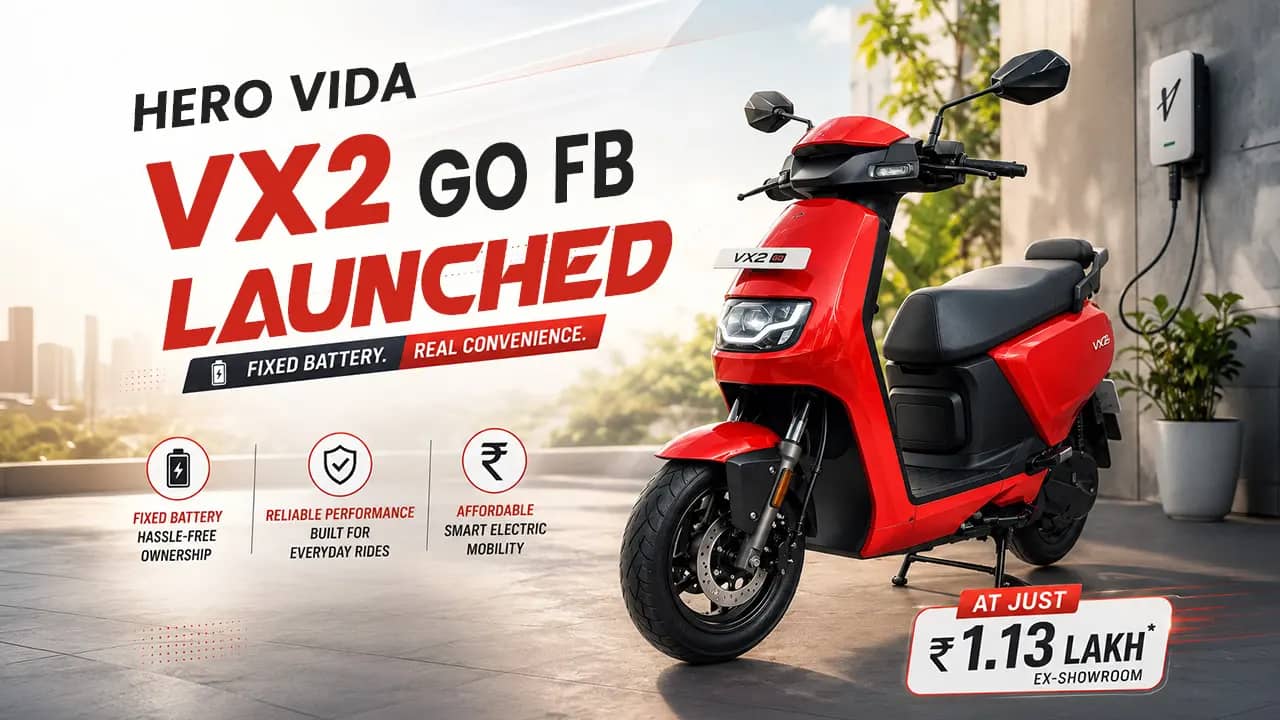
Hero Vida VX2 Go FB Launched With Fixed Battery At Rs 1.13 Lakh brings key updates for two-wheeler buyers in India. Hero Vida VX2 Go FB has gone on sale in India at Rs 1.13 lakh (ex-showroom, Delhi), and it changes the calculation for buyers who never wanted to lug a
Hero Vida VX2 Go FB has gone on sale in India at Rs 1.13 lakh (ex-showroom, Delhi), and it changes the calculation for buyers who never wanted to lug a battery pack up three flights of stairs in the first place. This is the first fixed-battery variant in the VX2 lineup, built around a 3.1kWh pack that stays bolted into the scooter and charges directly from a wall socket. Hero says deliveries begin at dealerships nationwide from early August, and the timing matters — this scooter arrives right as festive-season EV buying picks up pace.
What the Vida VX2 Go FB Actually Offers
The fixed 3.1kWh battery returns an IDC-certified range of 128km, which slots it neatly between the existing VX2 Go 2.2kWh (93km) and the VX2 Go 3.4kWh (146km). Power comes from the same 6kW swingarm-mounted motor used across the VX2 range, and top speed is capped at 70kph — enough for city commuting, not much beyond that. DC fast charging is supported, taking the battery from 0-80 percent in 65 minutes, which is a genuine advantage over some rivals that force full overnight charging as the default.
Where this variant breaks from Vida's usual playbook is the "fixed" part. Every other VX2 trim uses removable batteries that owners can carry indoors to charge — handy if you live in an apartment without dedicated parking near a socket, less handy if you'd rather not haul 15kg of battery up a staircase every evening. The Go FB drops that flexibility in exchange for a scooter you plug in where it's parked, using Hero's network of over 5,900 fast-charging points and 700-plus service touchpoints as backup for longer runs.
Price, On-Road Cost, and What Ownership Actually Looks Like
At Rs 1.13 lakh ex-showroom in Delhi, expect the on-road price to land close to Rs 1.19-1.20 lakh once you factor in insurance — EVs are exempt from road tax in most states including Delhi, which keeps the gap between ex-showroom and on-road figures unusually small compared to petrol scooters. Financed at 20 percent down over 60 months at 11 percent interest, the EMI works out to roughly Rs 1,970 a month, which is lighter on the wallet than most people assume an EV commitment will be.
Running costs are where the fixed battery quietly earns its keep. A full charge from that 3.1kWh pack costs somewhere around Rs 25 at typical Delhi domestic tariffs, and it buys you the full 128km — call it 19-20 paise per kilometre. Ride 40km a day for commuting and you're looking at roughly Rs 230-250 a month in electricity, a fraction of what a 110cc petrol scooter burns through at current rates. Service costs should stay low too; without an engine, gearbox, or oil to worry about, a 10,000km service on an electric scooter typically runs Rs 800-1,200, mostly brake checks, tyre rotation and battery health diagnostics.
Hero Vida VX2 Go FB vs the Competition
Bajaj Chetak sits at roughly Rs 1.19 lakh with a 131km range, so the VX2 Go FB actually undercuts it slightly on price for comparable range. TVS iQube and Ola S1X both offer variants in a similar bracket, though neither has committed to a fixed-battery, direct-plug model at this price point — Vida is betting that buyers who don't need portability will pay for a simpler, cheaper-to-maintain pack instead. It's a reasonable bet. Removable batteries sound appealing on paper, but most owners charge at home anyway, and a fixed pack means one less thing that can be dropped, damaged, or stolen off a parked scooter.
Vida isn't abandoning the removable-battery crowd, either — the Go FB launches alongside the existing lineup, and Hero is also offering a Battery-as-a-Service option that can push the upfront price down considerably for buyers who'd rather pay a monthly subscription than commit to owning the pack outright. That's worth checking against your monthly riding distance before deciding; BaaS tends to favour low-mileage riders, while owning the fixed battery outright makes more sense once you're consistently past 30-35km a day.
Feature-wise, expect the Go FB to carry over the rest of the VX2 Go's kit — a 4.3-inch LCD cluster running the Vida Edge app, turn-by-turn navigation, remote immobilisation, fall and accident alerts, reverse-assist, underseat storage, and a front frunk. None of that has changed; only the battery architecture has.
For anyone shopping in the sub-Rs 1.2 lakh electric scooter segment who's decided portability isn't worth the trade-off, the Vida VX2 Go FB is one of the stronger options on the table right now — cheaper to run than its removable-battery siblings in practice, and priced competitively against the Chetak and iQube. Check the on-road price and EMI for the Hero Vida VX2 Go FB in your city on Drivio.
Hero Vida VX2 Go FB has gone on sale in India at Rs 1.13 lakh (ex-showroom, Delhi), and it changes the calculation for buyers who never wanted to lug a battery pack up three flights of stairs in the first place. This is the first fixed-battery variant in the VX2 lineup, built around a 3.1kWh pack that stays bolted into the scooter and charges directly from a wall socket.