Honda QC3 Launched at Rs 1.35 Lakh: Third Electric Scooter Takes Aim at Chetak and iQube
Overview
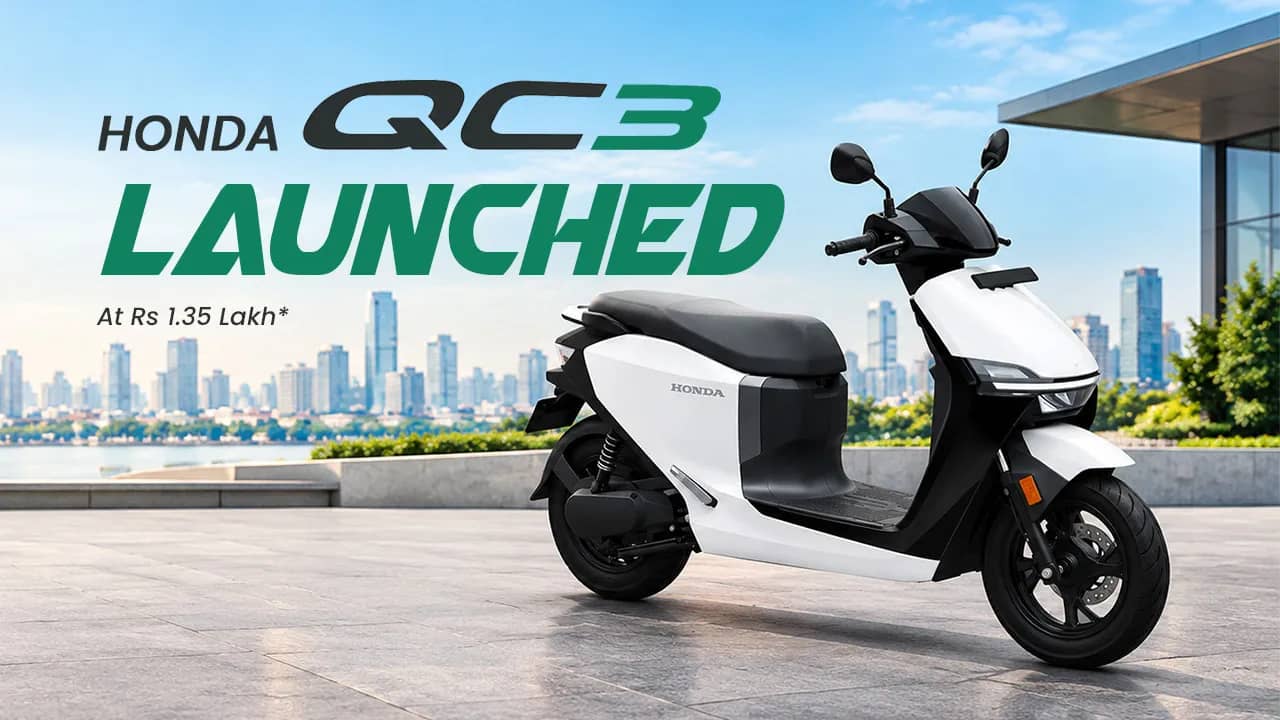
Honda has launched its third electric scooter, the QC3, in India at Rs 1.35 lakh, ex-showroom Delhi. Positioned as a family-friendly urban commuter, it packs a 3.0kWh battery good for a claimed 145km range, a 32-litre underseat boot, Smart Key access, and a 5-inch TFT display with Honda RoadSync navigation. The rollout starts small, limited to five cities — Delhi, Agra, Cuttack, Surat and Kollam — with bookings open at Rs 5,000. It directly rivals the TVS iQube, Bajaj Chetak and Ather's electric lineup in this price bracket.
Honda has launched the QC3 electric scooter in India at Rs 1.35 lakh, ex-showroom Delhi, making it the company's third battery-powered two-wheeler after the QC1 and the Activa e:. Bookings are open now for a token of Rs 5,000, but the rollout isn't nationwide — only riders in Delhi, Agra, Cuttack, Surat and Kollam can walk into a Honda RedWing dealership and place an order at launch. That city-by-city approach tells you something important: Honda is testing the waters before committing to a pan-India push, which matters if you're outside these five cities and wondering how long you'll have to wait.
What Rs 1.35 Lakh Actually Buys You
The QC3 runs a 3.0kWh battery pack rated for 145km on the IDC cycle — real-world figures will land somewhere between 100 and 115km depending on how aggressively you twist the throttle in city traffic. A full charge takes roughly four hours, and Honda claims a 0-80% top-up in 2 hours 40 minutes, numbers that put it in line with rivals rather than ahead of them. Underneath the family-scooter styling sits a telescopic fork up front and dual shocks at the rear, with braking handled by a front disc and rear drum — a sensible, cost-conscious setup rather than a flashy one.
Where the QC3 tries to earn its keep is in daily usability. A 32-litre underseat boot swallows a full-face helmet with room for a laptop bag, the Smart Key system means you never fish for a physical key, and a 5-inch TFT cluster runs Honda RoadSync with turn-by-turn navigation pulled from your phone. None of this is class-leading, but for a buyer choosing between this and a petrol Activa, it's the difference between an EV that feels like a compromise and one that feels like an upgrade.
Honda QC3 Range and Charging Time: Is 145km Enough?
For most Indian commuters doing 25-30km a day between home, office and errands, a single charge covers four to five days of riding without touching the plug — that's the real story behind the 145km claim, not the number itself. Charge overnight once or twice a week and you're covered. The bigger question is whether Honda's swapping and service network can keep pace as the QC3 expands beyond its five launch cities, since a flat battery in a city with no nearby Honda EV support point is a genuine inconvenience, not a hypothetical one.
How the Honda QC3 Compares on Price
Honda has priced the QC3 to sit right in the thick of the family e-scooter segment, not above it.
At this price the iQube undercuts it slightly while offering a comparable pack, and the Chetak and Konarc both pack more battery capacity for a bit more money. Honda's pitch isn't the cheapest option or the longest range — it's the brand's service reputation and dealer trust, which counts for more than spec-sheet bragging rights for a first-time EV buyer who's nervous about resale and after-sales support.
The Real Cost of Owning One
Run the numbers Honda won't put in its brochure, and the QC3 starts to make financial sense fast. Charging that 3kWh pack from empty roughly 20 times a month at a typical domestic tariff of Rs 8 per unit costs around Rs 480 — compare that to a 110cc petrol scooter covering similar monthly distance at 45kmpl, which burns close to Rs 2,000 a month at Rs 103 a litre. That's a saving of over Rs 1,500 every month, or close to Rs 18,000 a year, which meaningfully changes the ownership math even before you factor in lower service costs typical of electric drivetrains with fewer moving parts.
On finance, a buyer putting down 20% (about Rs 28,400 on an estimated on-road Delhi price of Rs 1.42 lakh, factoring in the EV road-tax exemption most states offer) and financing the rest over three years at 10% interest would land an EMI close to Rs 3,650 a month. Add the fuel savings back in, and the effective monthly outgo drops closer to Rs 3,150 — not far off what many riders already pay for a mid-range petrol scooter loan, but with a running cost that's a fraction of the price.
Should You Book One?
The Honda QC3 isn't trying to win on range or raw power — it's betting that Honda's badge, dealer network and a genuinely useful 32-litre boot will pull buyers away from TVS and Ather. If you live in Delhi, Agra, Cuttack, Surat or Kollam and want an EV backed by a brand you already trust for your Activa or Shine, the QC3 is a safer bet than most of its rivals, even if the iQube edges it on price and the Chetak edges it on battery size. Riders outside those five cities, though, are better off waiting for confirmation of a wider rollout before parting with the Rs 5,000 booking amount. Check the on-road price and EMI for the Honda QC3 in your city on Drivio.
Priced competitively against the iQube and Chetak, the QC3 doesn't lead on range or battery size but banks on Honda's dealer trust and after-sales reputation. Charging costs work out to roughly Rs 480 a month against Rs 2,000 for an equivalent petrol scooter, and financing at 20% down over three years brings the EMI to around Rs 3,650. It's a sound pick for buyers in the five launch cities; those elsewhere should wait for a wider rollout before booking.