Kawasaki Ninja 500 SE Launched Abroad In Two Colours — Will It Reach India?
Overview
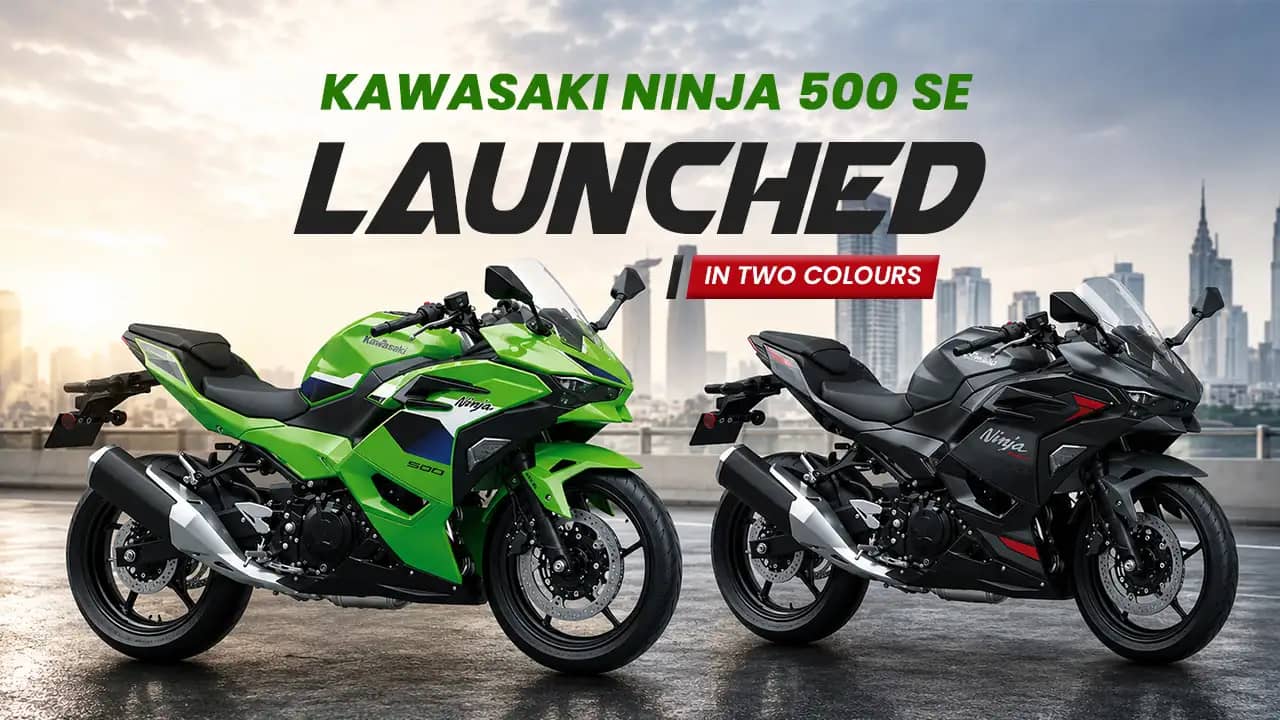
Kawasaki has launched the Ninja 500 SE abroad in two new colourways — Lime Green and Metallic Matte Graphenesteel Gray/Metallic Spark Black — bringing a TFT instrument cluster, KIPASS keyless ignition, LED turn signals and a USB-C port over the standard bike. The engine is unchanged: a 451cc parallel-twin making 44.7bhp and 42.6Nm. Crucially, this SE variant is not sold in India; Kawasaki India continues to offer only the base Ninja 500 at ₹5.76 lakh ex-showroom, with a basic LCD cluster and no keyless start. The article covers the new colours and equipment, why the SE hasn't reached India, how the base bike stacks up against the Aprilia RS 457, and real EMI/fuel-cost numbers for Indian buyers considering the standard Ninja 500 today.
The Kawasaki Ninja 500 SE has just gone on sale abroad in two new shades, and it is not the bike currently sitting in Indian showrooms. Kawasaki's India arm sells only the standard Ninja 500, priced at ₹5.76 lakh (ex-showroom), while this SE variant — with its TFT dash and keyless ignition — remains a Europe-only proposition for now. That distinction matters more than the colour update itself, because it tells you exactly what Kawasaki is choosing not to bring here.
What's new on the Ninja 500 SE
The two new shades are Lime Green and Metallic Matte Graphenesteel Gray paired with Metallic Spark Black. The green option carries Kawasaki's familiar white-and-blue fairing graphics, but with one twist: the front section around the turn indicators gets a black finish instead of matching green, a small detail that separates it visually from the Lime Green worn by the standard Ninja 500 and other models in the range. The grey-and-black option is the quieter of the two, offset by red graphics so it does not disappear into every other blacked-out Ninja on the road.
Mechanically, nothing has changed. The SE runs the same 451cc, liquid-cooled, parallel-twin engine as the standard bike, producing 44.7bhp at 9,000rpm and 42.6Nm of torque. What separates the SE from the base model is equipment: a full-colour TFT instrument cluster instead of the standard bike's LCD unit, Kawasaki's KIPASS keyless ignition system, LED turn signals, a larger windscreen, frame sliders, and a USB-C charging port. In the UK market, Kawasaki's 2027 range update prices the Ninja 500 lineup from £6,599 (roughly ₹7.3 lakh at current exchange rates), though the SE-specific variant typically commands a premium over that entry figure — Kawasaki has not published a separate SE price for every market yet.
Why India doesn't get the SE — yet
Autocar India flagged this gap back when the standard Ninja 500 first launched here: what reaches Indian showrooms is the base bike, not the up-spec SE. That has not changed with this colour update. India's Ninja 500, now in its 2026 avatar, runs a basic LCD cluster with Bluetooth connectivity rather than the SE's TFT screen, and it skips keyless start entirely. Riders who want the SE's kit currently have no legal way to buy it here — Kawasaki India sells the 451cc twin as a fully imported CBU, which already pushes its ex-showroom price close to double that of its nearest rival, and adding SE equipment would stretch that gap further.
That rival is the Aprilia RS 457, priced from ₹4.22 lakh ex-showroom in Maharashtra — a full ₹1.54 lakh cheaper than the base Ninja 500, and it already comes with a five-inch TFT display, ride-by-wire throttle and multiple riding modes as standard. Against that kind of value, importing a Ninja 500 SE would put Kawasaki in an even tougher spot on pricing than it already occupies with the standard bike.
What this means if you're financing a Ninja 500 in India
For anyone actually shopping the Ninja 500 in India right now, the SE talk is background noise — the numbers that matter are on the base bike. On-road in Delhi, the Ninja 500 works out to roughly ₹6.55 lakh. Put down 20 percent and finance the rest over 60 months at 11 percent interest, and the EMI lands around ₹11,400 a month. That is before you factor in running costs: at Kawasaki's ARAI-claimed 26.31kmpl and today's Delhi petrol price of ₹103 a litre, a rider doing a modest 1,500km a month is looking at close to ₹5,870 in fuel alone. Add in periodic servicing — expect the first 10,000km check-up to run somewhere in the ₹4,000–6,000 bracket for an imported 450cc-class machine, though Kawasaki hasn't published an India-specific service schedule cost publicly — and this is not a casual purchase.
None of that changes because Europe got two new colours. If you're set on the Ninja 500 experience in India today, you're buying the standard bike with its LCD dash and physical key, not the TFT-and-keyless SE riding around European showrooms this month. Kawasaki has shown no signal that it plans to import the SE, and given how the base bike is already priced against the RS 457, there's little commercial reason for it to start now.
Riders who specifically want the SE's kit are better off treating this as a bike to watch rather than one to wait for — Kawasaki's India lineup decisions tend to follow sales volume, and the standard Ninja 500 has moved in modest numbers here so far. Check the on-road price and EMI for the Kawasaki Ninja 500 in your city on Drivio before you decide whether the base bike's spec sheet is one you're willing to live with.
Kawasaki Ninja 500 SE gets two new shades globally with a TFT dash and keyless ignition, but India still gets only the standard Ninja 500 at ₹5.76 lakh — here's what that gap means for buyers and how it compares to the ₹4.22 lakh Aprilia RS 457.