New Delhi


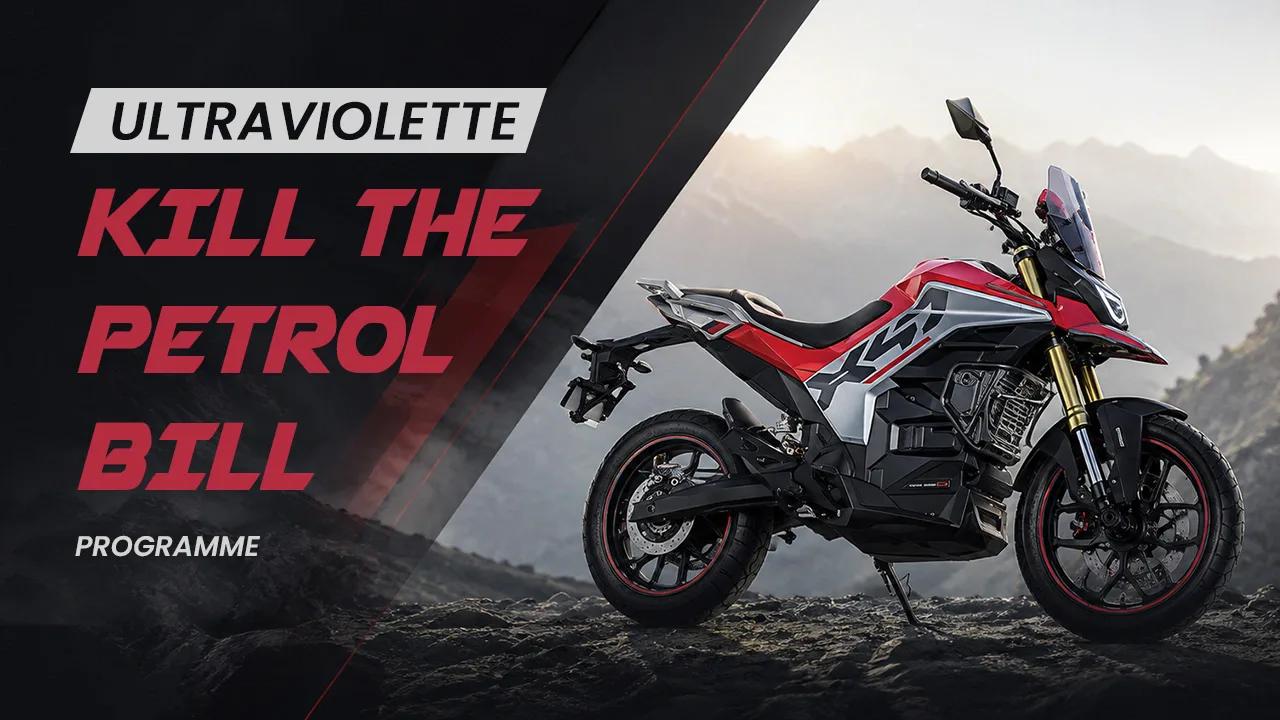

Ultraviolette Kill the Petrol Bill Programme: Up to ₹30,000 Cashback on F77 and X-47 — Is It Worth It?
News by Drivio | 6 Jun 2026
Ultraviolette's Kill the Petrol Bill programme, announced on 5 June 2026, is one of the more direct attempts by an Indian electric motorcycle maker to convert the country's vast base of ICE two-wheeler owners into EV riders — not through advertising, but through a cashback mechanism tied to actual riding history.
What the programme offers
The mechanics are straightforward. Customers who switch to an Ultraviolette F77 or X-47 receive a cashback amount equivalent to the total kilometres they logged on their previous petrol two-wheeler over the past two years. Ride 15,000 km on your old bike in that period and you receive ₹15,000 off. The maximum benefit under the scheme is capped at ₹30,000, which means riders with 30,000 km or more of verified usage over two years unlock the full amount. Cashback is calculated using the customer's verified two-year mileage history.
Ultraviolette simultaneously projects ongoing monthly savings of ₹3,000–₹5,000 in fuel costs for riders who make the switch — a figure derived from comparing petrol running costs with the significantly lower cost of charging an electric motorcycle under typical Indian urban riding conditions.
The Ultraviolette Kill the Petrol Bill programme is available across the brand's national dealer network, and both covered models — the F77 Mach 2 and the X-47 — are currently available with or without the recently launched Battery Flex (BaaS) pricing structure.
The motorcycles at the centre of this offer
The F77 Mach 2 is Ultraviolette's performance-focused offering. In Standard trim it carries a 7.1 kWh battery with a claimed IDC range of 206 km per charge, a peak torque of 85 Nm, and a top speed of 140 kmph. The Recon variant steps up to a 10.3 kWh pack, 95 Nm of torque, 306 km of claimed range, and a top speed of 152 kmph. Kerb weight sits at 158 kg. Pricing currently stands at ₹3.09 lakh for the Standard and ₹4.24 lakh for the Recon (ex-showroom). Under the Battery Flex plan, the F77 is accessible from ₹1.99 lakh with a monthly battery subscription of ₹2,678 onwards.
The X-47 is built on the same platform but designed around versatility rather than outright performance. It targets riders who want long-range capability with a more upright riding posture — a crossover between a sport tourer and an ADV. The X-47 carries a claimed range of up to 323 km in its larger battery configuration, and pricing starts at ₹2.49 lakh for early buyers, rising to ₹2.74 lakh at standard rates. Under Battery Flex, entry pricing drops to ₹1.49 lakh.
Petrol vs electric: what the numbers say in June 2026
India's fuel prices as of June 2026 remain above ₹103–₹106 per litre in most major cities. For a 300cc–400cc petrol motorcycle delivering real-world mileage of approximately 28–32 km/l, a rider covering 1,500 km per month spends roughly ₹4,800–₹5,600 on fuel alone. Annual petrol expenditure for this usage profile works out to approximately ₹57,000–₹67,000.
Charging an Ultraviolette F77 or X-47 under home or public tariffs — typically ₹7–₹9 per unit in urban India — costs roughly ₹0.40–₹0.60 per km, depending on the battery variant and riding conditions. The same 1,500 km monthly riding profile translates to a charging cost of ₹600–₹900 per month, or roughly ₹7,200–₹10,800 annually. That represents a running-cost saving of approximately ₹46,000–₹56,000 per year against a comparable petrol motorcycle.
Maintenance costs widen the gap further. A 300cc–400cc petrol motorcycle typically requires engine oil changes, air filter replacements, chain maintenance, and valve adjustments at 5,000 km service intervals — annual maintenance costs generally run ₹8,000–₹14,000 including consumables and labour. An electric motorcycle eliminates these entirely, with annual upkeep primarily limited to brake pads, tyres, and software updates. Ultraviolette's own five-year TCO estimates project savings approaching ₹2 lakh — which aligns with independent cost modelling for daily riders in this performance bracket.
Why Ultraviolette is pushing this now
The timing of the Kill the Petrol Bill programme reflects a broader inflection point in Indian EV adoption. The electric two-wheeler segment has expanded rapidly over the past 18 months, but penetration in the premium performance motorcycle segment has remained limited, constrained by upfront cost perception rather than running-cost economics. Ultraviolette's Battery Flex plan, introduced in March 2026, already addressed the price barrier for new buyers. This programme now targets the conversion problem — active petrol motorcycle riders who may be evaluating a switch but need a concrete financial bridge to make that decision.
Narayan Subramaniam, CEO and Co-founder of Ultraviolette, noted that enabling prospective owners to make the switch with greater confidence, while benefiting from meaningfully lower running costs, is at the core of the initiative. Ultraviolette's positioning — backed by TVS Motor Company and operating in a segment where rivals are few — gives the brand room to run this kind of programme without cannibalising volume from direct competitors.
Is the programme genuinely worth it?
For a rider currently on a 300cc–400cc petrol motorcycle who has been commuting actively for the past two years, the cashback benefit of up to ₹30,000 is real money — it meaningfully reduces the upfront cost of switching to an F77 or X-47, particularly when combined with Battery Flex pricing. The ongoing monthly fuel savings of ₹3,000–₹5,000 mean the effective cost advantage compounds quickly. A buyer who qualifies for the maximum ₹30,000 cashback and switches to the X-47 under Battery Flex entry pricing is looking at a combined vehicle + battery acquisition price that is genuinely competitive with new 300cc petrol motorcycles.
The programme makes the strongest case for riders already doing the cost maths on EV ownership — urban commuters and daily riders who consistently cover 1,200–1,800 km per month and are weighed down by recurring fuel expenses. For touring riders with range anxiety or those in cities with thin charging infrastructure, the considerations are more nuanced, and Ultraviolette's expanding DC fast-charger network will remain a relevant factor in that decision.
Check the latest on-road price, finance options, and EMI plans for the Ultraviolette F77 in your city on Drivio.