Ultraviolette X-47 Venom Deliveries Begin in India From ₹2.65 Lakh
Overview
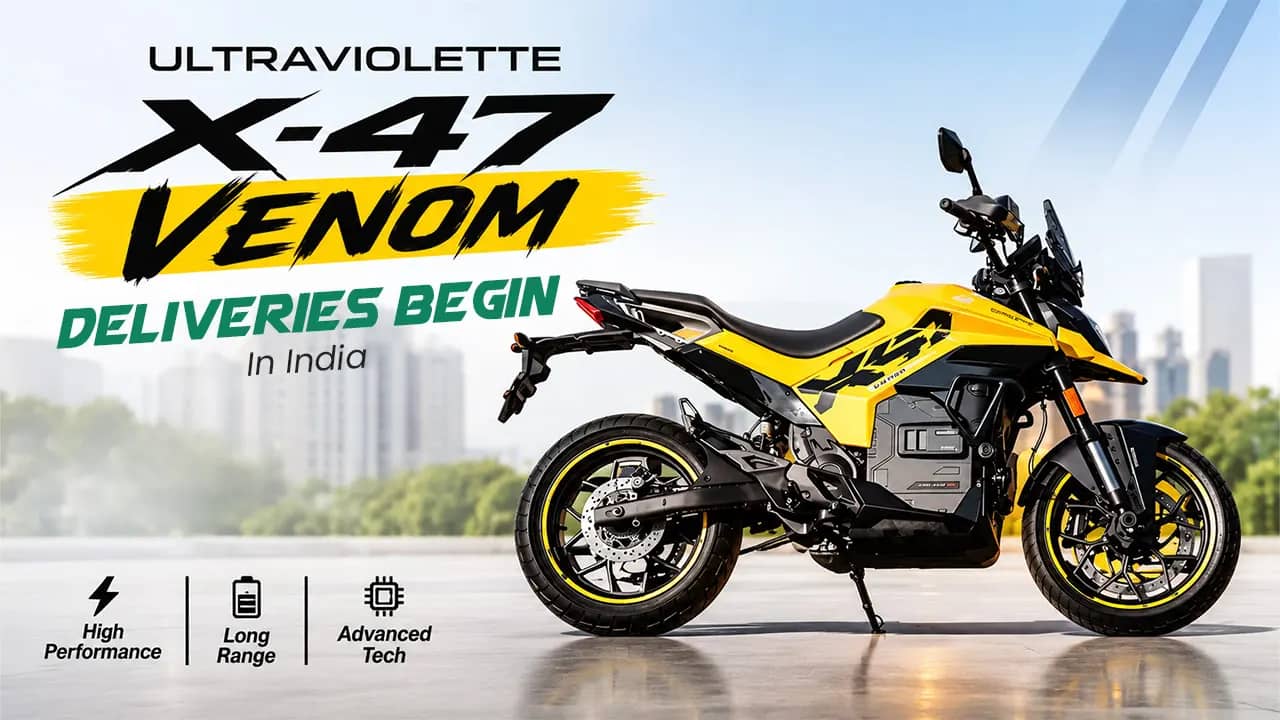
Deliveries of the X-47 Venom electric motorcycle began in India on 23 November, with prices starting at ₹2.65 lakh ex-showroom (introductory). This guide covers the four variants, the weight and range gains from the new VX-100 platform, and the real monthly cost against a petrol rival like the Triumph Speed 400. It is meant for riders deciding now, before the introductory price window closes.
Ultraviolette X-47 Venom deliveries began in India on 23 November, and the cheapest version costs ₹2.65 lakh ex-showroom. That is an introductory price. Only the first 5,000 buyers get it, and every variant rises by ₹35,000 after that. The Venom is the first motorcycle on Ultraviolette’s new VX-100 platform, and it is lighter, longer-legged and quicker to 100 kmph than the X-47 Crossover it replaces. If you booked in October or are still deciding, the next few weeks matter.
Ultraviolette X-47 Venom Price in India: Four Variants, Two Batteries
Ultraviolette sells the Venom in four trims, split across two battery packs. Prices below are introductory, ex-showroom Bengaluru, and the spread within each trim depends on charger type and colour.
On-road price context matters more than the sticker. Autocar India’s expected Delhi on-road range runs from about ₹2.86 lakh for the base bike to ₹4.31 lakh for the Recon+, and those are estimates until your dealer quotes you. Deliveries are rolling out in phases through Ultraviolette’s retail and experience network, so your city may not get bikes on day one.
What the VX-100 Platform Changes on the Road
The headline is weight. The base 7.5kWh bike now weighs 180 kg, 17 kg less than the old 7kWh X-47, and the Recon with the new 11kWh pack weighs 195 kg, 13 kg lighter than before. Claimed range climbs by 16 km on the base bike and 20 km on the top one.
Peak numbers barely moved. The Recon makes 40 hp and 90 Nm at the motor, with 550 Nm at the rear wheel. Yet the claimed 0-100 kmph time is now 5.9 seconds, 2.2 seconds quicker, and 0-60 stays at 2.7 seconds. Less mass explains it. Ballistic, the fastest ride mode, now works until the battery drops to 10 percent instead of 30 percent, which matters if you ride hard on a half-empty pack.
Charging is the one step backwards, and a small one. A 20-80 percent top-up on the standard 1.3 kW portable charger takes 5 hours 30 minutes, up from 5 hours. Plan on overnight charging at home. Real-world range will be lower than the claimed figure, and 70-75 percent of it, around 250 km on the 11kWh pack, is a sensible expectation.
Features: Who Gets Radar, Cruise Control and Parking Assist
The new 7-inch TFT is standard. Cruise control and camera-based parking assistance are not: both are limited to the top three variants, so the base Venom misses them. Higher trims also add four-level traction control, a radar-based Hypersense system and an integrated dashcam. The rear radar watches up to 200 metres behind, feeding blind-spot monitoring, lane-change assist and overtake alerts. Dual-channel ABS, traction control and stability control come on every bike.
The chassis is untouched, which is fine for Indian roads. Seat height is 820 mm and ground clearance is 200 mm, enough to clear most speed breakers without drama. A 41mm USD fork, a preload-adjustable monoshock, 320 mm and 230 mm discs and a 150/60 R17 rear tyre carry over.
Ultraviolette X-47 Venom vs Triumph Speed 400: Monthly Cost
Take 20 percent down, 60 months and 11 percent interest. On the base Venom’s ₹2.86 lakh Delhi on-road estimate, you put down ₹57,200 and borrow ₹2.29 lakh, which works out to about ₹4,975 a month. The Recon+ at ₹4.31 lakh on-road means roughly ₹7,500. The Triumph Speed 400, around ₹2.4 lakh ex-showroom and roughly ₹2.63 lakh on-road in Delhi, comes to about ₹4,575.
Now fuel. Ride 1,000 km a month on petrol at ₹103 a litre, assume the Triumph returns about 30 kmpl (a likely real-world figure), and you burn roughly ₹3,430. The Venom, at around 250 km per full 11kWh charge and an assumed ₹7 per unit at home, costs about ₹350 for the same distance.
Add EMI to energy and the Venom lands near ₹5,325 a month against about ₹8,000 for the Speed 400. That gap of roughly ₹2,700 compounds to about ₹1.6 lakh over the loan. Cut your riding to 500 km a month and the saving falls to around ₹1,300, so the maths only works if you actually ride.
The Rivals and the Alternatives
The Speed 400 is the closest petrol match on price and attitude, but it cannot match the Venom’s 5.9-second sprint to 100 kmph or its rider aids. It does win on refuelling: five minutes at a pump, no charging plan. If a petrol bike is the goal and ₹2.65 lakh feels steep, Drivio’s coverage of the 2026 Bajaj Pulsar RS200, launched at ₹1.98 lakh, shows how much cheaper the petrol route stays. And if you only want an electric ride rather than a performance one, our River Indie story covers its ₹14,999 down-payment offer, though that is a scooter, not a crossover.
Buy Now or Wait?
Buy now if you ride daily, can charge at home and want a fast electric motorcycle. Pick the Venom+ at ₹3.15 lakh for most riders, because cruise control makes long commutes less tiring and the 227 km claimed range covers city use. Go for the Recon if highway runs are part of your week, since the 11kWh pack’s 343 km claim gives you real margin. Skip the base Venom only if features matter; for a short, fixed commute it is the cheapest way in.
Wait if you live in an apartment with no charging point, or if your city is not in the first delivery wave. Ultraviolette has also announced warranty cover extendable up to 8 lakh km, but eligibility terms were not detailed at launch, so ask the dealer to put them in writing before you sign. Check the on-road price and EMI for the Ultraviolette X-47 Venom in your city on Drivio.
Our pick is the Venom+ at ₹3.15 lakh, since it adds cruise control without the Recon’s price jump. Highway riders should stretch to the 11kWh Recon. At 1,000 km a month, the electric Venom costs roughly ₹2,700 less per month than a petrol Speed 400, even after counting its higher EMI. Riders doing under 500 km a month, or without a home charging point, are better off staying petrol.