New Delhi


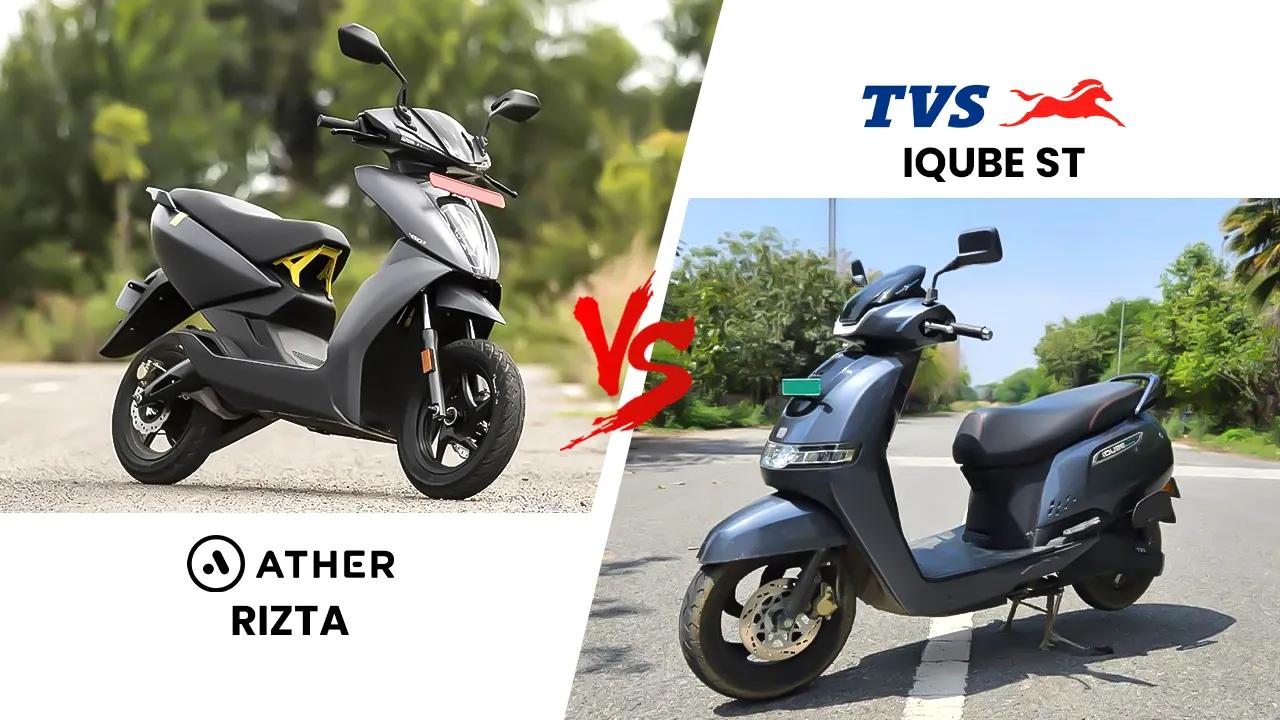

Ather Rizta vs TVS iQube ST: Best Family EV Scooter 2025?
Reviews by Drivio | 10 Mar 2026
Electric scooters are rapidly becoming the preferred family vehicles in India. Two models dominating this segment are the Ather Rizta and the TVS iQube ST. Both promise practicality, long range, and smart technology—exactly what urban commuters need in 2025.
In this Ather Rizta vs TVS iQube ST comparison, we analyze performance, range, technology, and overall usability to determine which electric scooter is the better family EV choice.
Motor Performance & Riding Experience
The Ather Rizta focuses on balanced city performance with a 4.3 kW electric motor producing 22 Nm torque and a top speed of 80 km/h. It accelerates from 0-40 km/h in around 4.7 seconds, making it quick enough for urban traffic.
The TVS iQube ST uses a 3 kW BLDC hub motor delivering 4.4 kW peak power and 140 Nm torque, also offering a top speed of about 78–82 km/h depending on the variant.
In real-world riding, the Rizta feels slightly smoother due to its mid-drive motor setup, while the iQube ST provides strong low-speed torque that suits stop-and-go city riding.
Range & Charging Capability
Range is one of the biggest decision factors for EV buyers.
The Ather Rizta offers two battery options—2.9 kWh and 3.7 kWh, with a claimed IDC range of 123 km and 159 km respectively. Charging from 0–80% takes around 4.5 to 6.5 hours, depending on the charger used.
The TVS iQube ST stands out with a larger 5.3 kWh battery pack, delivering a claimed 212 km range in IDC testing. Charging from 0–80% takes roughly 4 hours.
For long daily commutes or multi-day charging cycles, the iQube ST clearly has the range advantage.
Technology, Comfort & Family Usability
The Rizta is designed specifically as a family electric scooter. It offers a large seat, 34-litre under-seat storage, optional 22-litre frunk, traction control, reverse assist, and smartphone connectivity via a 7-inch display on higher variants.
The iQube ST focuses more on connected technology. Its 7-inch TFT touchscreen, voice assist, navigation, OTA updates, geofencing, and anti-theft features make it one of the most tech-loaded scooters in the segment.
Both scooters prioritize comfort with telescopic front suspension and commuter-friendly ergonomics.
Price & Value Proposition
The Ather Rizta lineup starts at roughly ₹1.10 lakh and goes up to about ₹1.50 lakh (ex-showroom) depending on the battery pack and variant.
The TVS iQube ST is positioned slightly higher, with prices starting around ₹1.52 lakh and going up to about ₹1.86 lakh (ex-showroom) for larger battery variants.
While the Rizta offers better affordability, the iQube ST justifies its premium with superior range and features.
Specifications Comparison
| Specification | Ather Rizta | TVS iQube ST |
| Motor Power | 4.3 kW | 3 kW (4.4 kW peak) |
| Peak Torque | 22 Nm | 140 Nm |
| Top Speed | 80 km/h | 78–82 km/h |
| Battery Capacity | 2.9 kWh / 3.7 kWh | Up to 5.3 kWh |
| Range | 123–159 km (IDC) | Up to 212 km (IDC) |
| Charging Time (0–80%) | 4.5–6.5 hrs | ~4 hrs |
| Ex-Showroom Price (Delhi) | ₹1.10–1.50 lakh | ₹1.52–1.86 lakh |
Conclusion
Both scooters are excellent choices in India’s growing EV market, but they serve slightly different priorities.
The Ather Rizta is ideal for families seeking practicality, affordability, and strong city performance with thoughtful storage solutions.
The TVS iQube ST, on the other hand, is better suited for buyers who prioritize maximum range, premium technology, and long-distance commuting capability.
If budget and family comfort matter most, the Rizta makes strong sense. But if range anxiety is your biggest concern, the iQube ST stands out as one of the most capable family electric scooters of 2025.