Hero Splendor Plus Flex Fuel vs Hero HF Deluxe Flex Fuel: Detailed Comparison
Overview
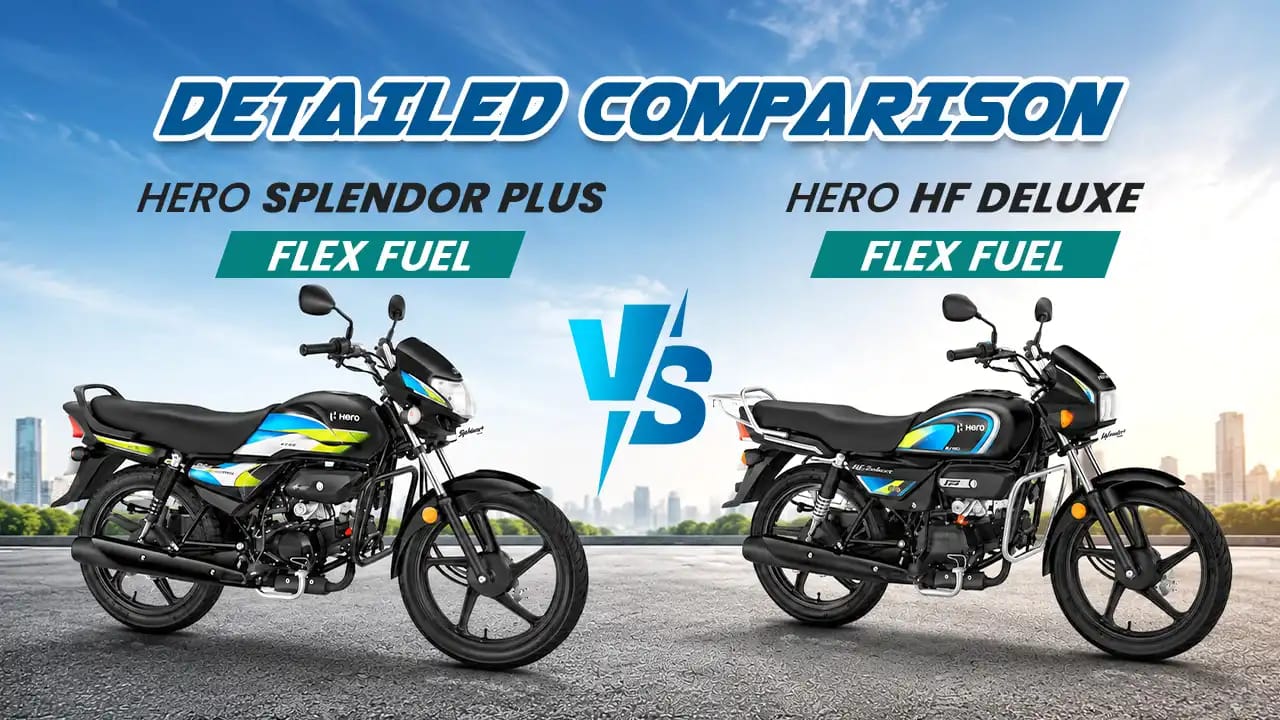
Hero Splendor Plus Flex Fuel vs Hero HF Deluxe Flex Fuel: Detailed Comparison brings key updates for two-wheeler buyers in India. Hero Splendor Plus Flex Fuel vs Hero HF Deluxe Flex Fuel is the comparison that Indian commuters are searching for right now
Hero Splendor Plus Flex Fuel vs Hero HF Deluxe Flex Fuel is the comparison that Indian commuters are searching for right now, and with good reason. Hero MotoCorp officially launched both flex-fuel motorcycles in India on June 3, 2026, pricing the Splendor Plus Flex Fuel at ₹82,710 (ex-showroom, Delhi) and the HF Deluxe Flex Fuel at ₹72,792 (ex-showroom, Delhi). With India's ethanol blending programme accelerating rapidly and E85 infrastructure being rolled out first in Delhi and select Maharashtra markets, flex-fuel motorcycles are no longer a niche curiosity — they are a practical decision for millions of daily commuters. The question is not whether to buy a Hero flex-fuel bike, but which one makes the most sense for your budget and riding needs.
Price Comparison: A ₹10,000 Gap That Defines the Choice
The ₹9,918 difference between the two motorcycles is the single biggest factor in this comparison. At ₹72,792, the HF Deluxe Flex Fuel is the more accessible entry point into Hero's ethanol-compatible ecosystem. Factor in RTO, insurance, and handling charges, and the on-road price in Delhi works out to approximately ₹87,400 for the HF Deluxe and ₹97,500 for the Splendor Plus — a difference that stretches to roughly ₹10,100 once all costs are accounted for.
For context, the standard HF Deluxe was priced at ₹59,477 before this launch, meaning the flex-fuel premium on the HF Deluxe works out to roughly ₹13,000 — which pays for the engine recalibration, new fuel pump, and secondary fuel filter. The Splendor Plus flex-fuel premium over its standard variant is similarly positioned at around ₹5,000 over the top-end standard trim. Both represent reasonable premiums for future-proof technology, but the HF Deluxe clearly wins on absolute affordability.
Design and Styling Differences
Neither motorcycle departs dramatically from its standard counterpart's silhouette, and Hero has not attempted to make these flex-fuel variants look radically different. The design changes are primarily cosmetic — both get new graphics packages with lime yellow and black colour schemes that carry Flex Fuel badging to distinguish them at a glance.
Where the two bikes genuinely differ is in road presence and build perception. The Splendor Plus carries a slightly more upright, boxy stance with its iconic tank and panel proportions — a shape that has been embedded in Indian commuter culture for three decades. It simply looks more premium on a dealership floor. The HF Deluxe, by contrast, reads as a more compact, no-frills commuter. Its proportions are functional rather than aspirational, which is not a criticism — it serves its purpose well — but the Splendor Plus does feel like the more polished product in a side-by-side showroom comparison.
One practical note: the Splendor Plus has a 20mm lower seat height at 785mm versus the HF Deluxe's 805mm. For shorter riders, the Splendor Plus is meaningfully more accessible; taller riders may actually prefer the slightly stretched-out feel of the HF Deluxe.
Engine and Flex Fuel Technology
Both motorcycles are powered by the same 97.2cc single-cylinder, air-cooled engine that Hero has refined over many years. In E85 configuration, both produce 8.5–8.57 PS at 8,000 rpm and 8.3 Nm of torque at 6,000 rpm, paired with a 4-speed gearbox. These figures represent a marginal improvement over the standard petrol variants — the regular Splendor Plus makes 7.89 PS, for instance — with the higher octane content of ethanol enabling more aggressive ignition timing.
The flex-fuel hardware is identical across both bikes: revised ECU calibration, a new high-pressure fuel pump rated for ethanol compatibility, and an additional inline fuel filter to protect the injector from ethanol's solvent properties. Both are compatible with any blend between E20 and E85, which means riders can fill up with whatever ethanol concentration is available at their local pump without any manual adjustment. The ECU manages fuel delivery automatically.
In daily riding, the performance difference between E20 and E85 is not dramatically perceptible in traffic. What riders on E85 do report is a slightly crisper throttle response from idle — the higher octane rating allows the ignition to fire earlier in the compression cycle, which translates to a more eager pull off the line. For a 97.2cc commuter engine doing largely sub-50 kmph city work, this is a subtle but real improvement in the riding experience.
Ride Quality and Comfort
The suspension setups on both motorcycles are identical in design: telescopic hydraulic forks at the front and a swingarm with twin shock absorbers at the rear. Hero offers 2-step adjustable preload on the rear shocks of both variants, which is a useful touch for pillion-heavy riding or heavier riders.
The Splendor Plus, at 113 kg versus the HF Deluxe's 112.5 kg, is virtually identical in mass — the 0.5 kg difference is irrelevant in practice. Both bikes handle India's ubiquitous broken tarmac, speed breakers, and potholed lanes with the predictable, forgiving character that has made them bestsellers. The long, flat single-piece seat on both bikes offers good pillion accommodation, though neither is particularly plush for rides exceeding 30–40 kilometres.
The lower seat height on the Splendor Plus translates to slightly better confidence for shorter riders at traffic signals in congested Indian cities, and that is a meaningful real-world advantage. The HF Deluxe's higher stance, on the other hand, gives marginally better visibility in traffic — a trade-off that different riders will weigh differently.
Features Comparison
This is where the Splendor Plus earns its ₹10,000 premium most clearly. Both motorcycles receive a semi-digital instrument cluster with a digital fuel gauge (upgrading from the all-analogue setup on their standard counterparts), side-stand engine cut-off, USB charging port, and tubeless tyres on alloy wheels.
However, only the Splendor Plus Flex Fuel gets Hero's i3S (Idle Stop-Start System), which shuts the engine off automatically when the bike is stationary at a signal for more than a few seconds and restarts instantly when the clutch is engaged. In urban Indian traffic conditions, where idle time can constitute 15–20% of total ride time, i3S delivers measurable fuel savings. The HF Deluxe Flex Fuel omits i3S entirely, which is a notable gap given that the primary use case for both bikes is city commuting.
Both bikes also include a fall sensor that cuts the engine if the motorcycle tips over — a basic safety feature that is increasingly standard across commuter segments. Neither gets ABS or CBS in this configuration, relying instead on combined drum brakes front and rear.
Mileage and Running Costs
On standard petrol (E20), both motorcycles are claimed to return around 65 kmpl under ARAI test conditions. Real-world figures in Indian city traffic tend to settle closer to 55–60 kmpl. Assuming 1,000 km of monthly riding at a petrol price of ₹103 per litre, monthly fuel expenditure on E20 works out to approximately ₹1,716 (at 60 kmpl real-world).
The real ownership advantage of flex-fuel technology kicks in when E85 becomes widely available. Ethanol at the pump typically costs 30–40% less than petrol on a per-litre basis, though because ethanol has lower calorific value than petrol, real-world mileage on E85 drops by approximately 20–25%. The net cost saving still works out to 15–20% in favour of E85 over pure petrol when pricing trends hold. For a commuter covering 1,000 km monthly, that difference can amount to ₹250–₹350 per month — meaningful over the ownership lifecycle.
The Splendor Plus's i3S advantage adds another 3–5% real-world efficiency improvement in city conditions, further reducing its monthly fuel outlay compared to the HF Deluxe. Over a three-year ownership period, i3S savings in fuel alone could partially recover the initial price premium of the Splendor Plus.
How Does the Bajaj Freedom 125 Compare?
Buyers considering an alternative fuel commuter should be aware of the Bajaj Freedom 125, which takes a different approach with CNG rather than ethanol. Priced from ₹91,000 (ex-showroom) and delivering approximately 94 km/kg on CNG, the Freedom 125 offers a compelling running cost argument where CNG infrastructure is mature — primarily metro cities. However, the Freedom 125's 147.8 kg kerb weight, significantly heavier 125cc CNG hardware, and CNG station dependency make it a different product for a different use case. Both Hero flex-fuel bikes are lighter, simpler to refuel, and available at substantially lower price points, making them the stronger choice for riders outside CNG-dense metro corridors.
Hero Splendor Plus Flex Fuel vs Hero HF Deluxe Flex Fuel: Which One Should You Buy?
The answer depends on what you are optimising for. If budget is the primary consideration and you want the most affordable way to future-proof your commuter against rising petrol prices and expanding ethanol infrastructure, the Hero HF Deluxe Flex Fuel at ₹72,792 is a straightforward recommendation. You get identical engine technology, the same flex-fuel compatibility range, and the same core reliability that has made the HF Deluxe one of India's most trusted commuter motorcycles for years.
However, if you are thinking about total cost of ownership over three to five years, and particularly if you ride primarily in city traffic, the Hero Splendor Plus Flex Fuel makes a stronger financial case despite its higher initial price. The i3S system alone recovers a portion of the premium through fuel savings, the slightly larger 9.8-litre tank extends range between fill-ups, the lower seat height improves everyday ergonomic confidence, and the Splendor nameplate carries stronger resale value in secondary markets across India.
For long-term ownership, daily city commuting, and those who prioritise resale value, the Hero Splendor Plus Flex Fuel is the clear winner. For budget-focused buyers and first-time motorcycle owners who want flex-fuel technology at the most accessible price, the HF Deluxe Flex Fuel is the better entry point.
Both motorcycles represent a genuine step forward for Indian commuter technology in June 2026. Whichever you choose, you are buying into a fuel ecosystem that will only become more relevant as India expands its ethanol supply infrastructure over the coming years.
Check the latest on-road price and EMI options for the Hero Splendor Plus Flex Fuel and Hero HF Deluxe Flex Fuel in your city on Drivio.
Hero Splendor Plus Flex Fuel vs Hero HF Deluxe Flex Fuel: Specifications at a Glance
| Specification | Splendor Plus Flex Fuel | HF Deluxe Flex Fuel |
| Ex-Showroom (Delhi) | ₹82,710 | ₹72,792 |
| Approx. On-Road (Delhi) | ~₹97,500 | ~₹87,400 |
| Engine | 97.2cc, Air-Cooled | 97.2cc, Air-Cooled |
| Power (E85) | 8.57 PS @ 8,000 rpm | 8.5 PS @ 8,000 rpm |
| Torque (E85) | 8.3 Nm @ 6,000 rpm | 8.3 Nm @ 6,000 rpm |
| Gearbox | 4-Speed Manual | 4-Speed Manual |
| Claimed Mileage | ~65 kmpl (petrol) | ~65 kmpl (petrol) |
| Fuel Tank | 9.8 litres | 9.6 litres |
| Kerb Weight | 113 kg | 112.5 kg |
| Seat Height | 785 mm | 805 mm |
| i3S (Idle Stop-Start) | Yes | No |
| USB Charging | Yes | Yes |
| Instrument Cluster | Semi-Digital | Semi-Digital |
| Side-Stand Cut-Off | Yes | Yes |
| Flex Fuel Range | E20–E85 | E20–E85 |
| Warranty | 5 years / 70,000 km | 5 years / 70,000 km |
Hero Splendor Plus Flex Fuel vs Hero HF Deluxe Flex Fuel is the comparison that Indian commuters are searching for right now, and with good reason. Hero MotoCorp officially launched both flex-fuel motorcycles in India on June 3, 2026, pricing the Splendor Plus Flex Fuel at ₹82,710 (ex-showroom, Delhi) and the HF Deluxe Flex Fuel at ₹72,792 (ex-showroom, Delhi).