Honda Activa vs Suzuki Access 125: Is Switching Worth It in 2026?
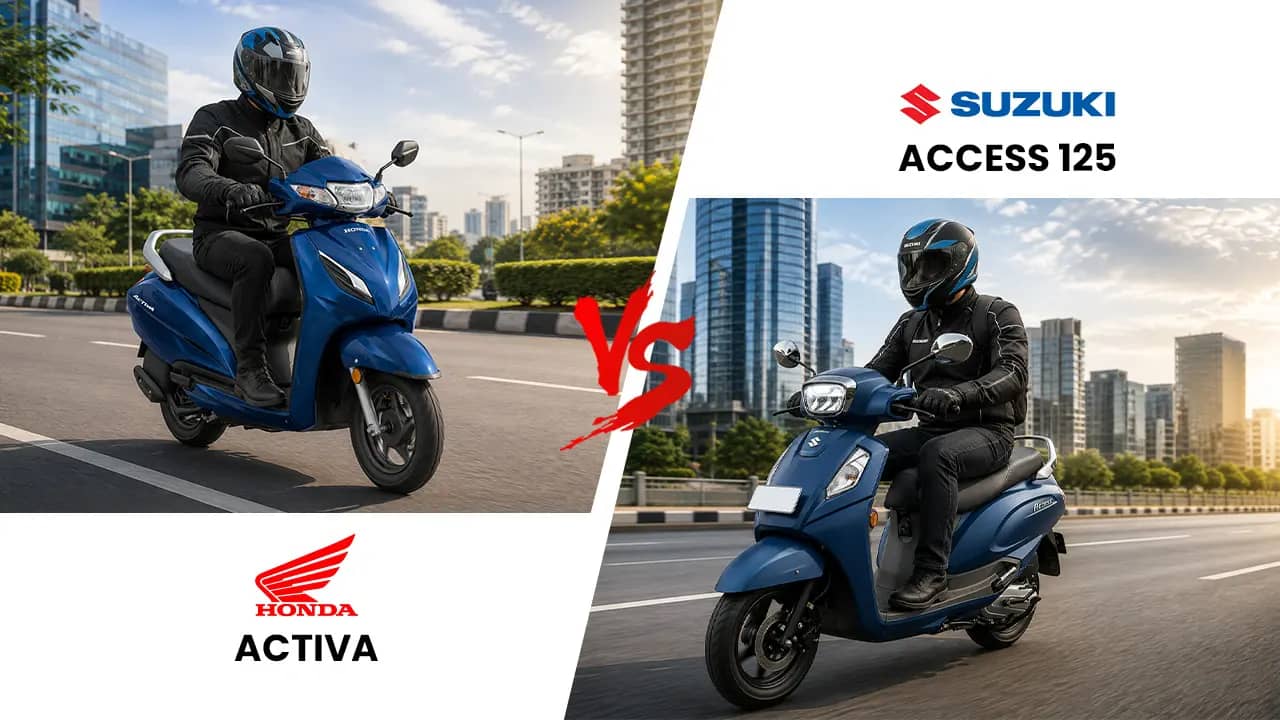
Overview
A 2026 comparison piece weighing whether Honda Activa 110 owners should upgrade to the Suzuki Access 125, covering price (₹75,958 vs ₹79,885 ex-showroom Delhi), power/torque, real-world mileage, EMI math, and fuel-cost-per-month, closing with a clear buy/stay verdict rather than a generic "both are good" take.
Honda Activa vs Suzuki Access 125 is the question every Activa owner in India starts asking once their scooter crosses three or four years and the itch to upgrade sets in. The base Activa 110 starts at ₹75,958 ex-showroom in Delhi, while the Suzuki Access 125 begins at ₹79,885 — a gap of roughly ₹4,000 that barely covers a tank of petrol, yet decides which side of a 14cc gap you end up on. That difference matters more than it looks on paper, because it changes what the scooter can actually do for you on a Monday morning in Delhi traffic.
What Changes When You Move From Activa to Access 125
The Activa's 109.51cc engine makes around 7.68-7.99 bhp and 9.05 Nm of torque, tuned entirely for efficiency rather than punch. Suzuki's 124cc motor on the Access 125 pushes that to roughly 8.3-8.6 bhp and 10.2 Nm — not a dramatic jump, but enough to feel different every time you pull away from a signal with a pillion on board. Riders who've done both back to back describe the Access as noticeably calmer at 60-70 kmph, where the Activa starts to feel stretched. On Delhi's arterial roads, where merging into fast-moving traffic from a side lane is a daily negotiation, that extra low-end shove isn't a luxury. It's the difference between confidently nosing in and waiting for a gap that suits the Activa's more modest pull.
Fuel economy tells the opposite story. The Activa 110 is ARAI-rated at 59.5 kmpl, with most owners reporting 47-55 kmpl in real city riding. The Access 125, being the larger motor, settles into the 40-47 kmpl range depending on how heavy your right wrist is. Run the numbers for a typical 1,200 km monthly commute at ₹103 a litre — Delhi's approximate current petrol price — and the Activa costs around ₹2,377 a month in fuel, against roughly ₹2,747 for the Access 125. That's a ₹370 monthly gap, which sounds small until you stretch it across five years of ownership: nearly ₹22,000 extra spent purely on petrol.
Price, EMI and What Switching Actually Costs
Here's where the decision gets concrete. Take the base variants of both, on-road in Delhi — the Activa STD lands close to ₹87,000 including RTO and insurance, while the Access 125 Standard Edition comes in around ₹92,500. Financed at 20% down over 60 months at 11% interest, the Activa works out to roughly ₹1,513 a month, and the Access 125 to ₹1,609 — a gap of just under ₹100 monthly. On a loan, in other words, the two scooters are almost indistinguishable in what they demand from your wallet each month. It's the fuel bill, not the EMI, that quietly does the damage over time.
Service costs sit close together too. Expect a routine service on either scooter to run somewhere around ₹700-₹1,000 at 10,000km, with the Access 125's slightly larger engine typically pushing consumable costs (oil, filters) up by a small margin — Suzuki dealer network density in smaller towns still lags Honda's, though, which matters if you live outside a metro.
Who Should Actually Make the Switch
Not every Activa owner needs the Access 125, and pretending otherwise would be dishonest. If your commute is short, mostly flat, solo, and under 20-25 km a day, the Activa 110 remains the more sensible machine — cheaper to buy, cheaper to run, and just as reliable as Honda's reputation suggests. Where the Access 125 earns its keep is on longer commutes, regular two-up riding, or if you frequently carry weight — groceries, a work bag, a second rider — where the extra torque stops the engine from feeling like it's working overtime.
There's a third option worth a glance before you commit either way: the TVS Jupiter 125, which undercuts the Access 125 slightly on price while matching it on displacement, and the Honda Dio 125, which shares the Access's engine character in a sportier shell — both are worth cross-checking if power output alone is driving your decision, not brand loyalty. For riders staying within the Honda ecosystem but wanting the bigger engine, the Activa 125 splits the difference at around ₹89,656 ex-showroom, though its 47 kmpl mileage erases most of the fuel-economy advantage the standard Activa currently holds.
The honest verdict: if you're switching purely for bragging rights or because the Access "feels premium" at the dealership, save the ₹4,000-and-change price gap and the extra fuel cost, and stick with the Activa. If you're switching because your daily riding has genuinely outgrown 110cc — longer distances, a regular pillion, hillier routes — the Access 125's torque advantage justifies the small monthly cost difference. Check the on-road price and EMI for the Suzuki Access 125 and the Honda Activa in your city on Drivio before deciding which one actually fits your commute.
The Suzuki Access 125 costs only about ₹4,000 more than the Honda Activa 110 ex-showroom in Delhi, but its 124cc engine delivers noticeably more torque (10.2 Nm vs 9.05 Nm), making it the calmer, more confident ride in traffic and with a pillion. That extra performance comes at a running-cost penalty, though — the Activa's 47-55 kmpl real-world mileage beats the Access 125's 40-47 kmpl, adding up to roughly ₹370 more in monthly fuel for the Access 125 at ₹103/litre. On a standard 60-month EMI at 20% down and 11% interest, the two are nearly identical month to month (₹1,513 vs ₹1,609), so the real decision comes down to use case rather than affordability. The article's verdict: stick with the Activa for short, solo commutes, and only switch to the Access 125 if your riding has genuinely outgrown 110cc — longer distances, regular pillion use, or hillier routes.