Overview
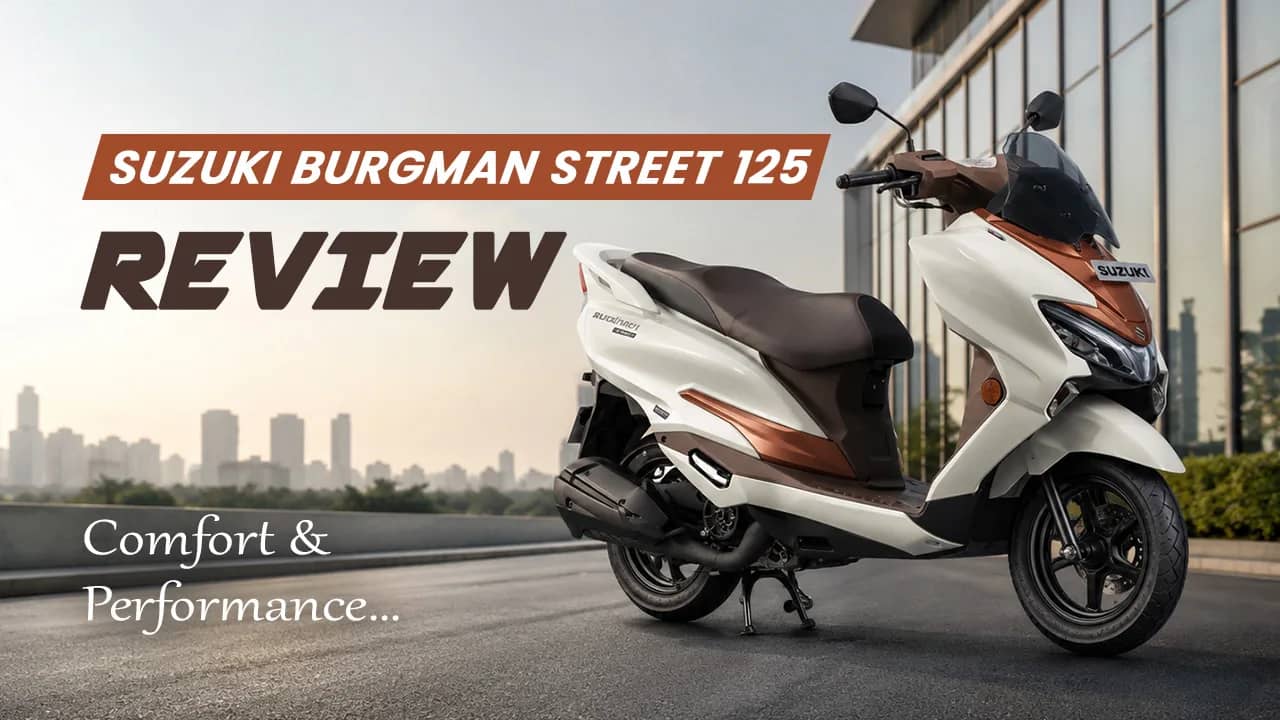
Suzuki Burgman Street 125 Review: Comfort & Performance brings key updates for two-wheeler buyers in India. The Suzuki Burgman Street 125 review conversation has picked up pace in 2026
The Suzuki Burgman Street 125 review conversation has picked up pace in 2026, and for good reason — this is one of the few 125cc scooters in India that genuinely feels like a scaled-down maxi-scooter rather than a commuter wearing fancy badges. Suzuki has priced the 2026 model at ₹1.02 lakh ex-showroom for the base Ride Connect Edition, climbing to roughly ₹1.13 lakh for the top Ride Connect TFT Edition, and that positioning puts it right in the middle of India's most competitive scooter segment. For anyone navigating Delhi's ring roads or Mumbai's monsoon traffic on a daily basis, the question isn't whether the Burgman looks good standing still — it's whether the comfort and ride quality hold up after the fortieth speed breaker of the day.
Suzuki Burgman Street 125 Price in India
The Suzuki Burgman Street 125 price starts at ₹1.02 lakh ex-showroom for the Standard Ride Connect trim, with the fully loaded Ride Connect TFT Edition topping out near ₹1.13 lakh. Add registration, insurance, and RTO charges, and the Suzuki Burgman Street 125 on-road price in Delhi lands between ₹1.20 lakh and ₹1.33 lakh depending on variant and insurance tenure; Mumbai and other metros track close behind, usually within a few thousand rupees either way. That's a premium of nearly ₹15,000–20,000 over rivals like the TVS NTorq 125 or Honda Activa 125, and Suzuki is betting that buyers will pay it for the styling, the underseat storage, and the riding position. It's not the cheapest 125cc scooter in India, and Suzuki isn't pretending otherwise — the Burgman is aimed squarely at someone who wants a scooter that doesn't look or feel like an entry-level appliance.
Suzuki Burgman Street 125 Review: Comfort and Riding Position
This is where the Burgman Street earns its keep. The seat is wide, properly cushioned, and sits low enough that even riders under 5'4" can plant both feet flat at a signal — something that matters more in Indian traffic than most spec sheets admit. The floorboard is flat and genuinely spacious, with enough room to shift your feet during a long wait at a railway crossing or to carry a bag between your knees without it sliding into the front wheel well. Handlebar reach is upright and relaxed rather than sporty, which takes pressure off your wrists and shoulders on a 45-minute office commute through Gurugram's NH-48 service lanes. Pillion comfort is genuinely above average for the segment too, with a wide rear seat pad and grab rails positioned where a second rider can actually use them, not just decorative loops bolted on for the brochure photo.
Why the Maxi-Scooter Styling Actually Works Here
Suzuki's maxi-scooter design language on the Burgman isn't just cosmetic flourish borrowed from the bigger Burgman 400 — the tall windscreen genuinely cuts wind blast at highway speeds, and the bulkier front apron does shield your knees from spray during Mumbai's monsoon months. Where it becomes a trade-off is at low speed: the extra visual bulk and slightly taller seat height make U-turns in narrow Old Delhi lanes a touch more deliberate than on a slim-bodied Activa. It's a fair exchange for most daily riders, but taller, heavier-set buyers will appreciate it more than shorter riders threading through tight parking lots.
Engine, Performance and City Ride Quality
Under the bodywork sits a 124cc air-cooled engine producing roughly 8.2–8.7 PS and 10–10.2 Nm of torque, mated to a CVT automatic transmission tuned for smooth, linear pickup rather than aggressive low-end snap. Throttle response off the line is gentle and predictable, which makes the Burgman forgiving in stop-start traffic. Suzuki's 2026 update specifically improved the 30–60 kmph acceleration band, and that shows up exactly where it matters — overtaking a slow-moving auto-rickshaw or closing a gap before a signal turns red. Cruising at 55–60 kmph on a flyover feels composed and vibration-free, helped by the fuel-injected engine and a chassis that stays settled over expansion joints. The front telescopic forks and rear shocks soak up potholes, speed breakers, and patchwork tarmac without transmitting harshness into the seat, and a front disc paired with Suzuki's Combined Braking System (CBS) on most variants adds real confidence during sudden stops in traffic.
Mileage and Monthly Running Cost
Real-world Suzuki Burgman Street 125 mileage in city riding settles around 45–50 kmpl, with ARAI-certified figures touching the high 50s under controlled conditions — the gap between the two is mostly traffic density and how often you're crawling in first-gear-equivalent CVT range. On a typical urban commute of around 30 km a day, that works out to roughly 18–20 litres consumed per month. At today's petrol price of approximately ₹103/litre in cities like Delhi and Gurugram, that puts monthly fuel cost in the ₹1,850–₹2,100 range for a moderate daily commute — comfortably cheaper than running most 150cc bikes, though slightly higher than ultra-light rivals like the Yamaha RayZR 125, which trades some of that maxi-scooter bulk for a mileage edge.
Features, Storage and Practicality
The Burgman Street 125 carries a genuinely useful 24.2–24.6-litre underseat storage compartment, large enough to swallow a full-face helmet along with a small bag, which is one of the bigger storage wells in the 125cc scooter in India category. Higher variants get a 4.2-inch TFT instrument console with Bluetooth connectivity, navigation prompts, and call/SMS alerts, while the base trim sticks to a clear LCD display with the same Bluetooth link. Keyless ignition on the top TFT Edition removes the fumbling-for-keys moment at a busy parking lot, and Suzuki's Easy Start system means the engine fires instantly without holding the brake lever in an awkward position. None of this reinvents the segment, but it's executed cleanly, and the practicality of a comfortable scooter for daily use comes through in details like the underseat hook and the flat floorboard rather than just the spec sheet.
Suzuki Burgman Street 125 vs Rivals
Against the TVS NTorq 125, the Burgman gives up some outright peppiness — the NTorq's sportier CVT tuning and lighter kerb weight make it the quicker scooter away from the lights, and TVS's SmartXonnect app suite is more feature-dense for tech-focused buyers. The Honda Activa 125 remains the practicality benchmark, with a slightly lower price, Honda's dealer network reach, and resale value that the Burgman simply can't match yet given its shorter time in the market. The Yamaha RayZR 125 undercuts the Burgman on both weight and mileage, making it the better pick for someone who rides solo most of the time and prioritizes flickability over cruising comfort. Where the Burgman Street 125 wins outright is comfort over distance and pillion usability — if your daily ride includes a second person more often than not, the seat width and posture advantage are hard to ignore.
Verdict: Should You Buy the Burgman Street 125?
Office commuters covering 20–40 km a day, taller riders who've outgrown smaller-bodied scooters, and family buyers who regularly carry a pillion will get genuine value from this Suzuki Burgman Street 125 review's core finding: comfort and storage compound the longer you own it. Buyers chasing the sportiest acceleration, the lowest price tag, or sharp low-speed handling should look elsewhere; the NTorq 125 and RayZR 125 serve that brief better. As of June 2026, the Burgman Street 125 remains a confident, comfort-first choice rather than the flashiest one on paper. Check the on-road price and EMI for the Suzuki Burgman Street 125 in your city on Drivio.
The Suzuki Burgman Street 125 review conversation has picked up pace in 2026, and for good reason — this is one of the few 125cc scooters in India that genuinely feels like a scaled-down maxi-scooter rather than a commuter wearing fancy badges. Suzuki has priced the 2026 model at ₹1.02 lakh ex-showroom for the base Ride Connect Edition, climbing to roughly ₹1.13 lakh for the top Ride Connect TFT Edition, and that positioning puts it right in the middle of India's most competitive scooter segment.