TVS Jupiter vs Honda Activa: Family Scooter Buying Guide for India
Overview
Two 110cc automatics dominate Indian family garages, and the price gap between them is tiny. This guide pits the Jupiter 110 (from about ₹73,400 ex-showroom) against the Activa 110 (from about ₹75,400) on engine, mileage, storage, EMI and servicing. It is written for first-time scooter buyers and households choosing one vehicle for school runs, office trips and weekend shopping.
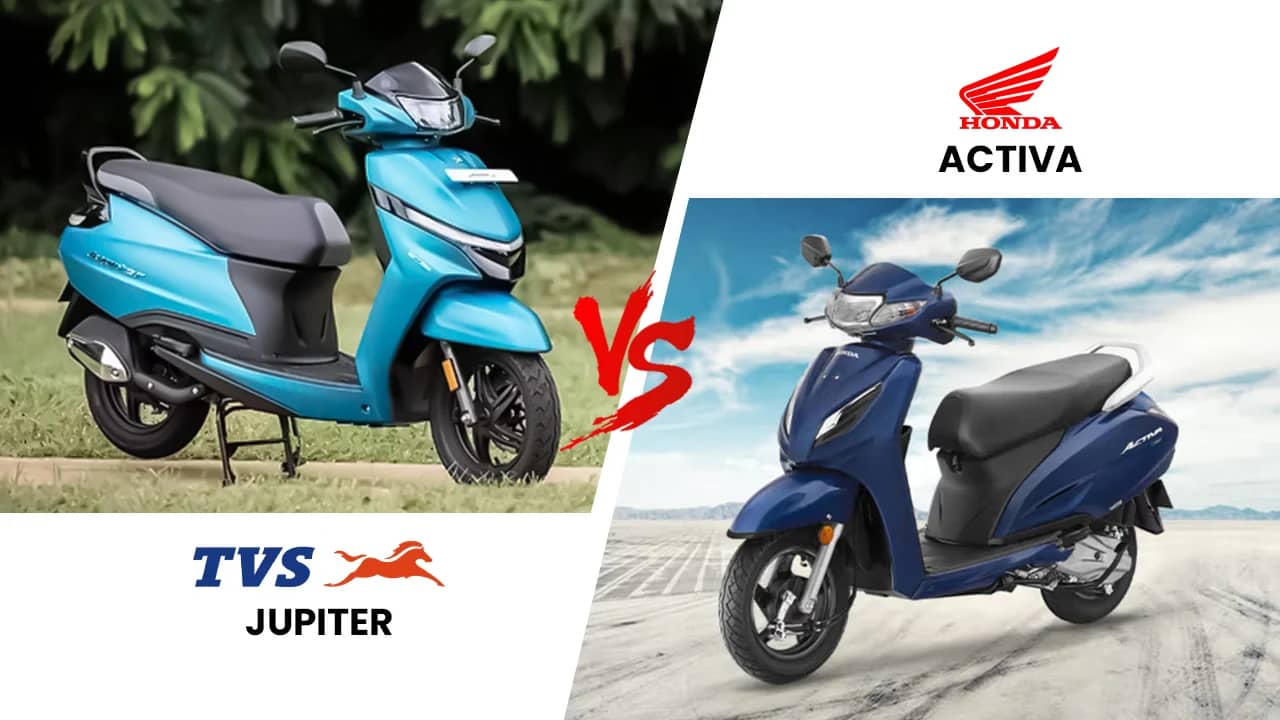
The TVS Jupiter vs Honda Activa decision in India comes down to a gap of barely ₹2,000 at the showroom, with the Jupiter 110 starting around ₹73,400 and the Activa 110 around ₹75,400 (ex-showroom). Both are 110cc automatics built for school runs, office commutes and the weekly market trip. Prices already crept up in February 2026, and the festive season is when dealers are most willing to negotiate. If you are buying this month, the choice deserves a proper look.
TVS Jupiter vs Honda Activa: Price, On-Road Cost and EMI
Ex-showroom numbers are only the start. The Jupiter 110 runs from about ₹73,400 for the Drum variant to roughly ₹86,900 for the Special Edition. The Activa 110 begins near ₹75,400, with the DLX around ₹85,300 and the Smart trim near ₹89,800. Add RTO and insurance and a Delhi buyer should expect an on-road figure of roughly ₹85,000-₹88,000 for the base versions of either scooter. Mumbai typically runs a few thousand rupees higher. These are likely figures, so confirm with your dealer.
Financing is where families actually feel the difference. Take ₹85,000 on-road, a ₹10,000 down payment and a ₹75,000 loan over 36 months at 10 per cent. The EMI works out to about ₹2,420 a month. Stretch it to 48 months and it drops near ₹1,900, but you pay roughly ₹4,000 more in interest overall. A ₹2,000 price gap changes that EMI by only about ₹65, so base price should not decide this contest.
Engine and Performance: Which Feels Better in Traffic?
The Jupiter runs a 113.3cc engine making about 8 bhp, with up to 9.8 Nm when TVS’s iGO Assist micro-hybrid boost kicks in. The Activa’s 109.5cc motor makes about 7.8 PS and 9.05 Nm. On paper that is a small margin. On a loaded scooter it is noticeable. With two adults and a school bag, the Jupiter pulls off the line with less throttle and holds 50-55 km/h more calmly on flyovers.
The Activa answers with refinement. Honda’s motor is smooth and quiet, and the throttle response is gentle, which suits a nervous first-time rider. Both weigh almost the same, at 105 kg for the Jupiter and 106 kg for the Activa, so manoeuvring in a crowded Gurugram or Pune lane is equally easy. The Jupiter feels livelier, the Activa feels calmer. Neither will thrill you, and neither is meant to.
Which Scooter Gives Better Mileage?
Claimed ARAI numbers flatter both scooters. Owner reports suggest roughly 45-50 kmpl for the Jupiter and 48-55 kmpl for the Activa in mixed city use. These are likely ranges, not lab figures. Honda’s engine tune has traditionally been the more frugal one.
Now the monthly bill. Assume 1,000 km a month and petrol at about ₹103 a litre. The Jupiter at 48 kmpl burns roughly 20.8 litres, which costs about ₹2,150. The Activa at 52 kmpl burns roughly 19.2 litres, costing about ₹1,980. That is a gap of around ₹165 a month, or close to ₹2,000 a year. It is real money, but it takes the Activa about a year to claw back what the Jupiter’s extra boot space saves you in daily hassle.
Storage, Features and Family Practicality
This is where the Jupiter pulls clear. Its underseat boot holds about 33 litres and swallows two helmets, while the Activa’s roughly 18 litres manages one. It also has an external fuel filler cap, so a woman in a saree or a parent with a child on the footboard never has to get off to refuel. For a family scooter, that is a daily convenience, not a brochure line.
The Jupiter’s higher trims add a semi-digital cluster and Bluetooth connectivity, and the footboard is wide enough for a toddler or a grocery bag. The Activa keeps its cluster simple. Its Smart variant adds a smart key, which is genuinely handy when your hands are full, but it costs near ₹90,000. When you set the TVS Jupiter vs Honda Activa feature lists side by side at the same budget, the Jupiter simply gives you more scooter per rupee.
Service Costs and Ownership After 10,000 km
Running costs are close. A routine service at the 10,000 km mark likely costs ₹800-₹1,200 on the Jupiter and ₹700-₹900 on the Activa, with the Honda usually a touch cheaper. Parts for both are easy to find, but Honda’s network is larger, so a small-town breakdown is easier to fix on an Activa. Honda also offers an extended warranty package that can run up to 10 years, three standard plus seven optional.
Resale is the Activa’s strongest card. It is India’s default used scooter, and a three-year-old Activa typically finds a buyer faster and at a firmer price than almost anything else in the segment. The Jupiter holds value well too, but it rarely matches that. If you change vehicles every four or five years, factor that in.
Which Should Your Family Buy?
Buy the Jupiter if your scooter does real family work: school bags, helmets, vegetables, a child on the footboard. It has the better boot, the stronger pull with a load, the more useful features, and a lower sticker price. The extra ₹165 a month in petrol is the cost of that convenience, and most families will happily pay it.
Buy the Activa if you ride gently, plan to sell in a few years, or live somewhere that Honda’s service network reaches and TVS’s does not. It is the safer, easier, lower-drama choice. If you need more power for highway stretches, look at 125cc rivals Drivio has covered, such as the Suzuki Access 125 or the Honda Activa 125. For most Indian households, though, the TVS Jupiter vs Honda Activa verdict leans Jupiter.
Check the on-road price and EMI for the TVS Jupiter in your city on Drivio.
TVS Jupiter vs Honda Activa, Jupiter 110 price, Activa 110 mileage, best family scooter India, 110cc scooter comparison, scooter EMI calculator, Jupiter vs Activa on-road price, scooter running cost