Overview
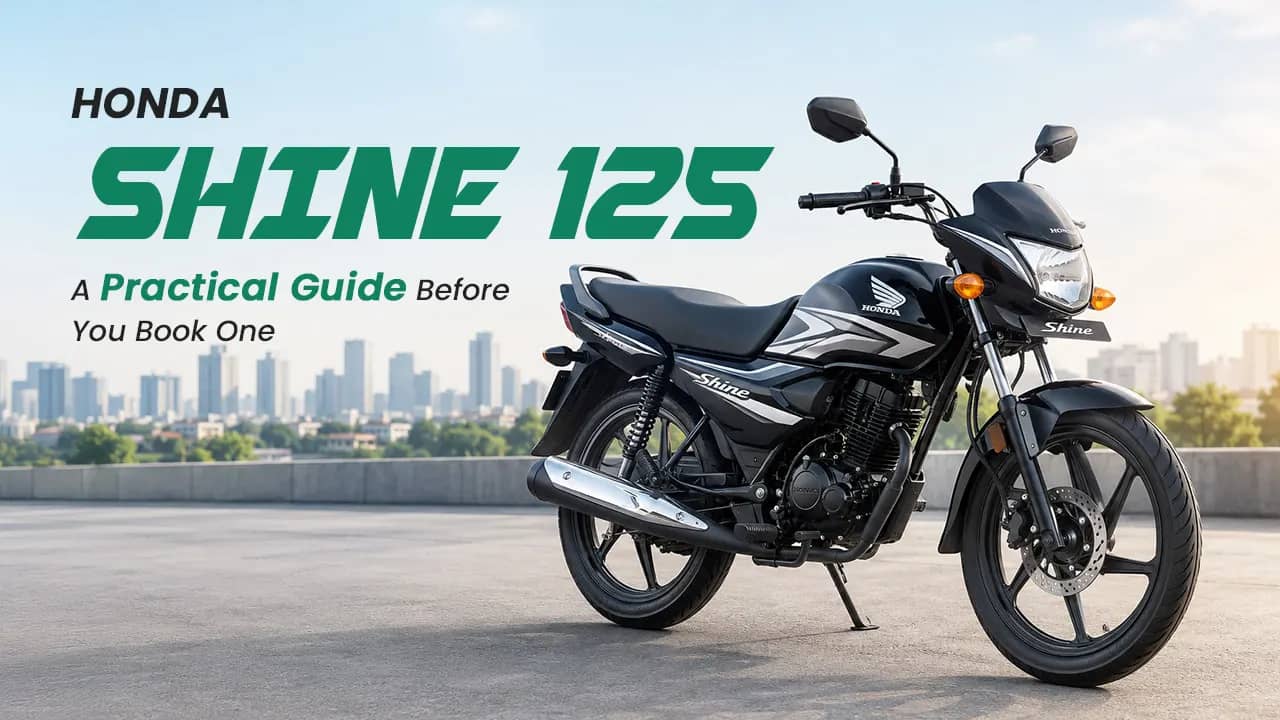
The Honda Shine 125 is aimed at commuters who want a practical 125cc motorcycle without moving into a more aggressive street-bike format. Its 123.94cc fuel-injected engine, 5-speed gearbox, neutral riding position and simple day-to-day controls make it worth considering for office travel and regular family use. The current equipment list includes a digital instrument cluster, idling-stop function and USB Type-C charging, with equipment depending on the variant. Before booking, buyers should compare Drum and Disc versions, check real-world fuel use against their route, test the seat with a pillion and calculate an EMI using the final local on-road price. This guide separates useful features from assumptions and highlights the checks that matter at the dealership.
The Honda Shine 125 is a sensible shortlist choice for someone who rides daily, wants a predictable petrol commuter and values ease of use over aggressive performance. Its 123.94cc engine produces approximately 7.93 kW (about 10.6 bhp) and 11 Nm of torque, and it uses a 5-speed manual gearbox. That puts it above a basic 100cc commuter in performance reserve while keeping the riding experience approachable.
It is particularly worth a test ride if your route mixes stop-start city traffic with flyovers or open roads, or if you regularly carry a pillion. It is less compelling for a buyer whose only goal is the lowest upfront price, or for someone who specifically wants ABS, a highly connected dashboard or a sporty riding position. Compare the exact variant and current city quote before you pay a token.
Engine, gearbox and everyday response
The Shine 125’s 123.94cc single-cylinder, air-cooled, fuel-injected engine is tuned for regular commuting rather than racing. Maximum output is around 7.93 kW at 7,500 rpm and torque peaks at 11 Nm at 6,000 rpm. In practical terms, it gives a commuter useful flexibility when moving away from a traffic light, carrying a passenger or accelerating into a gap, without needing a very high-revving riding style.
The 5-speed gearbox is an important distinction from many 100cc commuter motorcycles with four speeds. It gives riders another ratio to work with as speed builds on an arterial road. Still, the right gear depends on load, gradient and traffic. During a test ride, listen for unusual noises, check that gear changes engage cleanly and see whether the clutch lever feels comfortable in repeated stop-start traffic.
Key specifications and how they affect the buyer
|
Specification |
What it means in everyday use |
|
Engine |
123.94cc, single-cylinder PGM-FI; designed for daily commuting. |
|
Power and torque |
About 10.6 bhp and 11 Nm; useful reserve for mixed city riding and a pillion. |
|
Transmission |
5-speed manual; gives more ratios for differing traffic and road speeds. |
|
Kerb weight and seat height |
Around 113 kg and 791 mm respectively in current spec listings; sit on the bike to check personal fit. |
|
Fuel tank |
About 10.5 litres; actual range depends on fuel economy and reserve practice. |
|
Wheels and tyres |
18-inch alloy wheels with tubeless tyres listed by current spec sources; confirm exact tyre fitment on the chosen variant. |
|
Braking |
Drum variant uses a front drum; Disc variant offers a 240 mm front disc. Combined braking is provided; the Shine 125 does not offer ABS in the current model listings. |
|
Convenience features |
Digital instrument cluster, idling-stop system and USB Type-C charging are listed on current product information; confirm equipment for the specific trim. |
Drum or Disc: which variant should you choose?
The main decision is whether the front disc brake justifies the price difference for your riding conditions. The Drum variant is the straightforward entry option. The Disc variant uses a 240 mm front disc, which can provide a different lever feel and stronger braking response than a drum when correctly maintained. Neither version should be mistaken for an ABS-equipped bike; confirm the exact specification on the price sheet and owner’s manual before booking.
The Limited Edition or colour/feature variants may change cosmetic details and the final price. Avoid assuming that a special edition automatically adds essential safety equipment. Ask the dealer to mark the variant name, brake type, charging socket and included accessories on the proforma invoice. This prevents a mismatch between what you test-rided and what appears in the delivery bay.
Mileage: what should you realistically budget for?
The official or certified mileage figure is measured under test conditions. Automotive specification sources commonly list an ARAI figure of about 54.96 km/l, while owner reports often fall around 50–55 km/l. Your result can be lower in heavy traffic, with frequent short trips, hard acceleration, a heavy pillion or poorly maintained tyre pressure. Use 50–55 km/l as a planning range rather than treating a top claim as a guarantee.
At a petrol price of ₹100 per litre and 1,000 km of riding in a month, 50 km/l means 20 litres and a fuel bill of ₹2,000. At 55 km/l, the same distance takes about 18.2 litres and costs roughly ₹1,818. That difference is real but not large enough to ignore fit, braking equipment, comfort or purchase price when choosing between bikes.
Price, down payment and an illustrative EMI
The final price changes by city and variant because ex-showroom price, road tax, registration and insurance are not the same everywhere. The October 2026 reference range used for this guide is roughly ₹84,000–₹90,000 ex-showroom for standard Drum and Disc variants, but public price pages and dealer quotes can differ. Check Honda’s current city price and get a written on-road breakup before publishing or booking.
For budgeting, suppose the final on-road price is ₹98,000 and you pay ₹20,000 as a net down payment. The illustrative loan principal is ₹78,000. At an assumed 14.5% annual reducing-balance rate, an approximate EMI is ₹3,763 over 24 months or ₹2,685 over 36 months. These are mathematical illustrations, not an offer or eligibility promise. Processing fees, documentation charges, stamp duty and insurance choices may increase the upfront amount or alter the financed principal.
|
Illustrative input |
Assumption |
|
On-road price |
₹98,000 (example only; confirm in your city) |
|
Net down payment |
₹20,000 |
|
Financed principal |
₹78,000 |
|
Rate and method |
14.5% per year, reducing balance (illustrative) |
|
24-month EMI |
About ₹3,763; total interest around ₹12,323 |
|
36-month EMI |
About ₹2,685; total interest around ₹18,654 |
The shorter tenure costs more each month but less interest overall. The longer tenure reduces the instalment but increases cumulative interest and keeps the obligation with you for an extra year. Choose the shortest tenure that leaves room in your budget for fuel, servicing, tyres and unexpected household expenses.
Comfort and ownership checks before booking
Take a test ride long enough to include a few slow turns, a stop-start stretch and a short open-road section. Check whether the handlebar reach feels natural, your knees fit comfortably and the pillion seat and grab points work for the person who will ride with you. A 791 mm listed seat height can feel different depending on inseam length, seat width and footwear, so do not judge solely from the specification sheet.
Check the service network near your home and workplace, service intervals, warranty terms, consumable costs and availability of tyres and brake parts. Ask about the actual delivery unit’s manufacturing date, inspect the paint and body panels, test all lights and controls, and match the chassis and engine numbers to the invoice and registration documents. If the bike is financed, check that the approved amount, EMI, tenure and any hypothecation entry are consistent with the documents you sign.
Who should buy the Honda Shine 125—and who should compare alternatives?
Consider the Shine 125 if you need a dependable commuter for everyday distances, want 125cc performance without a highly aggressive stance and prefer familiar mechanical controls. It is also worth considering for regular pillion use, provided both riders are comfortable during the test ride.
Compare the Honda SP125 if you want a different feature package; try the TVS Raider 125 if you prefer a sportier response and design; and consider a 100cc motorcycle such as the Splendor Plus if minimum purchase and fuel costs are your top priorities. Compare variants, not only model names, because braking hardware and features can change within a range.
Final recommendation
The Honda Shine 125 remains a practical option for riders who want a balanced 125cc daily motorcycle. Its strongest case is the combination of manageable performance, a 5-speed gearbox and commuter-oriented equipment—not a promise that it will deliver the same mileage for every rider. Test the Drum and Disc variants, verify the current price in your city, compare the total on-road and finance costs, and make sure the bike fits your commute before booking.
The Shine 125 suits riders who want a calm, efficient commuter with more performance reserve than a 100cc bike. Its 123.94cc engine makes about 10.6 bhp and 11 Nm, paired with a 5-speed gearbox; owner-reported mileage is around 50–55 km/l in mixed use. Select the front-disc variant if that fits your budget, but confirm braking equipment and price locally. The Shine 125 is not an ABS-equipped motorcycle, so safe riding, tyres and maintenance remain important.