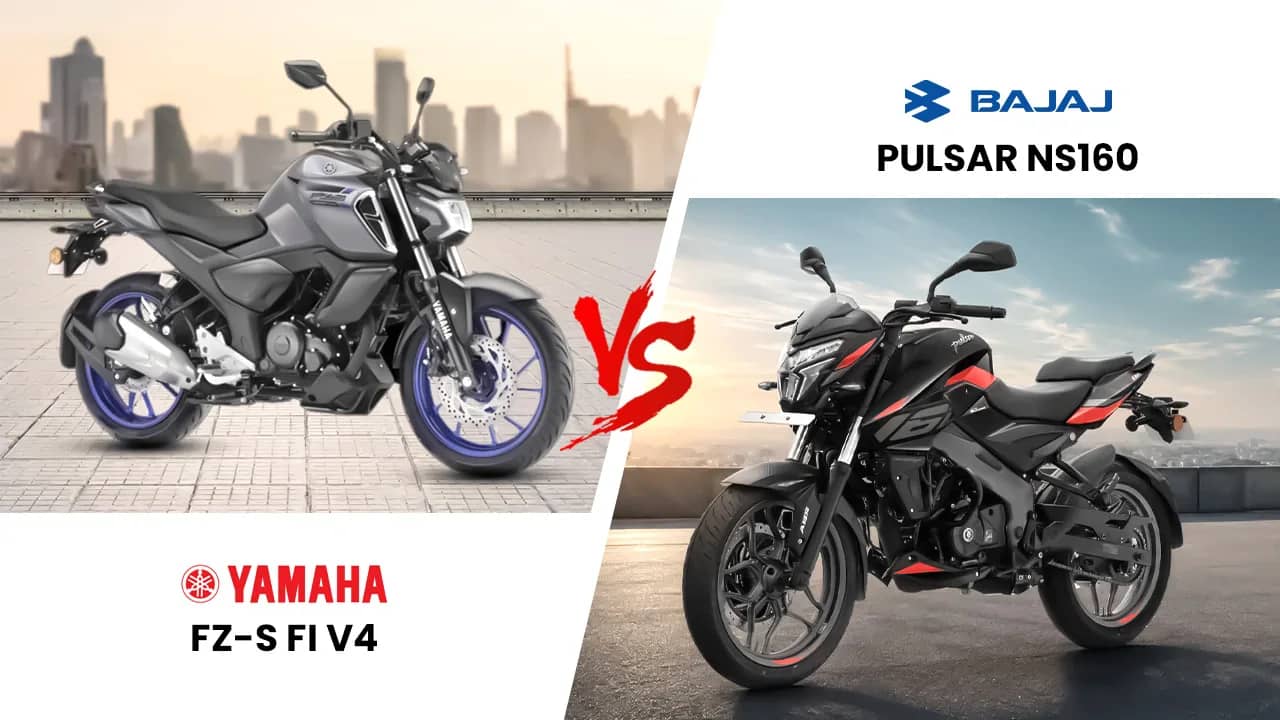
Yamaha FZ-S FI V4 vs Bajaj Pulsar NS160: Style vs Performance, Which One Wins?
Overview
A head-to-head comparison of two of India's most popular 150-160cc streetfighters — the Yamaha FZ-S FI V4 (₹1.20 lakh, ex-showroom Delhi) and Bajaj Pulsar NS160 (₹1.27 lakh). The piece breaks down pricing, EMI, power/torque figures, real-world mileage, running costs, and everyday comfort to help readers decide between a comfort-first commuter and a performance-oriented streetfighter.
Yamaha FZ-S FI V4 vs Bajaj Pulsar NS160 is the comparison every 150-160cc shopper in India eventually runs into, and the answer depends entirely on what you're optimising for. The FZ-S FI V4 is priced at ₹1,19,846 (ex-showroom, Delhi) after the GST 2.0 rate cut in September 2025, while the Pulsar NS160 starts at ₹1,26,819 for the base single-channel ABS variant. Both sit in the same wallet bracket, both get sold to the same 22-to-30-year-old commuter, and both claim to be the "sporty" option in their showroom. They are not, however, chasing the same rider.
Yamaha FZ-S FI V4 vs Bajaj Pulsar NS160: Price and On-Road Costs in Delhi
On-road in Delhi, the FZ-S FI V4 works out to roughly ₹1,36,261 including RTO and insurance, against ₹1,44,359 for the NS160's base variant — a gap of nearly ₹8,000 before you've even ridden either bike home. Finance it the standard way, 20% down over 60 months at 11% interest, and the FZ-S FI V4 comes to an EMI of around ₹2,370 a month, while the NS160 lands closer to ₹2,511. That ₹141 monthly difference isn't going to make or break anyone's budget, but it does set the tone: Yamaha is selling comfort and running economy, Bajaj is selling a faster, harder-edged machine, and both prices reflect exactly that positioning.
Engine, Power and Performance Compared
Here is where the two bikes stop pretending to be rivals in anything but price. The FZ-S FI V4 runs a 149cc air-cooled single making 12.4 PS at 7,250 rpm and 13.3 Nm at 5,500 rpm through a 5-speed gearbox — modest numbers that put it at the bottom of the 150-160cc pack. The NS160's 160.3cc oil-cooled, twin-spark motor makes 17 PS at 9,000 rpm and 14.6 Nm at 7,250 rpm, routed through a 6-speed box, and the extra ratio matters as much as the extra 4.6 PS on Delhi's stop-start traffic.
Autocar India's road test clocked the FZ-S FI V4 doing 0-60kph in 5.4 seconds but a laboured 19.47 seconds to 100kph, capping out around 110kph in fifth gear. The NS160, riding on the older NS200's perimeter frame with a 37mm USD fork on the top variant, pulls harder past 80kph and holds its line better through fast corners — the kind of thing you notice on the Noida Expressway more than inside a housing society.
Mileage and What You'll Actually Spend on Fuel
Real-world city mileage runs 45-50 kmpl on the FZ-S FI V4 against 40-44 kmpl on the NS160. At ₹103/litre and a modest 1,200 km of monthly riding — a fair estimate for someone commuting through Gurugram or Noida traffic five days a week — that gap works out to roughly ₹2,472 a month for the Yamaha versus ₹3,090 for the Bajaj, a difference of about ₹618 every month, or close to ₹7,400 a year. Service costs follow a similar pattern: the FZ-S FI V4's simpler air-cooled motor typically runs lighter on maintenance bills to the 10,000km mark than the NS160's oil-cooled, twin-spark unit, which needs its coolant checked and carries marginally pricier service parts.
Design and Everyday Comfort
The FZ-S FI V4 leans on Yamaha's now-familiar muscular tank shrouds and a boxy LED headlight, weighs a light 136kg, and rides with a plush enough suspension setup to shrug off speed breakers without unsettling the rider — Drivio's road test of the bike noted its comfort held up even two-up on a 200km highway run. The NS160 is heavier at 152kg with a taller 805mm seat, and its naked-streetfighter stance, muscular tank, and LED projector headlamp give it visibly more road presence, though that comes with a firmer ride that Delhi's potholed arterial roads will remind you of daily.
Rivals Worth Cross-Checking
Neither bike exists in isolation. The TVS Apache RTR 160 4V undercuts both on outright sportiness, the Hero Xtreme 160R competes closely with the NS160 on power figures, and Bajaj's own Pulsar N160 — which Drivio has reviewed separately — actually outguns the NS160 on paper while costing less, making it worth a showroom visit before you commit to either bike in this comparison.
Verdict: Style vs Performance, Which One Wins?
If your commute is mostly city traffic and your budget is genuinely feeling the EMI, the FZ-S FI V4 wins on running cost, ride comfort, and a five-figure gap that adds up over three years of ownership. If you ride longer distances, want a bike that can actually overtake with confidence on the highway, and don't mind spending a bit more each month, the Pulsar NS160 is the better machine, full stop — the extra power isn't a marketing number, it's something you feel every time you open the throttle past 60kph. Check the on-road price and EMI for the Yamaha FZ-S FI V4 and the Bajaj Pulsar NS160 in your city on Drivio.
Yamaha's FZ-S FI V4 wins on affordability and fuel economy — lower on-road price, lighter EMI (~₹2,370/month vs ~₹2,511), and 45-50 kmpl real-world mileage against the NS160's 40-44 kmpl. Bajaj's Pulsar NS160 counters with a bigger 160.3cc engine (17 PS/14.6 Nm vs 12.4 PS/13.3 Nm), a 6-speed gearbox, and a higher 120 kmph top speed, making it the stronger pick for highway riders. Verdict: FZ-S FI V4 for budget-conscious city commuters, Pulsar NS160 for riders who want more power and don't mind the extra running cost. Includes a full specs comparison table and mentions of key rivals (TVS Apache RTR 160 4V, Hero Xtreme 160R, Bajaj Pulsar N160).