Yamaha R15 vs Yamaha MT-15: Sports Bike or Naked Bike? A Real-World India Verdict
Overview
India’s two most-discussed 155cc Yamahas share an engine and a price band of roughly ₹1.64-1.73 lakh ex-showroom, so the choice comes down to posture, traffic and weekend plans. This guide compares the fully faired R15 V4 with the naked MT-15 V2 on ownership cost, fuel spend and riding comfort, and is written for first-time performance bike buyers who are also weighing a loan.
The Yamaha R15 vs Yamaha MT-15 debate looks pointless on paper. Both bikes have the same 155cc engine, the same 18.1 bhp and the same 141 kg kerb weight, and in India they sell in an overlapping ₹1.64-1.73 lakh ex-showroom band. Yet the two feel nothing alike in a Delhi or Mumbai traffic jam. One makes you lean over the tank. The other lets you sit up and spot the auto that’s about to cut across you.
Same 155cc engine, very different bikes
Both run Yamaha’s liquid-cooled single with Variable Valve Actuation, making 18.1 bhp (18.4 PS) at 10,000 rpm and 14.2 Nm at 7,500 rpm. A six-speed gearbox with an assist-and-slipper clutch carries it. Neither bike is quick by 2026 standards, because a Bajaj Pulsar NS200 makes about 6 PS more. But this motor revs with a keenness that 150cc commuters can’t match, and the note changes character as the VVA kicks in near 7,400 rpm. Traction control and dual-channel ABS come on both, so safety hardware doesn’t separate them.
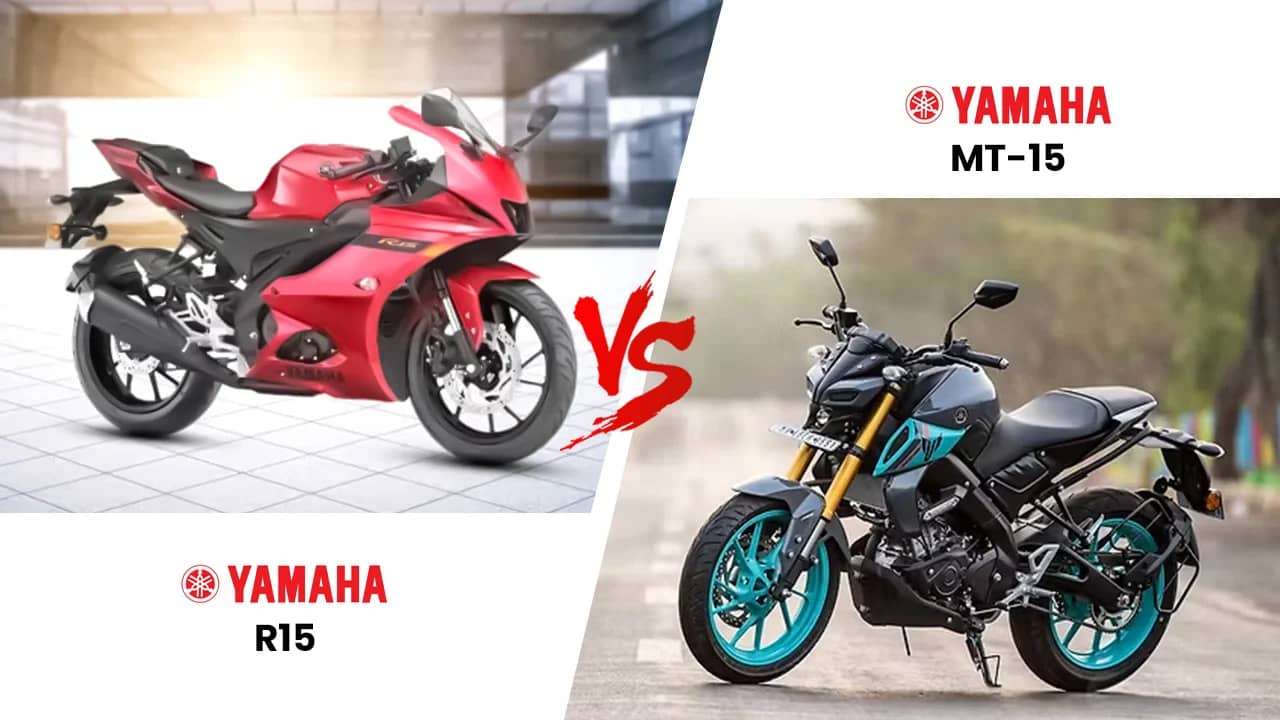
Body position does. The R15 V4 has low clip-on handlebars, rear-set footpegs, a full fairing and an 815 mm seat. The MT-15 V2 swaps all that for a wide, single-piece handlebar, a more upright seat at 810 mm and an angry LED headlamp with no bodywork around it. The riding position is the entire difference between them.
Which is better for daily riding in India: R15 or MT-15?
The MT-15, for most people. Stop-start traffic is where a clip-on bike punishes you. After 40 minutes of crawling through Gurugram or Andheri, the R15’s rider has weight on both wrists and a tight lower back, while the MT-15 rider is sitting almost like they’re on a Splendor. The MT-15’s wider bars also give more leverage for slicing through gaps, and its slightly lower seat helps at red lights.
Speed breakers and potholes make the case stronger. Both bikes ride firm on their USD forks, and both have 170 mm of ground clearance. The R15 sends more of that stiffness straight into your hands. A short rider will find either bike manageable, but the MT-15 feels friendlier at walking pace.
Yamaha R15 vs Yamaha MT-15 on the highway
Now the argument flips. Above 90 km/h the R15’s fairing and screen actually do something, deflecting wind off your chest so a 100 km ride doesn’t leave your neck sore. On the MT-15, the wind hits you square at the same speeds. Both bikes run out of breath somewhere around 130-140 km/h (likely, depending on rider and road), so neither is a real expressway tool. But if your weekend means Delhi to Jaipur or Mumbai to Lonavala, the R15’s tuck-in stance wins the comfort argument over a few hours.
Tank size is identical at 11 litres, which at real-world mileage works out to a range of roughly 420-480 km.
What the R15 and MT-15 really cost to own
Take a ₹40,000 down payment, a 36-month tenure and an interest rate of about 10.5% (expected for a good credit profile). On the MT-15’s roughly ₹1.99 lakh on-road price, the loan is about ₹1.59 lakh, and the EMI comes to roughly ₹5,200. The R15, at around ₹2.08 lakh on-road, pushes the loan to ₹1.68 lakh and the EMI to about ₹5,460. That ₹260 monthly gap adds up to nearly ₹9,400 over the loan. It isn’t dramatic, but it’s the price of the fairing.
Fuel is where the two bikes are closest. Ride 1,000 km a month at 42 kmpl, a sensible mixed-use figure well below the ARAI claim, and you burn about 24 litres. At ₹103 a litre that’s roughly ₹2,450 a month, or about ₹2.45 per kilometre. Compare that with a 150cc commuter doing 55 kmpl at ₹1.90 per kilometre, and you can see what the extra 20 cc of fun costs in a year: around ₹6,600 more at 1,000 km a month.
Servicing is predictable, not cheap. Budget about ₹2,500-3,500 (likely) for the 10,000 km service, which typically includes an oil and filter change, chain adjustment and a brake check. Add around ₹11,000 (likely) for first-year comprehensive insurance, which is already in the on-road figures above. Parts for both bikes are widely available, though R15 fairing panels cost a lot more to replace after a fall than the MT-15’s exposed tank and tail section.
Rivals worth a test ride before you sign
If you’re cross-shopping, the Bajaj Pulsar NS200 and the TVS Apache RTR 200 4V both cost around ₹1.5 lakh (likely) and beat the Yamahas on outright power, with the NS200 making about 24.5 PS. They’re quicker in a straight line but lack the Yamahas’ finish quality, traction control and that high-revving character. For a fully faired alternative to the R15, the Suzuki Gixxer SF 155 is the nearest rival, though it’s the more basic bike. If you like the R15’s styling but want more equipment, Drivio’s coverage of the R15 M and the retro-styled XSR155 shows how far the same engine can be stretched in looks and price.
The verdict: choose the MT-15 unless highways rule your week
The MT-15 wins this comparison for the typical Indian rider. It costs about ₹9,000 less on the road, saves your wrists in traffic, and gives away very little performance. Buy the R15 only if you consistently ride long highway stretches or you simply want a bike that looks like a mini-supersport, and accept that you will pay for that in comfort at 20 km/h. If you’re still on the fence, book a test ride of both on the same afternoon. The difference shows up in the first ten minutes. Then check the on-road price and EMI for the Yamaha MT-15 in your city on Drivio.
Pick the MT-15 if most of your riding is office runs and city roads. The upright stance spares your wrists, and the on-road price sits about ₹9,000 below the R15’s. Choose the R15 if highway stretches and the fairing matter more. Either bike burns roughly ₹2,450 of petrol per 1,000 km, and EMI on a ₹40,000 down payment lands between ₹5,200 and ₹5,460 a month.