TVS Raider vs Yamaha FZ: Which Is Better for City Riders in India?
Overview
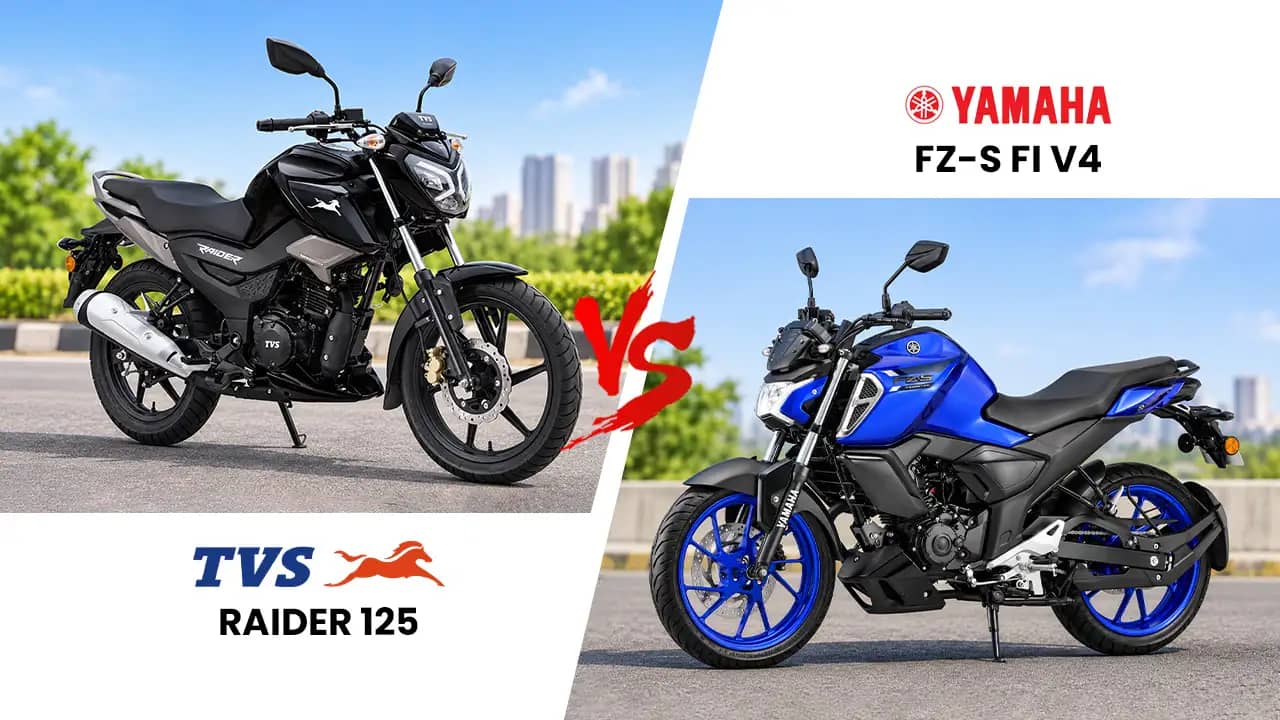
This guide pits the TVS Raider 125 against the Yamaha FZ-S Fi V4 for daily city riding in India. The Raider starts at ₹84,460 ex-showroom in Delhi; the 149cc FZ costs ₹1.20 lakh. We run EMI, real-world mileage and monthly petrol bills side by side to show which bike suits your commute and budget.
The TVS Raider vs Yamaha FZ decision starts with a gap of about ₹35,000. The Raider 125 begins at ₹84,460 ex-showroom in Delhi, while the Yamaha FZ-S Fi V4 asks for ₹1.20 lakh, and in India’s stop-start city traffic that difference matters more than any spec sheet. Petrol sits near ₹103 a litre, and TVS updated the Raider only in October, so both bikes deserve a fresh look.
TVS Raider vs Yamaha FZ: Price, On-Road Cost and EMI
Start with what lands on your invoice. In Delhi, the base Raider drum costs roughly ₹92,000 on the road, and the SXC DD, the version most city buyers end up eyeing, comes to about ₹1.10 lakh. The FZ-S Fi V4 on-road price in Delhi is close to ₹1.31 lakh, and some listings push it towards ₹1.37 lakh once insurance is loaded in.
Now run the standard finance test: 20 per cent down, 60 months, 11 per cent interest. The Raider SXC DD needs ₹22,000 down and an EMI near ₹1,910. The FZ needs ₹26,200 down and roughly ₹2,280 a month. Choose the base Raider instead and the EMI drops to about ₹1,600, a ₹680 monthly swing against the FZ before a single litre of petrol is burned.
Engine and Performance: 125cc vs 150cc in Real Traffic
The FZ has the bigger heart. Its 149 cc motor makes 12.4 PS at 7,250 rpm and 13.3 Nm at 5,500 rpm. The Raider’s 124.8 cc unit manages 11.38 PS at 7,500 rpm and 11.2 Nm at 6,000 rpm. Both run five-speed gearboxes.
A gap of just over 1 PS and 2 Nm looks small on paper. Torque is what you feel between 30 and 60 km/h, though, and the FZ’s extra 2.1 Nm means fewer downshifts when a flyover ramp or a loaded autorickshaw breaks your rhythm. The Raider answers with weight. At roughly 123 kg against the FZ’s 136 kg, it is easier to filter through a Mumbai bottleneck or hold a tight U-turn. The FZ rewards the rider who spends 10-15 km of every commute on a ring road or expressway. The Raider rewards the one who rarely leaves third gear.
Raider 125 Mileage vs FZ-S Fi: The Monthly Fuel Bill
Claimed figures flatter both bikes: about 72 kmpl for the Raider, 60 kmpl for the FZ. City use is harsher. Once signals, idling and traffic crawl are counted, expect 55-60 kmpl from the Raider and 45-50 kmpl from the FZ.
Take 1,000 km a month, roughly 33 km a day, and use the cautious end of those ranges. At 55 kmpl the Raider drinks about 18 litres, which is ₹1,870 at ₹103. At 45 kmpl the FZ needs about 22 litres, or ₹2,290. Add the EMI difference and the Raider costs around ₹3,780 a month to run against ₹4,570 for the FZ. The gap is roughly ₹790 a month, close to ₹9,500 a year.
Tank size evens things out slightly. The Raider’s 10-litre tank and the FZ’s 13-litre one give a similar city range of 550-585 km, so either bike needs a pump visit about every 17 days at that daily distance.
Features and Safety: What the Extra Money Buys
Safety is where the TVS Raider vs Yamaha FZ argument gets interesting. The October update gave the Raider SXC DD and TFT DD traction control, emergency brake warning, a wider rear tyre and a 27W USB-C charger, a first in the 125cc class in India. On a rain-slicked Delhi monsoon road or an oily Mumbai junction, that is not a gimmick.
The catch is braking. The Raider’s ABS is single-channel, working on the front wheel only. The FZ-S Fi V4 carries dual-channel ABS and Bluetooth connectivity through Yamaha’s Y-Connect app, which matters if you ride hard on wet roads or like turn-by-turn alerts on the console.
Neither bike lives in isolation. The Hero Xtreme 125R, from about ₹91,500, and the Honda SP 125, from about ₹89,750, chase the same city buyer as the Raider, and Drivio’s Honda SP 125 vs Shine 125 comparison covers the Honda side of that argument. The FZ’s true rivals are 160cc machines like the Bajaj Pulsar N160 and TVS Apache RTR 160, which our Pulsar 150 vs Pulsar N160 piece helps frame.
Which Is Better for City Riders?
For a city commute, the Raider is the better buy. It costs about ₹35,000 less ex-showroom, runs roughly ₹790 cheaper every month, carries less weight where weight hurts, and brings traction control to a segment that had never seen it. The FZ-S Fi V4 earns its premium only if highway stretches, dual-channel ABS or that extra 149cc shove are a genuine part of your week.
If you are leaning towards the Raider, check the on-road price and EMI for the TVS Raider 125 in your city on Drivio before the showroom hands you its own numbers.
Pick the Raider. It costs roughly ₹790 less every month once EMI and petrol are added together, is about 13 kg lighter in traffic, and now offers traction control on its top two variants. Riders who regularly cover highway stretches, want dual-channel ABS or prefer extra torque should pay the premium for the FZ-S Fi V4. For a pure city commute, the cheaper bike is the smarter one.