New Delhi


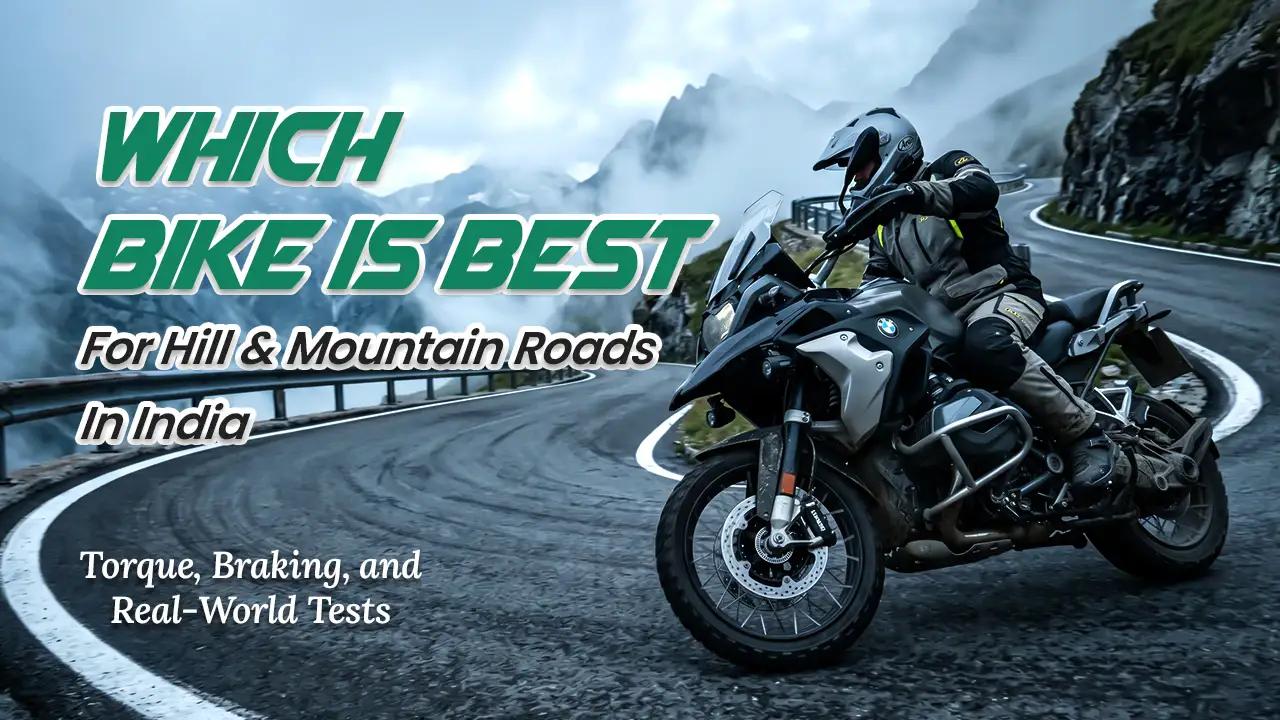

Best Bikes for Hill & Mountain Roads in India 2025
Featured Stories by Drivio | 12 May 2026
India's mountain roads are among the most punishing on the planet. From the high-altitude passes of Ladakh to the hairpins of Coorg, your motorcycle isn't just transport — it's a life-safety decision. The best bikes for hill and mountain roads in India share three non-negotiable traits: accessible low-end torque for steep climbs, high-confidence braking on descents, and suspension travel that absorbs punishment without destabilising the chassis.
Torque: The Real Currency on Mountain Roads
At altitude, naturally aspirated engines lose power as oxygen thins — which means torque at low rpm becomes more critical than peak horsepower. The Royal Enfield Himalayan 450 leads this category convincingly, with its Sherpa 452cc liquid-cooled engine delivering 40 Nm of torque at just 5,500 rpm and 39.47 bhp at 8,000 rpm. That broad, accessible torque band lets it pull strongly from low speeds without demanding constant gearshifts on switchback climbs.
The KTM 390 Adventure takes a different approach. Its 373.27cc liquid-cooled single produces 43.5 PS at 9,000 rpm and 37 Nm at 7,000 rpm — slightly peakier, but paired with ride-by-wire throttle and a quick-shifter, it rewards a skilled rider with explosive performance on faster, better-surfaced mountain passes.
The Bajaj Dominar 400, using the KTM-derived 373.3cc engine, makes 39.42 bhp and a strong 35 Nm of torque, making it a compelling highway-to-hills machine for riders who prioritize stability over off-road capability.
Braking: Where Safety Truly Lives
On steep descents with loose gravel or wet tarmac, braking systems define survival. The Himalayan 450 features dual disc brakes with switchable dual-channel ABS, alongside a 43 mm upside-down fork that provides composed braking stability over rocky terrain. The KTM 390 Adventure goes further with Cornering ABS and Motorcycle Traction Control (MTC), offering the most sophisticated safety net in this segment.
For riders on tighter budgets, the BMW G 310 GS brings dual-channel ABS and a high-mounted exhaust suited to Ladakh's unpredictable terrain. Do not consider any motorcycle without dual-channel ABS for serious mountain use — single-channel systems are inadequate on loose, off-camber surfaces.
Real-World Performance: Who Wins the Hills?
On well-surfaced mountain tarmac, the Royal Enfield Thunderbird's torquey character lets it chug along effortlessly, whereas lighter, higher-revving bikes must be worked through the gears constantly. The Himalayan 450 inherits and expands this character — it is unhurried, planted, and forgiving. The KTM 390 Adventure, by contrast, is for technically skilled riders who want to attack mountain roads rather than cruise them.
For rough, unpaved tracks, the Hero Xpulse 200 4V punches well above its weight — its lightweight body and long-travel suspension absorb punishment that would unsettle heavier machines.
The Verdict
For most Indian riders tackling Himalayan terrain — loaded with luggage, perhaps a pillion — the Royal Enfield Himalayan 450 remains the gold standard. Its torque curve, switchable ABS, adjustable seat height (825–845 mm), and long-travel suspension form the most complete real-world package available under ₹3.5 lakh. The KTM 390 Adventure is the superior machine for the performance-focused solo rider. The mountains don't forgive mechanical inadequacy — choose the bike that matches your terrain, not just your ambition.