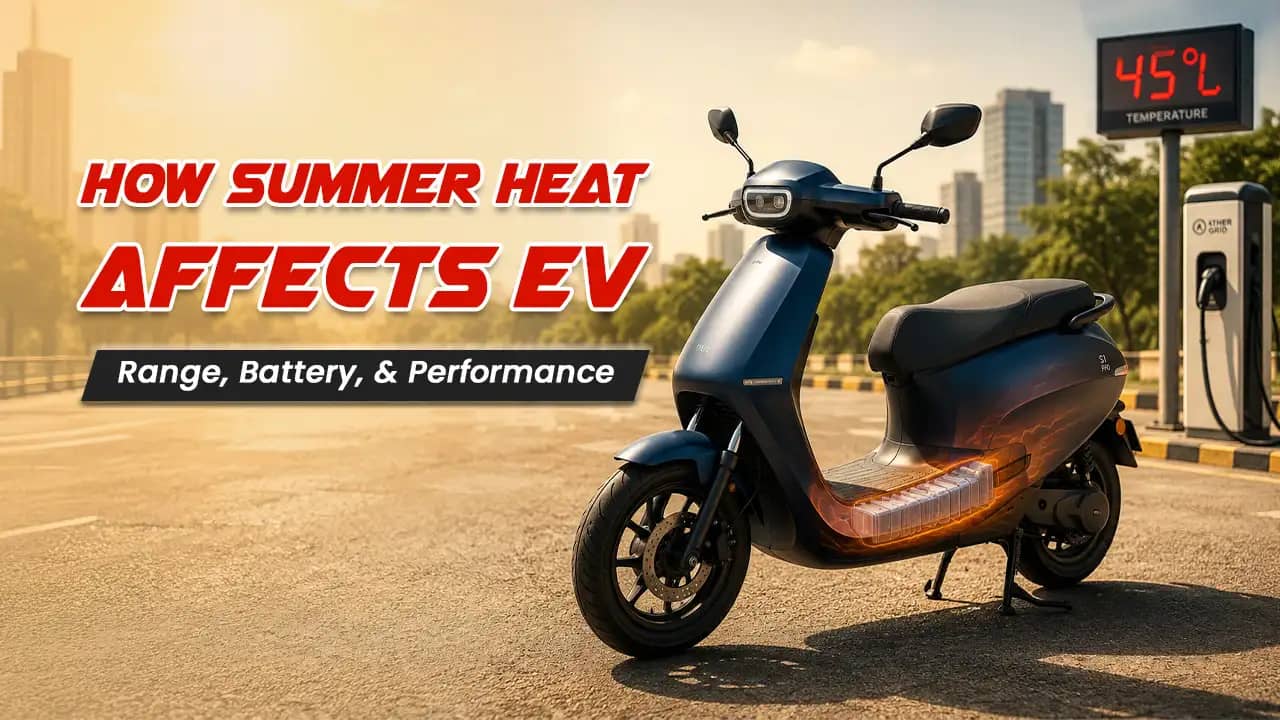
How Summer Heat Affects EV Range, Battery, and Performance in India
Overview
How Summer Heat Affects EV Range, Battery, and Performance in India brings key updates for two-wheeler buyers in India. Why Indian Summers Are a Real Test for EV Batteries EV range in summer can drop noticeably when temperatures cross 40°C across much of India, and for the millions of
Why Indian Summers Are a Real Test for EV Batteries
EV range in summer can drop noticeably when temperatures cross 40°C across much of India, and for the millions of electric scooter owners in cities like Delhi, Jaipur, Ahmedabad, and Nagpur, this is not a theoretical concern — it is a daily riding reality. With peak summer temperatures now routinely hitting 44–48°C in parts of Rajasthan and Gujarat, the interaction between ambient heat and lithium-ion battery chemistry has become one of the most important things an EV owner in India needs to understand.
This is not a reason to avoid buying an EV. Modern electric scooters from brands like Ather, Ola, TVS, and Bajaj are engineered with Indian conditions in mind, and their battery management systems handle heat far better than many first-generation products did. But understanding what actually happens inside your battery on a 45°C afternoon — and what you can do about it — is the difference between a battery that lasts eight years and one that starts degrading prematurely.
How Summer Heat Affects EV Range
The range drop that Ola S1 Pro and Ather 450X owners often notice during peak summer is caused by two overlapping effects. The first is energy diversion: when battery temperature rises above a comfortable threshold (typically around 35–40°C for the pack), the battery management system activates thermal regulation. In scooters with liquid-cooled battery packs, this means energy is redirected from propulsion to cooling, effectively reducing available range.
The second effect is electrochemical. Lithium-ion cells operate most efficiently within a temperature window of roughly 20–35°C. Outside this range — especially above 40°C — internal resistance increases, meaning the battery delivers less usable power per charge cycle. In practical terms, many Ather and TVS iQube owners report seeing their real-world range shrink by 8–15% during afternoon rides in peak summer compared to identical routes in the morning, when ambient temperatures are lower and the battery has not been sitting in direct sun.
Delivery riders who operate from 11 AM to 4 PM — the hottest window of the day — often see the sharpest contrast. A rider covering 100+ km daily in a city like Hyderabad or Pune will notice this range compression consistently during May and June, and the effect eases as monsoon temperatures moderate.
Does Heat Damage EV Batteries Over Time?
This is the question most EV owners in India genuinely worry about, and it deserves a straightforward answer. Yes — sustained exposure to high temperatures accelerates lithium-ion battery degradation, but the extent depends heavily on how the vehicle is used, stored, and charged.
At the chemistry level, elevated temperatures accelerate a process called solid electrolyte interface (SEI) layer growth on the anode. This layer thickens faster when cells are hot, gradually reducing the battery's capacity to accept and store charge. Studies on lithium-ion cells suggest that consistent operation above 45°C can reduce overall battery life by 20–30% compared to operation in temperate conditions. In a country like India, this makes parking habits and charging timing genuinely important ownership decisions, not just optional best practices.
The good news is that this degradation is largely preventable with basic habits. A Bajaj Chetak or TVS iQube parked in a shaded garage and charged overnight at a moderate rate will outlast the same vehicle that spends every afternoon baking under direct sun in a parking lot and gets fast-charged immediately after a hot ride.
Can Electric Scooters Overheat in Indian Summer Conditions?
Battery, Motor, and Controller Temperature
Overheating in EVs is not a single event — it involves three separate thermal systems that can each trigger protective responses independently: the battery pack, the motor, and the motor controller. Many Ather and Ola owners report that after parking their scooter outdoors for several hours on a summer afternoon, the dashboard battery temperature reading has already climbed significantly before the first ride begins. In some cases, the vehicle needs a few minutes of shaded rest before it will accept a fast charge.
The motor and controller are somewhat more tolerant of ambient heat because they only generate significant heat under load. However, for delivery riders doing continuous back-to-back runs through the afternoon without rest periods, motor temperature can rise enough to trigger power reduction mode — a deliberate throttling of output torque that protects the motor from damage. Riders will notice the scooter feeling sluggish on climbs or during sustained acceleration. This is a protective feature, not a malfunction.
Thermal protection systems in modern Indian EVs are designed to handle summer conditions. They use a combination of passive heat sinking, active cooling (in higher-end models), and software-based power reduction to keep critical components within safe operating bands. The system is doing its job correctly when you see power reduced — it is preventing something far worse.
Why Charging Slows Down in Hot Weather
One of the most consistent reports from EV owners across North India during summer is that fast charging takes noticeably longer than the claimed time. This is expected behaviour, and it is driven by the battery management system's thermal protocols.
When a battery pack is already at elevated temperature from a sun-soaked parking session or a long afternoon ride, the BMS reduces the maximum accepted charge rate to prevent further thermal stress. Where a cool battery might accept a 1.5–2 kW charge rate comfortably, a hot pack may be throttled to 0.8–1 kW until temperatures normalise. In practical terms, this can add 20–40 minutes to a charging session that would otherwise take an hour.
This is why the ideal charging window in Indian summers is between 9 PM and 7 AM — after ambient temperatures have dropped and the battery has had time to cool down from the day's riding. Charging immediately after a long ride in peak afternoon heat is the worst combination for both charging speed and long-term electric scooter battery life.
The Fire Question: What Actually Causes EV Battery Fires?
The concern about EV fires — particularly given news coverage of incidents in India — deserves a calm, factual examination rather than dismissal or alarm. Lithium-ion battery fires result from a process called thermal runaway: a self-sustaining chain reaction where one failing cell generates heat that causes neighbouring cells to fail in sequence. Ambient summer heat alone, even at 48°C, is not sufficient to initiate thermal runaway in a properly manufactured pack. The temperatures required are far higher — typically above 150°C internally.
The fires that have occurred in India have predominantly involved manufacturing defects, physical damage to cells, charging with non-standard chargers, or battery packs that were already compromised. A structurally sound, well-maintained EV from an established manufacturer — charged with the correct charger — is not meaningfully at fire risk from ambient summer temperatures.
Modern BMS systems monitor individual cell voltages, temperatures, and charge states at high frequency and will disconnect the pack before conditions approach dangerous levels. This is not a foolproof system, but it represents a significant and real layer of protection that first-generation products often lacked.
Real-World Summer Ownership: What Indian Riders Need to Know
The practical realities of riding an EV through an Indian summer vary sharply depending on context. An office commuter in Bengaluru covering 15–20 km each way on a relatively moderate climate will have a fundamentally different experience from a delivery rider doing 120 km through the afternoon heat of Delhi or Rajasthan.
For commuters, the main impact is modest range reduction and slightly slower charging if they plug in immediately after arriving home on a hot afternoon. For delivery riders, the effects compound — thermal throttling during the hottest rides, range compression across multiple charge cycles in the same day, and motor protection events if rest periods between runs are too short.
In states like Rajasthan and Gujarat, where summer temperatures regularly exceed 45°C for weeks at a stretch, parking matters enormously. A scooter left in direct sunlight will arrive at the next charging session with a battery already at 50–55°C or higher — well outside the optimal charging window. A shaded parking spot, even a tree or a temporary cover, can make a measurable difference to how the BMS responds.
How to Protect Your EV Battery Through the Indian Summer
The most effective protection habits are also the simplest. Park in shade wherever possible — underground parking, covered stalls, or even a reflective tarpaulin all help keep pack temperatures manageable before charging. Avoid fast charging when the battery is already hot; let the scooter rest for at least 30–45 minutes in a cooler environment before initiating a charge session.
Maintain the battery between 20% and 80% state of charge during regular daily use. Consistently charging to 100% and immediately riding in peak heat is harder on the cells than leaving a modest buffer. Most modern EVs allow you to set a charge limit through their app — using it is one of the highest-return habits available to Indian EV owners.
If the scooter will be unused for extended periods during summer — a vacation, for instance — store it at around 40–50% charge in the coolest available location. Leaving a fully charged lithium pack in a hot garage for two weeks is genuinely damaging in a way that a summer commute is not.
Should Indian EV Owners Worry About Summer Heat?
The honest answer is: be aware, not alarmed. Some range loss during peak summer is normal — it is a predictable characteristic of lithium-ion chemistry, not a defect. Some charging slowdown after a hot afternoon ride is normal — the BMS is doing exactly what it should. Some power reduction during extended high-load riding in extreme heat is normal — it is protecting the motor.
What is not normal is sudden and significant range loss that persists even in cool morning conditions, battery temperature warnings that appear repeatedly without clear cause, or any smell, unusual heat, or swelling around the battery area. Any of these warrants a visit to the authorised service centre promptly — do not defer.
Understanding how heat affects your EV can help you maximise battery life, maintain consistent range, and make smarter ownership decisions in India's demanding summer conditions.
EV range in summer can drop noticeably when temperatures cross 40°C across much of India, and for the millions of electric scooter owners in cities like Delhi, Jaipur, Ahmedabad, and Nagpur, this is not a theoretical concern — it is a daily riding reality.