TVS Crosses 5.9 Lakh Monthly Sales for the First Time Ever — What's Driving It?
Overview
TVS Crosses 5.9 Lakh Monthly Sales for the First Time Ever — What's Driving It? details recent electric two-wheeler market trends, highlighting monthly registration growth figures, shifting brand market shares, and key adoption milestones across the Indian EV industry.
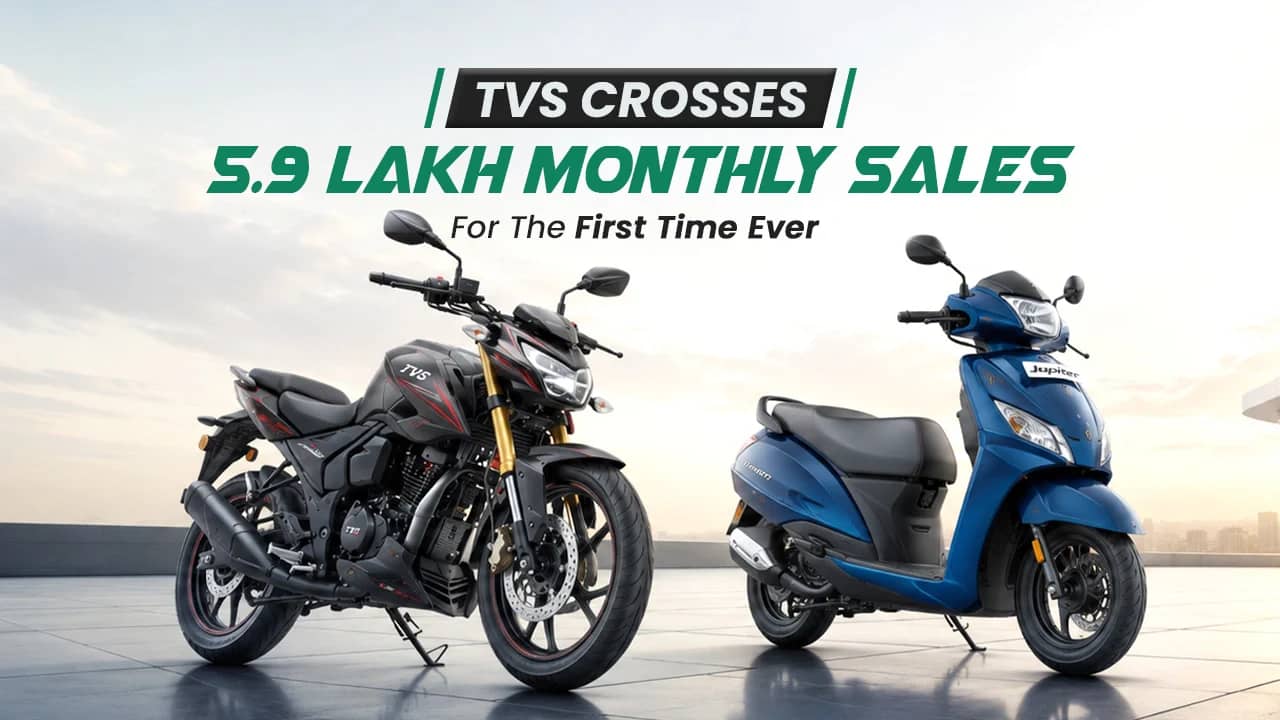
TVS Motor's monthly sales hit an all-time high in India this year, with the company shipping 5,90,003 units in June 2026 — the best single month in its history and a 47 percent jump over the 4,02,001 units it sold in June 2025. That beats TVS's own previous record of 4,82,495 units, set in September 2024, by more than a lakh units in under two years. For anyone shopping a TVS bike or scooter right now, a number like this usually means one thing at the dealership: faster stock turnover, shorter delivery waits, and sharper festive-season deals as TVS pushes to keep the momentum going into Q3.
TVS Motor Monthly Sales: What's Actually Driving the Surge
Two-wheelers did almost all the heavy lifting. TVS sold 5,65,417 two-wheelers in June, up 47 percent from 3,85,698 units a year earlier, and domestic two-wheeler sales alone grew 46 percent to 4,11,014 units. Break that down further and the picture gets specific: motorcycles rose 42 percent to 2,67,096 units, carried largely by the Apache range and the Raider, while scooters actually grew faster, up 53 percent to 2,47,950 units on the strength of the Jupiter and TVS's electric lineup. Three-wheelers added 24,586 units against 16,303 a year ago — a smaller base, but at 51 percent growth, it's one of TVS's strongest categories this month.
Exports weren't incidental either. International business grew 47 percent to 1,72,355 units, with two-wheeler exports climbing 48 percent to 1,54,403 units. TVS has spent several years building out distribution across Africa, Latin America, and Southeast Asia, and that groundwork is now showing up directly in the monthly numbers instead of sitting buried in annual reports.
The EV Line Is the One Worth Watching
TVS's electric two-wheeler sales more than tripled in June, jumping from 14,400 units in June 2025 to 48,537 units this year. That's not a rounding blip — it's the fastest-growing segment in the company's entire portfolio, split between the iQube and the newer Orbiter. TVS also crossed 10 lakh cumulative electric scooter sales in June 2026, becoming only the second Indian EV two-wheeler maker after Ola Electric to hit that mark, and it did the last 1 lakh of those units in just 75 days. Rising petrol prices, pushed up this year by the West Asia crude oil crisis, are clearly steering more Indian commuters toward electric, and TVS's dealership reach means it's capturing a large slice of that shift. FADA's June retail data shows EVs crossed 10 percent of total two-wheeler sales in India for the first time ever — and TVS's own EV growth rate is running well ahead of that industry average.
TVS, Hero, and Honda: Who's Actually Ahead
This is where the story needs some nuance instead of a straight victory lap. TVS's 5,65,417 two-wheeler dispatches in June technically edged out both Hero MotoCorp and Honda Motorcycle & Scooter India on a company-wide, exports-included basis — the first time TVS has beaten both rivals on this combined number in a single month.
| Company | June 2026 dispatches | YoY growth |
| TVS Motor | 5,65,417 | +47% |
| Hero MotoCorp | 5,41,159 | -2.3% |
| Honda (HMSI) | 5,28,281 | +26% |
But dispatch figures count what factories ship to dealers, not what customers actually rode home. On FADA's retail registration data for the same month, Hero still leads the domestic market with 4,72,144 units sold at the counter, followed by Honda at 4,52,754 — both ahead of TVS in pure retail terms. What the dispatch numbers do confirm is direction: Hero's domestic sales actually slipped this June, weighed down by softening demand for entry-level commuters, while Honda and TVS both posted strong double-digit growth. TVS is simply outpacing both rivals right now — in exports, in EVs, and in scooters specifically.
What This Means If You're Buying a TVS This Month
A record sales month usually loosens up supply at the dealer level, which matters if you've been waiting on a specific model. The Jupiter and the Ntorq have been running close to capacity for months, and buyers are reporting shorter delivery windows than earlier this year. On the EV side, volumes on the iQube and Orbiter are high enough that TVS has been expanding its EV dealership network, which usually translates to better spare-parts availability and shorter service queues — a real pain point for scooter owners dealing with newer EV brands.
None of this changes what a specific TVS actually costs to run day to day. An Apache RTR 160 owner covering 60km daily still spends roughly the same on fuel regardless of how many units TVS shipped last month — what changes is negotiating room at the showroom and how fast a booking turns into a delivery. If you're weighing a TVS motorcycle, scooter, or EV right now, check the on-road price and EMI for the exact model in your city on Drivio before you commit to a booking.
TVS Motor's monthly sales hit an all-time high in India this year, with the company shipping 5,90,003 units in June 2026 — the best single month in its history and a 47 percent jump over the 4,02,001 units it sold in June 2025. That beats TVS's own previous record of 4,82,495 units, set in September 2024, by more than a lakh units in under two years.