New Delhi


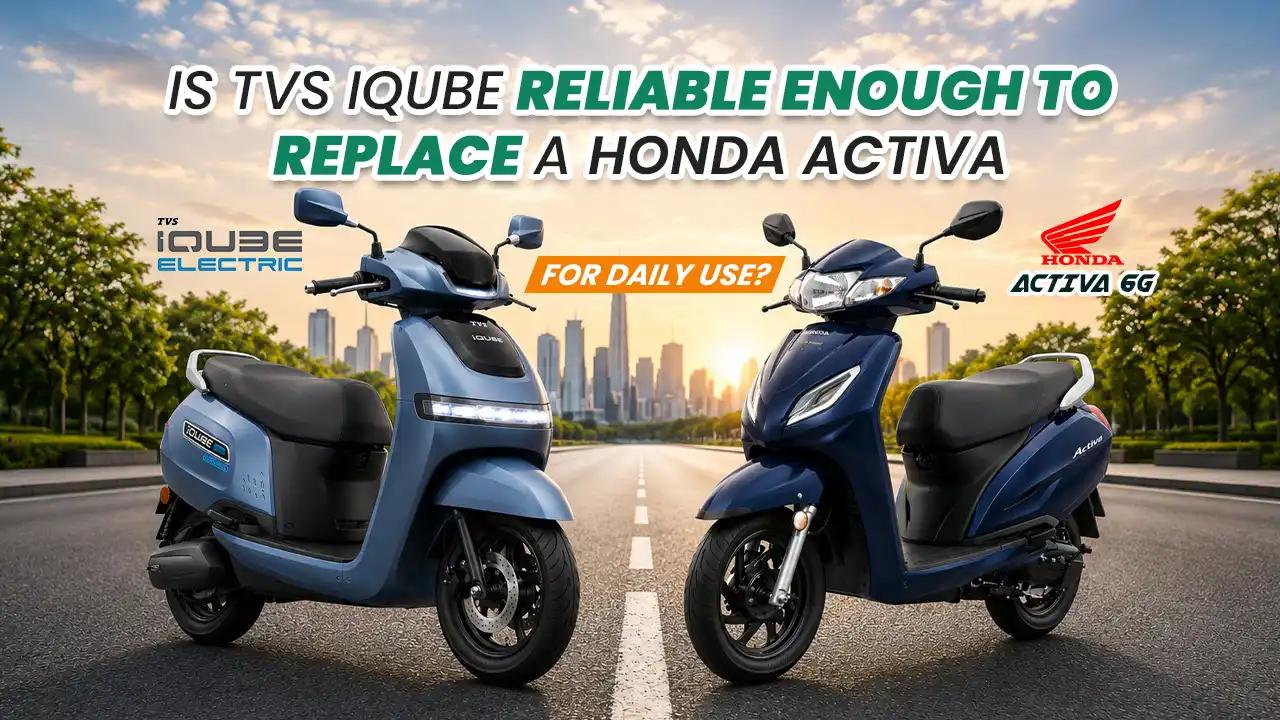

Is TVS iQube Reliable Enough to Replace a Honda Activa for Daily Use?
Featured Stories by Drivio | 4 Jun 2026
The TVS iQube vs Honda Activa debate is no longer just a conversation happening in showrooms — in June 2026, it is the central buying decision for hundreds of thousands of Indian commuters. The TVS iQube starts at around ₹1.15 lakh ex-showroom (for the 2.2 kWh base variant), while the Honda Activa 6G begins at approximately ₹75,500 ex-showroom, making the price gap wider than it might first appear. But as petrol prices hover above ₹103 per litre and electric vehicle adoption in India continues to accelerate, that gap is being looked at very differently by daily commuters who cover 30–50 kilometres every single day.
Why TVS iQube Is Being Compared To The Honda Activa
The Honda Activa did not become India's best-selling scooter by accident. For over two decades, it has offered exactly what the Indian family needs: a forgiving engine, a seat wide enough for school runs, parts available at every roadside mechanic, and a resale market that stays remarkably healthy. Buyers trust it with almost no deliberation. It is the default choice the way white rice is the default meal — reliable, everywhere, and rarely wrong.
The iQube has earned its place in this conversation through persistence. TVS launched it in 2020 as a niche urban experiment. By 2026, it has grown into a proper product family — five variants ranging from the entry 2.2 kWh to the long-range ST 5.3 kWh — with over 37,000 units retailed in April 2026 alone. That volume is not built on novelty; it is built on repeat buyers, positive word-of-mouth from actual owners, and the very real arithmetic of running costs. For commuters evaluating an electric scooter vs petrol scooter decision, the iQube has become the reference point in the same way the Activa is in the petrol segment.
Real-World Reliability: TVS iQube vs Honda Activa
Battery Reliability
The iQube's lithium-ion battery pack is covered by TVS's five-year warranty, which is the industry standard for this segment. Real-world degradation on lithium-ion chemistry typically runs at around 2–3% capacity loss per year under normal urban cycling. Over five years of 40 km daily use, most owners can expect the usable range to drop by 10–15% from the claimed figure — so a 3.5 kWh variant claiming 150 km in IDC conditions will likely deliver 85–100 km in city traffic on a full charge, and perhaps 75–90 km after five years of use. That is still adequate for most Indian urban commutes.
What happens after the warranty expires is the genuine unknown. Battery replacement costs for the iQube ST's 5.3 kWh pack are likely to be significant — potentially ₹40,000–₹60,000 — though prices are falling as domestic cell production scales. Owners of the base 2.2 kWh variant face lower replacement exposure but also a tighter range buffer for longer days. This is not a dealbreaker; it is a known variable that buyers should price into their ownership calculations.
One user report on BikeDekho noted that after 20,000 km over 3.5 years, one of two battery modules showed degraded performance. TVS's response through authorised service channels was prompt, but it highlights that the battery is the variable component in an otherwise low-maintenance drivetrain.
Motor Reliability
This is where the iQube holds a clear structural advantage over any petrol scooter. An electric motor has a fraction of the moving parts of a 109cc four-stroke engine. There is no camshaft, no valves, no carburettor, no ignition system to go wrong. The iQube's 4.4 kW hub-adjacent motor requires no scheduled servicing — no oil change, no belt tension check, no spark plug replacement. Failure rates in the first five years of ownership are extremely low.
Against the Activa's Honda-engineered engine, which is legitimately bulletproof, the iQube's motor arguably wins on mechanical simplicity even if it loses on the depth of the nationwide service ecosystem.
Electronics And Software
This is the iQube's most complex ownership variable. The TFT display, connected app, Bluetooth pairing, OTA update system, and smartwatch integration are genuinely useful features — and TVS has pushed consistent OTA updates to improve BMS behaviour and telematics since launch. However, real owner feedback consistently flags a few recurring friction points: the instrument cluster screen is prone to glare in direct sunlight (particularly in cities like Hyderabad and Delhi where summer riding is intense), the auto-brightness for night riding can over-correct, and the TVS iQube app has seen connectivity drop-out complaints, especially after software updates.
None of these are reliability failures in the mechanical sense. They are software and UX issues that TVS iterates on. But if you are comparing ownership experience with an Activa — which has no app dependency whatsoever — the iQube asks more of its owner in terms of managing the digital layer.
Honda Activa Reliability Benchmark
The Activa's 109cc engine regularly sees 70,000–100,000 km of use before any major intervention. A mechanic who has never seen a specific Activa variant in their life will still know what to do with it — the engine architecture is so widely understood across India's 150,000+ roadside mechanics that breakdowns are resolved in hours, not days. Service intervals are 3,000 km, and each service costs ₹300–₹600 depending on consumables. The Activa is not exciting; it is unconditionally dependable, which is exactly why it sells in the volumes it does.
Daily Commute Cost Comparison
Assume 40 km per day, 26 working days per month — that is approximately 1,040 km monthly.
Honda Activa Monthly Fuel Cost
The Activa delivers a real-world mileage of around 47 kmpl in urban traffic. At ₹103 per litre for petrol:
- Fuel needed: 1,040 ÷ 47 = approximately 22.1 litres
- Monthly fuel cost: 22.1 × ₹103 = approximately ₹2,276
- Annual fuel cost: approximately ₹27,312
TVS iQube Monthly Charging Cost
The iQube's real-world urban consumption sits at around 25–30 Wh/km. At ₹8 per unit (residential tariff average across Indian cities), charging 1,040 km costs:
- Energy consumed: 1,040 × 0.028 kWh = approximately 29 kWh
- Monthly charging cost: 29 × ₹8 = approximately ₹232
- Annual charging cost: approximately ₹2,784
Annual and Long-Term Savings
The annual fuel saving is approximately ₹24,500. Over three years, that is ₹73,500 back in your pocket. Over five years, you are looking at over ₹1.22 lakh in energy cost savings alone — which more than bridges the purchase price difference between a base-spec iQube and a top-spec Activa. When you add maintenance savings to that figure, the financial case for the iQube becomes difficult to argue against for a commuter doing 35–50 km daily.
Maintenance Cost: Which Scooter Demands Less Money?
The Activa's annual maintenance — four services with oil changes, occasional brake pad replacement, air filter cleaning, and tyre wear — comes to roughly ₹3,500–₹5,000 per year under normal urban use. This is inexpensive, and the availability of local mechanics keeps unplanned repair costs low.
The iQube's annual maintenance is even cheaper in terms of scheduled servicing — TVS recommends one annual inspection, primarily covering brake fluid, tyre condition, and software diagnostics. No engine oil, no spark plugs, no belt. Real owner costs run to ₹1,500–₹2,500 per year for routine servicing.
Where the iQube costs more is in tyre wear (the rear wears faster due to motor torque delivery), and in brake pad consumption — although regenerative braking noticeably extends pad life compared to a petrol scooter. Brake fluid replacement on the iQube's CBS system is an additional periodic cost the Activa does not have to the same degree. Net-net, iQube maintenance is cheaper by ₹2,000–₹3,000 annually, but you are dependent on TVS authorised service centres for anything software-related, and that network, while growing, is not yet as ubiquitous as Honda's.
Range Anxiety vs Fuel Convenience
Real-world iQube range across owner reports clusters around 80–100 km for the 3.5 kWh variant in Indian city conditions — with air conditioning, stop-start traffic, and the occasional pillion. The claimed IDC range of 145–175 km for various variants is achieved in controlled conditions that do not reflect a Bengaluru or Delhi commute in summer.
For a 40 km daily commuter with home charging, this is entirely adequate. Plug in overnight, wake up to a full charge, repeat. The anxiety only genuinely kicks in for two types of commuters: those living in apartments without dedicated parking or access to a power point, and those whose daily usage is unpredictable — some days 40 km, others 90 km. For apartment dwellers, portable charging through a standard 15A socket is possible but slow (5+ hours for a full charge), and access to building power points remains a politically complicated conversation in many housing societies.
The Activa wins on convenience without debate. Any petrol bunk in any Indian city, fill up in three minutes, leave. This frictionless refuelling is not a trivial advantage, particularly for users who travel to smaller towns or have erratic commute patterns. For a predictable urban commuter with home charging, the iQube's range is sufficient. For everyone else, the Activa's petrol convenience remains genuinely valuable.
Which Scooter Feels Better In Daily Traffic?
Ride both back-to-back in a city like Pune or Hyderabad and the differences are immediately apparent. The iQube's electric motor delivers instant torque from a standstill — the kind of surge that makes jumping away from traffic lights feel effortless. In crawling bumper-to-bumper traffic, this throttle response is an active pleasure; the iQube moves with the rhythm of urban traffic more naturally than the Activa.
U-turns are where the iQube's weight begins to show. The 3.5 kWh variant weighs around 118 kg — heavier than the Activa's 106 kg. In tight apartment gates and crowded market lanes, the lower centre of gravity from the floor-mounted battery helps, but the overall mass is more noticeable when manoeuvring at walking pace.
The Activa remains the more family-flexible machine. The flat floorboard can accommodate a child standing between rider and handlebars (as is Indian reality), the seat is wide and forgiving for pillion comfort, and the under-seat storage is more generous. The iQube's storage is adequate but not class-leading. For school-run families and weekend market trips, the Activa's ergonomics feel more thought out for the Indian use case.
For a solo urban commuter, the iQube's ride quality — quieter, smoother, and with better low-speed tractability — is the more pleasant daily experience.
TVS iQube vs Honda Activa: At a Glance
| Parameter | TVS iQube (3.5 kWh) | Honda Activa 6G |
| Ex-showroom price | ₹1.15–1.35 lakh | ₹75,500–87,500 |
| Running cost (per km) | ~₹0.22 | ~₹2.19 |
| Annual maintenance | ₹1,500–2,500 | ₹3,500–5,000 |
| Real-world range | 80–100 km/charge | Unlimited (petrol) |
| Reliability | Good; battery warranty 5 years | Excellent; 70,000–100,000 km proven |
| Convenience | Home charging; limited road-side support | Petrol anywhere; mechanics everywhere |
| Long-term cost (5 yr) | Lower by ₹1.5–2 lakh | Higher fuel and service costs |
Is TVS iQube Reliable Enough To Replace A Honda Activa For Daily Use?
Yes — but with a clear asterisk on who the buyer is.
The TVS iQube vs Honda Activa question ultimately comes down to commute predictability and home charging access. If you travel 30–50 km daily on a fixed urban route, have a parking spot with a power socket, and service the scooter at an authorised TVS dealer, the iQube will serve you as dependably as the Activa — and cost you significantly less to run over three to five years. The motor will not give you trouble. The battery, under the five-year warranty, is covered. The ride quality, particularly in city traffic, is arguably better than the Activa's.
Riders who should switch immediately: daily urban commuters in metro and tier-1 cities, riders covering 35–50 km in predictable patterns, anyone bothered by rising petrol costs, and buyers who service their vehicles regularly. The iQube makes strong financial and practical sense for this profile.
Riders who should stay with the Activa: those without home charging access, commuters whose routes extend into smaller towns where TVS authorised service is sparse, families needing maximum storage and pillion flexibility, and anyone who cannot tolerate any dependency on charging infrastructure. The Activa's near-zero mental load of ownership is a real and underrated quality.
Compared to alternatives like the Ola S1 Air, Bajaj Chetak, and Ather Rizta, the iQube sits in a more conservative, less volatile ownership position. It may not offer the Rizta's urban range or the Chetak's retro appeal, but TVS's dealer network and build quality give the iQube more long-term ownership assurance than several of its electric rivals.
The iQube will not replace the Activa in Indian households overnight. But for the right commuter in 2026, it is already the better daily machine on almost every metric that matters financially. Check the on-road price and EMI for the TVS iQube or Honda Activa in your city on Drivio.