Top 7 High-Speed Electric Scooters with the Longest Range (Real-World Tested)
Overview
Top 7 High-Speed Electric Scooters with the Longest Range (Real-World Tested) brings key updates for two-wheeler buyers in India. High-speed electric scooters in 2026 are defined as models capable of exceeding 75 km/h while delivering a real-world range of over 100 km . With improved battery efficiency and better
High-speed electric scooters in 2026 are defined as models capable of exceeding 75 km/h while delivering a real-world range of over 100 km. With improved battery efficiency and better software optimization, manufacturers are now focusing on practical, real-world performance instead of just IDC-certified numbers.
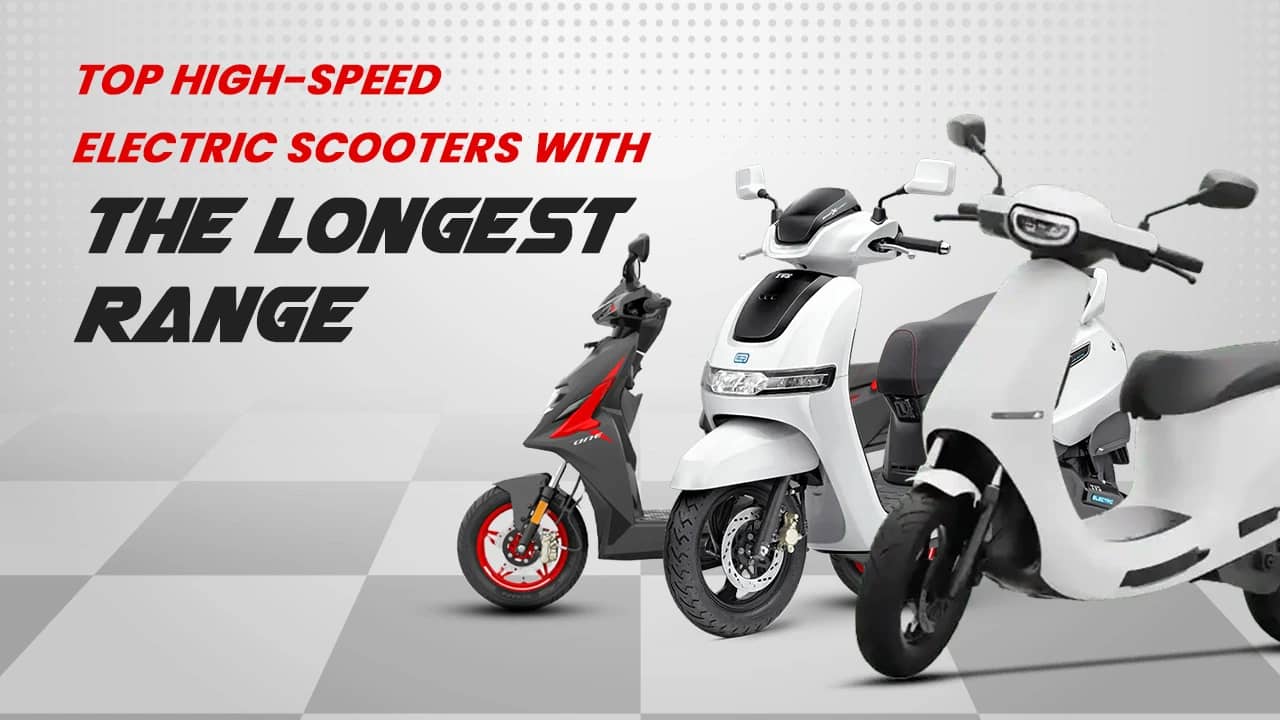
Currently, the range leader in India is the Simple Energy Simple One Gen 2, offering a tested real-world range of up to 190 km. Close competitors include the TVS Motor Company TVS iQube ST and the feature-loaded Ola Electric Ola S1 Pro Gen 2.
Prices for these premium long-range scooters range between ₹1.35 lakh to ₹1.85 lakh (on-road) depending on city and subsidy benefits.
1. The EV Landscape in 2026 & PM E-DRIVE Relevance
The Indian electric two-wheeler market in 2026 operates under the PM E-DRIVE scheme, which replaced FAME-II.
- Subsidy: ₹2,500 per kWh
- Maximum benefit: ₹5,000 per vehicle (FY 2025–26)
Unlike earlier policies, PM E-DRIVE encourages battery efficiency rather than simply increasing battery size.
High-speed electric scooters now dominate the premium L1 category, catering to:
- Highway commuters
- Daily office riders (30–60 km/day)
- Multi-day range users
2. Battery, Range & Performance (Technical Core)
Most long-range scooters now use:
- NMC (Nickel Manganese Cobalt) lithium-ion batteries
- LFP (Lithium Iron Phosphate) batteries
- IP67-rated battery packs (water & dust resistance)
Below are the top 7 high-speed electric scooters with the longest real-world range in 2026.
1. Simple One Gen 2
Manufacturer: Simple Energy
- Battery: 5.0 kWh (Fixed + Removable)
- IDC Range: 265 km
- Real-World Range:
- Eco – 190 km
- Ride – 160 km
- Motor: 8.5 kW peak | 72 Nm torque
- Top Speed: 105 km/h
- Charging: 0–80% in 5h 20m
✔ Highest real-world range in India (2026)
2. TVS iQube ST
Manufacturer: TVS Motor Company
- Battery: 5.1 kWh (NMC)
- IDC Range: 212 km
- Real-World Range:
- Eco – 150 km
- Power – 125 km
- Motor: 4.4 kW peak | 140 Nm (at wheel)
- Top Speed: 82 km/h
- Charging: 0–80% in 4h 30m
✔ Best balance of comfort, reliability & range
3. Ola S1 Pro Gen 2
Manufacturer: Ola Electric
- Battery: 4.0 kWh (NMC)
- IDC Range: 195 km
- Real-World Range:
- Eco – 143 km
- Normal – 110 km
- Motor: 11 kW peak
- Top Speed: 120 km/h
- Charging: 0–100% in 6.5 hours
✔ Fastest scooter in this list
4. River Indie
Manufacturer: River Mobility
- Battery: 4.0 kWh
- IDC Range: 161 km
- Real-World Range:
- Eco – 120 km
- Ride – 90 km
- Motor: 6.7 kW peak | 26 Nm torque
- Top Speed: 90 km/h
- Charging: 0–80% in 5 hours
✔ Best utility-focused electric scooter
5. Hero Vida V1 Pro
Manufacturer: Hero MotoCorp
- Battery: 3.94 kWh (Removable twin batteries)
- IDC Range: 165 km
- Real-World Range:
- Eco – 110 km
- Ride – 95 km
- Motor: 6 kW peak
- Top Speed: 80 km/h
- Charging: 0–80% in 5h 15m
✔ Best for apartment charging users
6. Bajaj Chetak 3201 (Special Edition)
Manufacturer: Bajaj Auto
- Battery: 3.2 kWh
- IDC Range: 136 km
- Real-World Range:
- Eco – 115 km
- Motor: 4.2 kW peak
- Top Speed: 73 km/h
- Charging: 0–100% in 4.5 hours
✔ Premium metal build & strong resale value
7. Ather 450X (3.7 kWh)
Manufacturer: Ather Energy
- Battery: 3.7 kWh
- IDC Range: 161 km
- Real-World Range:
- Eco – 110 km
- Ride – 90 km
- Motor: 6.4 kW peak | 26 Nm torque
- Top Speed: 90 km/h
- Charging: 0–80% in 4h 30m
✔ Best software experience & handling
3. Detailed Specifications Table
| Model | On-Road Price* | Battery | True Range | Top Speed | Charging Time |
| Simple One Gen 2 | ₹1,78,000 | 5.0 kWh | 190 km | 105 km/h | 6.0h |
| TVS iQube ST | ₹1,85,000 | 5.1 kWh | 150 km | 82 km/h | 6.0h |
| Ola S1 Pro Gen 2 | ₹1,47,000 | 4.0 kWh | 143 km | 120 km/h | 6.5h |
| River Indie | ₹1,46,000 | 4.0 kWh | 120 km | 90 km/h | 5.0h |
| Hero Vida V1 Pro | ₹1,50,000 | 3.94 kWh | 110 km | 80 km/h | 5.9h |
| Bajaj Chetak 3201 | ₹1,44,000 | 3.2 kWh | 115 km | 73 km/h | 4.5h |
| Ather 450X | ₹1,55,000 | 3.7 kWh | 110 km | 90 km/h | 5.7h |
*Prices estimated for Delhi/Bangalore including PM E-DRIVE subsidy.
4. Features & Technology
Modern high-speed scooters now offer:
- 7-inch TFT touchscreen displays
- Turn-by-turn navigation
- Reverse mode
- Hill hold assist
- Cruise control
- OTA software updates
The TVS iQube ST and Ola S1 Pro lead in display technology.
The River Indie offers a segment-best 55 liters storage (43L under-seat + 12L glovebox).
The Hero Vida V1 Pro remains the only premium scooter with fully removable twin batteries.
5. Real-World Ownership Costs (2026)
Electricity Cost
Average rate: ₹8 per unit
- 4 kWh battery full charge = ₹32
Cost per km
120 km real-world range = approx ₹0.27 per km
Annual Maintenance
- Brake pads
- Tire rotations
- Minor servicing
Average cost: ₹2,000 per year
Significantly lower than petrol scooters.
6. Pros and Cons Summary
Simple One Gen 2
Pros: Highest range, strong acceleration
Cons: Limited service network, waiting period
TVS iQube ST
Pros: Excellent build quality, family comfort
Cons: Highest price
Ola S1 Pro Gen 2
Pros: Highest top speed, feature-rich
Cons: Service inconsistency, software bugs
River Indie
Pros: Massive storage, 14-inch wheels
Cons: No regenerative braking, bulky design
Hero Vida V1 Pro
Pros: Removable batteries, wide service network
Cons: Reduced boot space
Bajaj Chetak 3201
Pros: Metal body, strong resale
Cons: Lowest top speed
Ather 450X
Pros: Reliable software, sharp handling
Cons: Stiff ride, paid Pro Pack features
7. Final Verdict
- Buy Simple One Gen 2 if maximum range is your priority.
- Buy TVS iQube ST for comfort and reliability.
- Buy Ola S1 Pro Gen 2 for speed and tech features.
- Buy River Indie for utility and storage.
- Avoid Bajaj Chetak 3201 if your commute includes frequent highway speeds above 80 km/h.
Conclusion
In 2026, high-speed electric scooters in India have matured significantly. With real-world ranges exceeding 150 km, improved battery chemistry, and better government policy under PM E-DRIVE, electric scooters are now a practical replacement for petrol scooters in urban and semi-urban India.
If your daily commute exceeds 40–50 km, investing in a long-range high-speed EV will significantly reduce your running costs while delivering strong performance.
High-speed electric scooters in 2026 are defined as models capable of exceeding 75 km/h while delivering a real-world range of over 100 km. With improved battery efficiency and better software optimization, manufacturers are now focusing on practical, real-world performance instead of just IDC-certified numbers.