Two-Wheeler Loan Rejected? Here Are the 7 Reasons Banks Say No — and How to Fix It
Overview
Two-Wheeler Loan Rejected? Here Are the 7 Reasons Banks Say No — and How to Fix It highlights how competitive interest rates, flexible tenure options, and instant approvals enable buyers to purchase new or pre-owned two-wheelers while effectively managing monthly budgets.
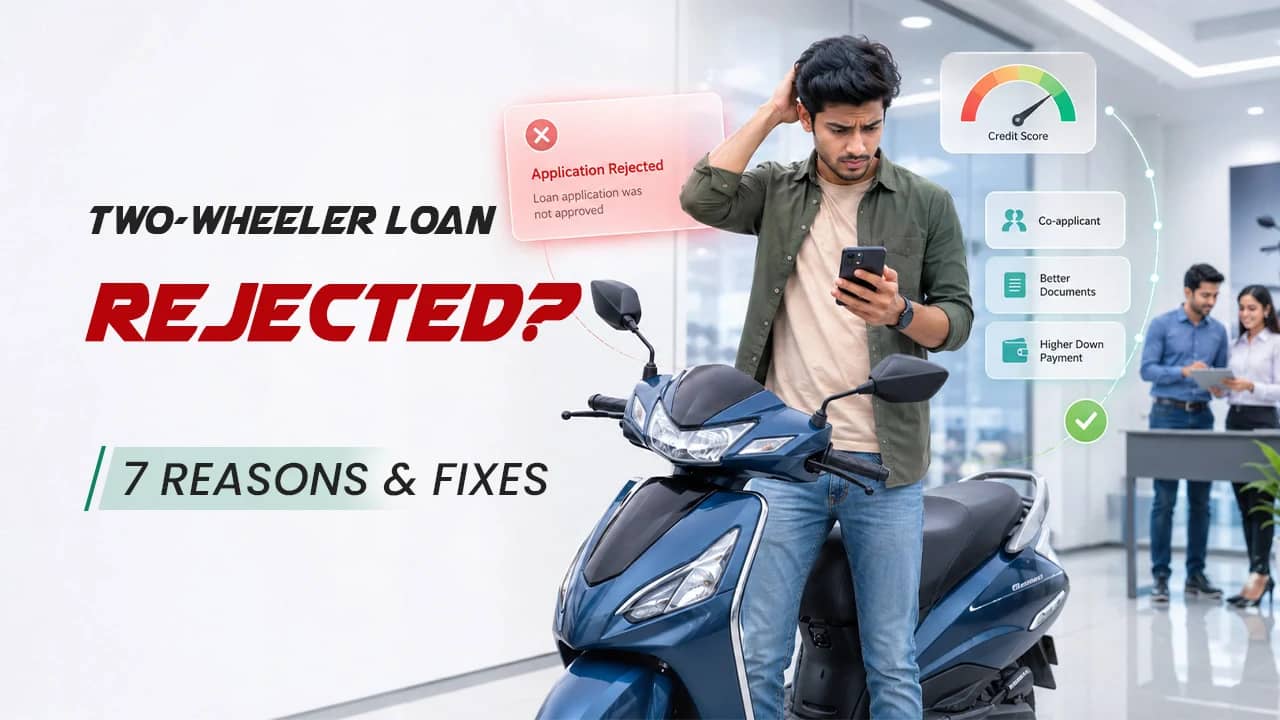
Your two-wheeler loan rejected notification usually arrives within seconds of applying, and it rarely comes with a real explanation. On a ₹90,000 scooter with 20% down and a 60-month tenure, most lenders in India quote somewhere between 10% and 26% interest depending on your profile — so the gap between approval and rejection isn't small change, it's the difference between an EMI you can live with and one that gets declined outright. Understanding why the rejection happened matters more than reapplying immediately, because the wrong fix can push your score down further before your next attempt.
Why Your Bike Loan Application Gets Rejected
Most rejections trace back to one of two things: what your credit report says, or what your income documents fail to prove. A CIBIL score below 650 is the single biggest reason lenders decline two-wheeler loans, and several banks now expect 700 or higher before they'll offer standard terms. Below that threshold, you're not automatically out, but you'll likely be pushed toward a higher down payment, a shorter tenure or a co-applicant requirement instead of a straight approval.
Income mismatch is the second big one. Lenders check your FOIR — fixed obligation to income ratio — and if your existing EMIs, credit card dues and rent already eat up 50-60% of your salary, a new loan pushes you past what most credit policies allow. Self-employed applicants face this more often, since inconsistent bank credits and thin ITR history make it harder for underwriters to trust a stated income figure.
The Credit Report Problem Nobody Checks
Roughly one in five credit reports in India carries an error — a closed loan still showing active, a settled account marked differently than it should be, or someone else's default attached to your PAN by mistake. If your two-wheeler loan gets rejected and your score seemed fine going in, pull your report from CIBIL or Experian before assuming the worst. A wrongly listed default can cost 50-plus points, and disputing it with the bureau is free, though it can take a few weeks to clear.
Multiple applications in a short window do real damage too. Every bank you apply to runs a hard inquiry, and three or four inquiries within a month reads to the next lender as desperation, not shopping around. This is the part most rejected applicants get wrong — they apply to five NBFCs the same week hoping one says yes, and each rejection makes the next one more likely.
Documentation and Employment Stability
Salaried applicants generally need 12 months in a current job; self-employed applicants need two years of business continuity with ITR filings to match. A recent job switch, even to a higher-paying role, can trigger a decline simply because the lender has no repayment track record to point to. Address proof mismatches — an Aadhaar showing a different city than your salary slip — cause more silent rejections than people realise, since underwriters flag inconsistency rather than ask for clarification.
Fixing a Rejected Application Without Tanking Your Score Further
The first move isn't reapplying — it's adding a co-applicant. A parent or spouse with a CIBIL score of 750 or above, added to the same application, is often enough to flip a decline into an approval, since the lender now has two incomes and two credit histories to assess risk against. This works faster than trying to repair your own score, which takes months of clean repayment to show up.
A bigger down payment is the second lever. Financing 100% of the on-road price on a low score signals maximum risk to the lender; putting down 30-40% instead of the standard 20% tells them you're less likely to default and reduces the amount they're exposed to. On an EMI calculator, run at 20% down over 60 months and roughly 11% interest — a common starting rate at NBFCs like TVS Credit and Bajaj Finance — the difference between a 20% and 35% down payment on a ₹1 lakh loan works out to a meaningfully lower monthly outgo, which is exactly what an underwriter wants to see.
Switching lender type helps more than switching lenders within the same category. Traditional banks like Axis or ICICI lean heavily on CIBIL and formal salary slips. NBFCs and fintech lenders increasingly weigh bank statement patterns and UPI transaction history instead, which means a gig worker or recently self-employed applicant with steady inflows can get approved where a bank said no — without the score ever entering the conversation the same way.
What This Means Before You Reapply
Don't treat rejection as a dead end, but don't treat it as noise either — every hard inquiry adds up, so fix the actual cause before your next application rather than trying your luck with a different bank the same week. Pull your credit report, correct any errors, add a co-applicant if your score is under 700, and raise your down payment if you're financing close to 100% of the bike's price. Riders comparing a Splendor Plus loan against an iQube EV loan on Drivio will notice the eligibility bar shifts slightly by vehicle category too, since EV financing sometimes comes with relaxed terms under state subsidy schemes.
A rejected application today doesn't rule out approval next month — it just means the lender needs a stronger case than the one you gave them. Check your CIBIL score, fix what's fixable, and run the EMI numbers for your two-wheeler loan on Drivio before you apply again.
Your two-wheeler loan rejected notification usually arrives within seconds of applying, and it rarely comes with a real explanation. On a ₹90,000 scooter with 20% down and a 60-month tenure, most lenders in India quote somewhere between 10% and 26% interest depending on your profile — so the gap between approval and rejection isn't small change, it's the difference between an EMI you can live with and one that gets declined outright.