Zero Down Payment Bike Finance in 2026: Smart Deal or Costly Trap?
Overview
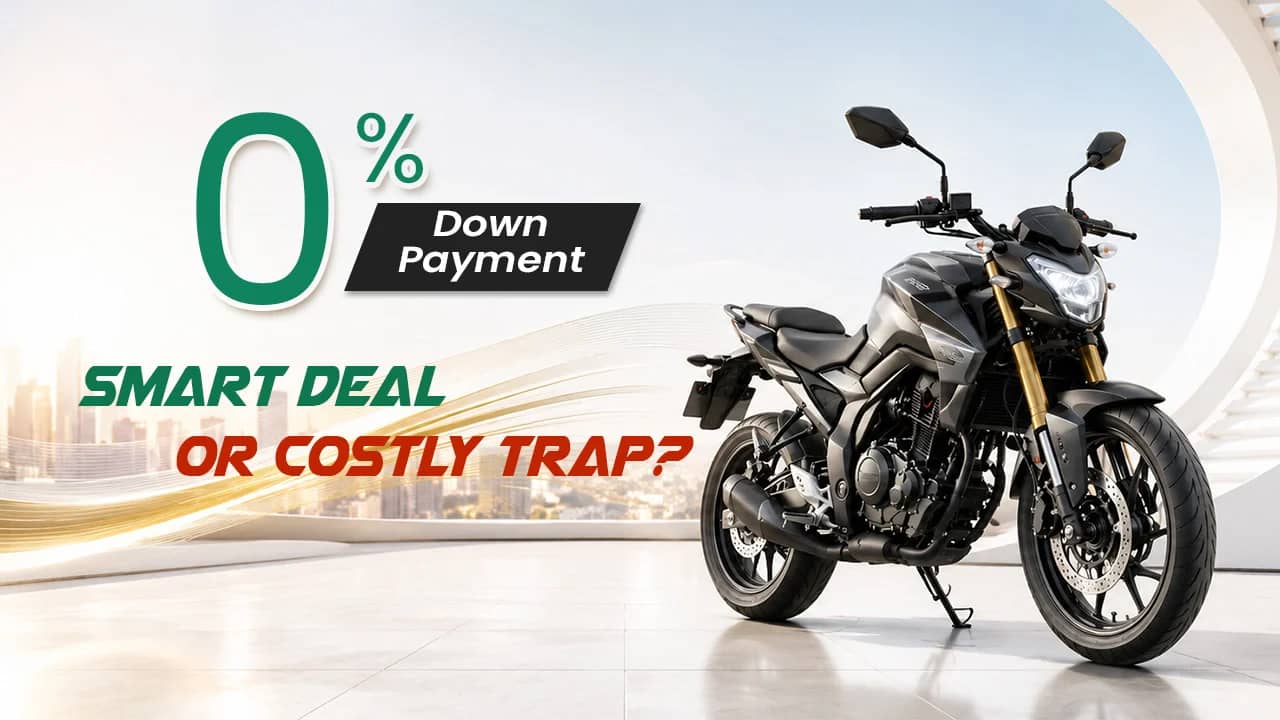
Zero Down Payment Bike Finance in 2026: Smart Deal or Costly Trap? highlights how competitive interest rates, flexible tenure options, and instant approvals enable buyers to purchase new or pre-owned two-wheelers while effectively managing monthly budgets.
Zero down payment bike finance lets you ride out of an Indian showroom without paying a single rupee upfront, but the interest rate attached to that convenience can quietly add tens of thousands of rupees to what you eventually repay. A Hero Splendor Plus priced at roughly ₹92,000 on-road in Delhi turns into two very different numbers depending on whether you walk in with 20% down at a standard rate, or sign a 100% finance deal at whatever rate the dealer's in-house NBFC happens to be pushing that day. With petrol holding near ₹103 a litre in July 2026 and most commuter budgets already stretched thin, that gap deserves more attention than the showroom brochure gives it.
What Zero Down Payment Bike Finance Actually Means When You Sign
No down payment doesn't mean no cost. It means the lender is financing 100% of the on-road price instead of the usual 80-90%, and in exchange, that lender charges a materially higher interest rate to offset the extra risk. Standard two-wheeler loans in India currently run anywhere from 10% to 14% per annum for buyers putting down 15-20% upfront. Zero down payment schemes, by contrast, typically land between 16% and 22% per annum, sometimes bundled with a higher processing fee since the lender has no cushion if the bike gets repossessed and resold. Bajaj Finance, TVS Credit, and several regional NBFCs all run these schemes, usually tied to specific budget models where the resale value stays predictable enough for the lender to take the gamble.
The Real Math on a ₹92,000 Splendor Plus
Numbers make this easier to see than percentages do. On a standard route, 20% down on a Splendor Plus works out to roughly ₹18,400 paid at the dealership, leaving a loan of ₹73,600. At 11% per annum over 60 months, that comes to an EMI of about ₹1,600, with total interest of roughly ₹22,400 paid over the loan's life. Total outgo, including the down payment: close to ₹1.14 lakh.
Now run the zero down payment version of the same bike. The full ₹92,000 gets financed, no upfront cash changes hands, but the rate jumps to around 18% per annum. Over the same 60-month tenure, the EMI climbs to roughly ₹2,340 a month, and total interest paid balloons to nearly ₹48,000. You save ₹18,400 on day one and end up paying about ₹25,700 more in interest alone by the time the loan closes. The EMI itself is also ₹740 higher every single month, which matters more to a monthly budget than the one-time saving does.
Where the Trap Bites Harder on Bigger Bikes
Scale this up to something like a Bajaj Pulsar 150, which runs close to ₹1.30 lakh on-road in Delhi with its 149.5cc engine and 14 PS output, and the arithmetic gets uglier. A 20% down payment here is roughly ₹26,000, a sum many first-time buyers genuinely don't have sitting around. Financing the full amount at a zero down payment rate near 20% per annum over 60 months pushes the EMI past ₹3,400, and total interest paid over the tenure crosses ₹75,000, well above what the same buyer would pay with even a modest down payment at a standard rate. The higher the on-road price, the more the compounding works against a buyer who skips the down payment entirely. This is exactly why used-bike lenders and premium-segment financiers rarely offer true zero down payment products; the risk-to-reward math stops making sense once loan sizes cross a lakh.
Fuel costs compound the squeeze further. A Splendor Plus returns a real-world 60-65 kmpl in mixed city riding, which at ₹103 a litre and a typical 1,200 km monthly commute works out to roughly ₹1,900-2,000 spent on petrol every month, on top of whichever EMI you've committed to. Add an expected ₹3,500-4,500 in cumulative service costs by the 10,000 km mark, and the true monthly cost of "free" ownership starts looking a lot less free than the zero down payment sticker suggests.
When Zero Down Payment Genuinely Makes Sense
None of this makes zero down payment bike finance a bad product outright. For someone whose bike is the only way to reach a job, and who simply doesn't have ₹18,000-26,000 in savings to put down today, riding home now on a slightly costlier loan beats losing weeks of income to public transport delays or missed shifts. The math only turns into a trap when a buyer has the down payment available and chooses zero down anyway, purely because the dealer pitched it as the smarter option. In that scenario, the buyer is paying a five-figure premium for a convenience they didn't actually need.
The smarter approach, if cash flow allows it, is a hybrid: put down whatever amount is comfortable, even 10%, to pull the loan out of the highest-rate bracket, and negotiate tenure separately from the down payment conversation. Most NBFCs quote a better rate the moment any down payment enters the picture, even a partial one. A buyer who can scrape together ₹10,000 against a ₹92,000 bike often gets meaningfully closer to the 11-13% bracket than the 18-22% one, without needing the full 20%.
Zero down payment bike finance works best as a last-resort bridge, not a default choice, and the difference between the two mindsets is worth ₹20,000 to ₹75,000 depending on the bike. Run the EMI numbers for the exact model, down payment, and tenure that fit your budget, and check the on-road price and EMI on Drivio before you sign anything at the dealership counter.
Zero down payment bike finance lets you ride out of an Indian showroom without paying a single rupee upfront, but the interest rate attached to that convenience can quietly add tens of thousands of rupees to what you eventually repay. A Hero Splendor Plus priced at roughly ₹92,000 on-road in Delhi turns into two very different numbers depending on whether you walk in with 20% down at a standard rate, or sign a 100% finance deal at whatever rate the dealer's in-house NBFC happens to be pushing that day.