New Delhi


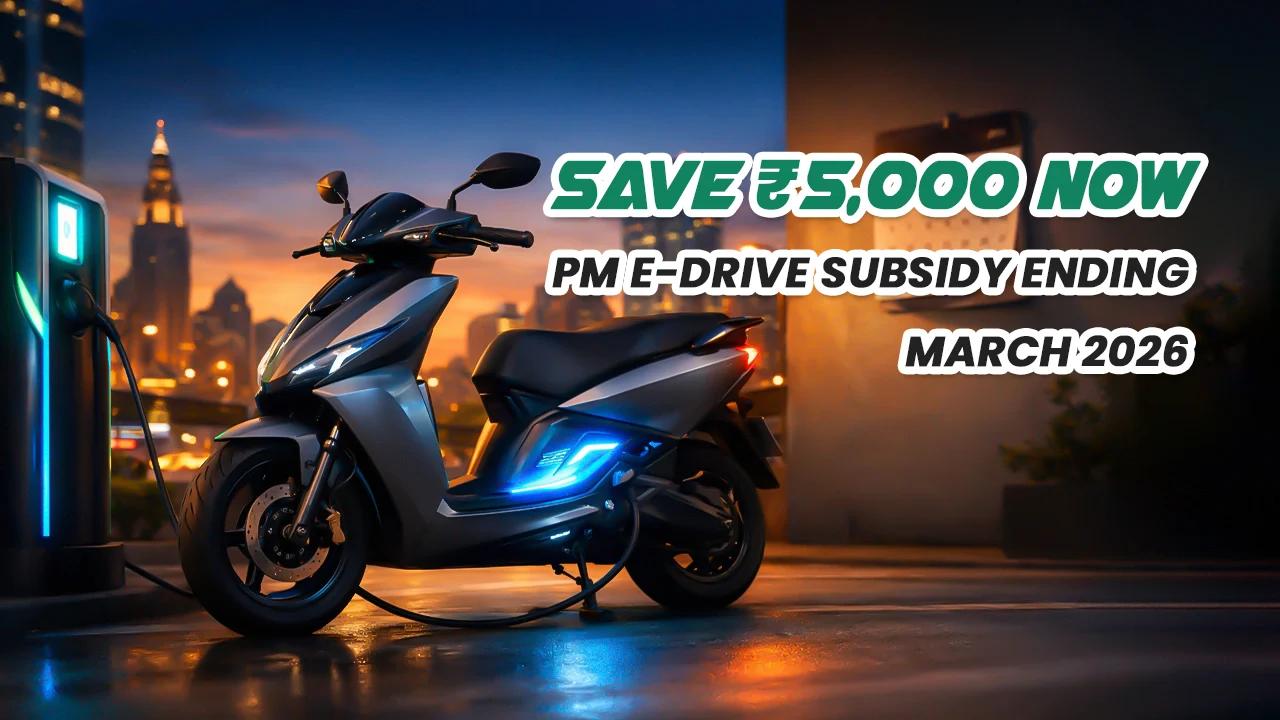

PM E-DRIVE Scheme Ends March 31, 2026: Buy Now or Lose Subsidy?
News by Drivio | 27 Feb 2026
The PM E-DRIVE (Prime Minister Electric Drive Revolution in Innovative Vehicle Enhancement) scheme for electric two-wheelers and three-wheelers will officially end on March 31, 2026.
For FY 2025–26, the subsidy is fixed at Rs. 2,500 per kWh, capped at Rs. 5,000 per vehicle. With premium electric scooters currently priced between Rs. 1,10,000 and Rs. 1,55,000 (ex-showroom) in cities like Delhi and Bengaluru, the removal of this incentive will directly increase purchase costs.
For buyers considering an EV in 2026, this is the final opportunity to secure central government support before prices rise.
The EV Landscape and Why This Deadline Matters
India’s electric two-wheeler market has moved beyond early adoption and now commands nearly 10% market penetration in urban regions.
The Ministry of Heavy Industries introduced the PM E-DRIVE scheme as a successor to the earlier FAME II program to continue supporting EV adoption.
While the broader PM E-DRIVE framework remains valid until 2028 for buses, trucks, and charging infrastructure, demand incentives for personal electric scooters and motorcycles end strictly on March 31, 2026.
This signals a strategic policy shift — the government believes the segment has matured enough to sustain growth without heavy subsidies.
For consumers, this means one thing: buy before the deadline or pay more later.
Battery, Range and Performance in 2026 EVs
Battery technology defines the real-world value of an electric scooter.
Battery Technology
Most 2026 electric scooters use:
- Lithium Iron Phosphate (LFP) – better thermal stability and longer life cycles
- Nickel Manganese Cobalt (NMC) – higher energy density and lighter weight
Typical premium models offer 2.9 kWh to 4.0 kWh battery packs with IP67 rating, meaning full dust protection and water resistance up to 1 meter.
Range: IDC vs Real-World
- IDC Range: 150–160 km (for ~3.7 kWh battery)
- Real-World Range (Eco Mode): 105–115 km
- Real-World Range (Sport Mode): 75–85 km
The certified IDC figure differs significantly from actual riding conditions. Factors like rider weight, throttle input, and traffic reduce effective range.
Motor and Performance
Premium scooters such as the Ather 450X and Ola S1 Pro typically feature:
- Permanent Magnet Synchronous Motor (PMSM)
- Peak Power: 6–7 kW
- Torque: Up to 26 Nm
- Top Speed: 85–95 km/h
Instant torque delivery ensures strong city acceleration.
Charging Time
- 0–80% via 750W home charger: 4.5–5 hours
- Fast charging: Approx. 1.5 km range per minute
Estimated Specifications (Flagship 2026 Model)
| Parameter | Specification |
| Price (Ex-showroom Delhi) | Rs. 1,39,900 (Post-subsidy) |
| Price (On-road Bengaluru) | Rs. 1,58,000 (Approx.) |
| Battery Capacity | 3.7 kWh (NMC/LFP) |
| IDC Range | 157 km |
| True Range (Eco Mode) | 110 km |
| True Range (Sport Mode) | 80 km |
| Top Speed | 90 km/h |
| Charging Time (0–80%) | 4 Hours 45 Minutes |
| Battery Warranty | 5 Years / 60,000 km |
| Motor Warranty | 3 Years / 30,000 km |
Features and Smart Technology
Modern electric scooters in 2026 focus heavily on connected technology:
- 7-inch TFT touchscreen display
- 4G LTE connectivity
- Integrated Google Maps navigation
- Reverse mode (park assist)
- Cruise control
- Boot space: 22–34 liters
- Mobile app integration (remote lock, geofencing, diagnostics)
- Over-the-air (OTA) software updates
Software improvements can enhance battery efficiency and introduce new ride modes even after purchase.
Real-World Ownership Experience
Ride Quality
Due to battery weight, suspension tuning is slightly firm. However:
- Telescopic front forks
- Rear mono-shock
provide adequate comfort for urban conditions.
Running Cost Advantage
At Rs. 8 per unit of electricity:
- 4 kWh full charge = Rs. 32
- Real-world range ≈ 100 km
- Cost per km ≈ Rs. 0.32
Petrol scooters typically cost Rs. 2.50–3.00 per km, making EVs significantly cheaper to operate.
Service networks for brands like TVS Motor Company, Bajaj Auto, and Ather Energy are strong in Tier 1 and Tier 2 cities, though rural reach remains limited.
Pros and Cons
Advantages
- Running cost under Rs. 0.40 per km
- Instant torque for city riding
- Low maintenance (fewer moving parts than ICE)
- Advanced features like hill-hold and navigation
Limitations
- Non-removable batteries limit charging flexibility
- Real-world range depends on riding style
- Plastic panels may rattle over time
- High battery replacement cost post-warranty
Final Verdict: Buy, Hold, or Avoid?
Buy
Ideal for urban commuters traveling 30–60 km daily with access to home charging. Fuel savings can offset the higher upfront cost within 18–24 months.
Hold
If your usage involves frequent inter-city travel or unstable power supply, waiting for better fast-charging infrastructure may be wise.
Avoid
Not suitable for riders needing 120+ km consistent high-speed range, as current battery technology in this price bracket cannot reliably deliver that without degradation.
Conclusion
The PM E-DRIVE subsidy ending on March 31, 2026 is a decisive moment for EV buyers. The financial benefit may appear small at Rs. 5,000, but combined with rising battery costs and inflation, prices are likely to climb post-deadline.
For budget-conscious urban riders, the smartest move is clear: secure the subsidy while it’s still available.