New Delhi


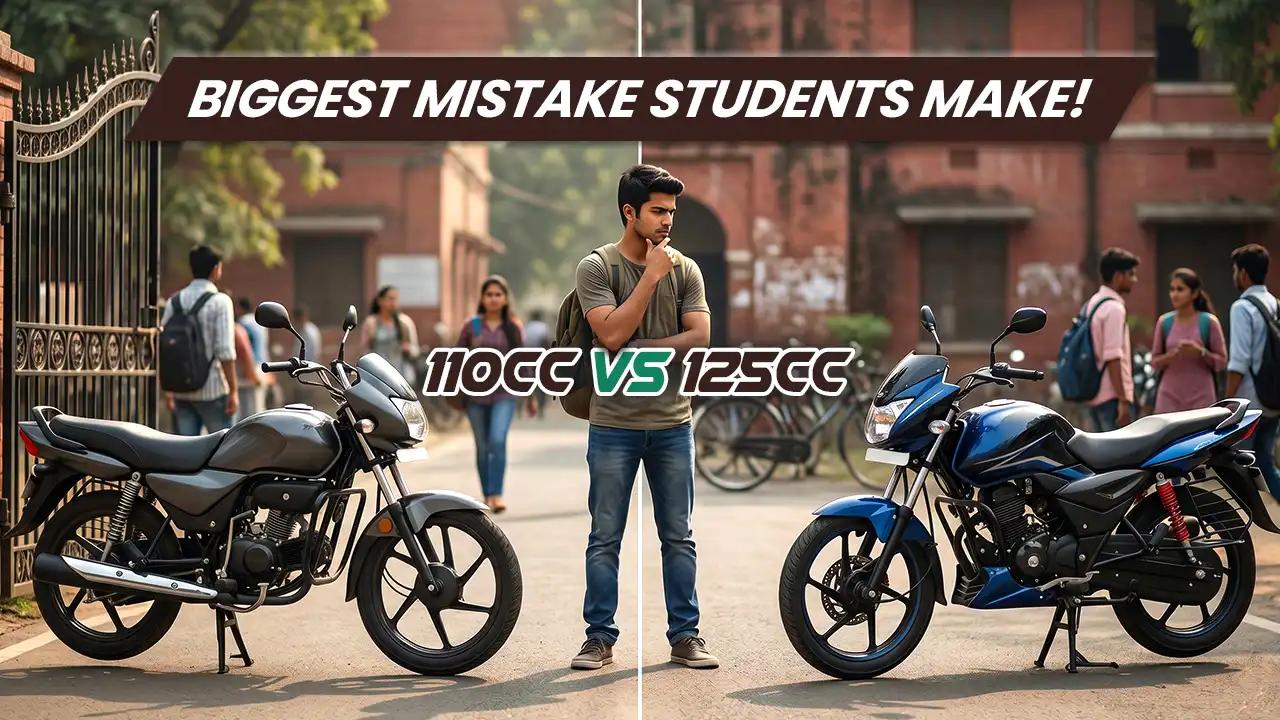

110cc vs 125cc Bike for College: The Honest Guide Your Senior Never Gave You
Reviews by Drivio | 23 Apr 2026
You're Standing at the Showroom. Now What?
Picture this. Your exams just got over, your parents finally agreed to get you a bike, and now you're standing at a dealership in some dusty showroom in Laxmi Nagar or Andheri or wherever — and the salesman is throwing numbers at you like it's a JEE paper.
"Sir, 110cc mein mileage better hai." "Sir, 125cc mein pickup zyada hai." "Sir, yeh wala premium model hai."
You nod. You smile. You have absolutely no idea what any of this means for your actual life.
That's what this article is for. No boring spec sheets. No YouTube influencer padding. Just the real stuff — what actually matters when you're riding to college every morning, splitting lanes at 9 AM, and calculating whether you have enough fuel money left for chai.
What 110cc and 125cc Actually Mean (In Human Language)
The "cc" in a bike's name stands for cubic centimetres — it's basically the size of the engine's cylinder where fuel burns to create power.
Bigger engine = more fuel burns = more power generated.
So a 125cc engine is slightly bigger than a 110cc engine. That's it. That's the whole secret. Everything else — mileage, pickup, sound, cost — flows from that one difference.
Think of it like this: a 110cc engine is like a solid, reliable pressure cooker. Does its job, doesn't waste gas, never overdoes it. A 125cc is like a slightly bigger cooker — heats up faster, handles more load, but uses a bit more fuel to do it.
Neither is "wrong." It just depends on what you're cooking.
Real-Life Differences (The Stuff That Actually Hits Different)
Mileage in the City
Here's what no one tells you upfront: city mileage is always worse than the claimed figure. Always.
A 110cc bike like the Hero Splendor Plus claims around 80 km/l. In actual Delhi or Pune city traffic — with stops, signals, and U-turns — you'll get somewhere between 55–65 km/l. Still excellent.
A 125cc like the Honda SP 125 or Hero Glamour claims 60–65 km/l. In real city use, expect 45–55 km/l.
That 10 km/l difference doesn't sound massive until you do the math. If you're riding 30 km a day, 5 days a week, over a month — you're spending roughly ₹150–200 extra per month on fuel with a 125cc. That's two plates of biryani. Or four cups of chai. Your call.
Pickup in Traffic
This is where the 125cc genuinely earns its keep.
College traffic — whether it's the gate rush at 8:45 AM or the evening exit madness — is brutal. You're constantly accelerating from near-zero, dodging autos, cutting gaps. A 125cc bike has noticeably better low-end torque, which means it responds faster when you twist the throttle from a standstill.
On a 110cc, you can do all of this — but you'll feel the engine working harder. It's not slow. It's just that the 125cc feels more relaxed doing the same thing.
If your college is in a dense metro area with a lot of stop-and-go traffic, the 125cc's pickup is genuinely useful, not just a showroom gimmick.
Maintenance
Both are commuter bikes, which means both are engineered to be cheap to maintain. Spare parts for 110cc bikes like the Splendor are so widely available that even a roadside mechanic in a tier-3 town can fix one in 20 minutes.
125cc bikes have slightly more expensive parts — service costs are roughly ₹300–500 more per service cycle. Not a dealbreaker, but worth knowing if you're on a tight monthly budget.
Riding Feel
Honest take: the 110cc feels like a reliable daily uniform. Gets you there, no drama.
The 125cc feels like you wore something slightly sharper to class. The engine is quieter at highway speeds, vibration is less, and it doesn't feel like it's straining when you carry a pillion (your friend who "just needs a lift to the metro").
If you're riding long distances or doing occasional weekend trips, the 125cc's smoother ride matters more than you'd think.
Real Cost Impact Over Two Years
| 110cc (e.g., Splendor+) | 125cc (e.g., SP 125) | |
| On-road price (approx.) | ₹75,000–80,000 | ₹85,000–95,000 |
| Monthly fuel (30 km/day) | ~₹1,100 | ~₹1,300 |
| Annual service cost | ~₹3,000 | ~₹4,000 |
| Insurance (approx.) | ~₹5,000/yr | ~₹5,500/yr |
| 2-year total (approx.) | ~₹1,09,000 | ~₹1,22,000 |
The gap over two years is roughly ₹12,000–15,000. One semester's worth of textbooks and chai combined.
Budget Breakdown (College-Student Math)
Most college students operate in one of three financial zones:
Zone 1 — "Bhai, tight hai" (Monthly pocket money ₹3,000–5,000) Every rupee counts. You're calculating fuel money against Friday dinner. The 110cc is your best friend. Lower EMI, better mileage, cheaper servicing. It does 90% of what the 125cc does at 80% of the cost.
Zone 2 — "Manage ho jaata hai" (Monthly ₹5,000–8,000) You have some breathing room. The ₹150–200/month extra fuel cost isn't going to wreck you. Here, the 125cc starts making sense if the smoother ride, better pickup, and slightly sharper look appeal to you.
Zone 3 — "Parents handle kar rahe hain" (Budget flexible) Go 125cc. Maybe even look at something like the Bajaj Pulsar 125 or Honda SP 125 Disc, which give you better braking and sportier styling for a marginal price bump.
One thing to remember: EMI psychology is real. A ₹1,000/month higher EMI on a 125cc doesn't sound bad until you've also got a hostel mess bill, a Netflix subscription you share with four people, and an upcoming trip to Rishikesh.
Don't overcommit. A slightly lower EMI with a 110cc means more cash freedom every month — and cash freedom in college is underrated.
The Social Factor (Yes, It Matters. Let's Be Honest About It.)
Nobody wants to admit it, but peer perception is real. Especially on campus.
Here's the unfiltered truth: nobody is judging your 110cc or 125cc as hard as you think they are. Your friends care about whether you'll give them a ride, not the cc count.
That said, there are real perception differences to acknowledge:
A Hero Splendor (110cc) reads as "sensible, dependable, uncle bike" in the popular imagination — even though it's a perfectly good machine. If that aesthetic bothers you, own it or pick something else.
A Honda SP 125 or Bajaj Pulsar 125 reads as sportier, more "college-appropriate" even though the performance difference is modest.
If looks and campus image matter to you (and it's okay if they do), the 125cc segment tends to have more stylish options — alloy wheels, disc brakes, LED headlights, sportier body panels — without jumping into the more expensive 150cc territory.
The sweet spot for style-conscious students on a budget: Bajaj Pulsar 125 or Honda SP 125 Disc variant. Looks sharp, rides well, doesn't murder your wallet.
When the 110cc Makes More Sense
Go with a 110cc if:
- Your daily commute is under 20 km. Mileage advantage pays off the most on short, frequent city rides.
- You're on a tight monthly budget. Every ₹200 you save on fuel is money for something else.
- You're in a tier-2 or tier-3 city where roads are less aggressive and traffic less dense. The 110cc handles these conditions perfectly without any compromise.
- Your parents or family are contributing and they'd be more comfortable with a lower EMI.
- You just need point A to point B reliability. The Hero Splendor's legendary reliability means it's the kind of bike that asks for nothing and gives everything.
- You plan to resell in 3–4 years. 110cc bikes — especially Splendor variants — hold resale value absurdly well in India.
When the 125cc Is Worth It
Upgrade to a 125cc if:
- Your commute is 25–40 km daily. The smoother engine makes longer rides noticeably less tiring.
- You're carrying a pillion regularly. Two people on a 110cc is manageable but laboured. On a 125cc, it's relaxed.
- You ride on highways or intercity roads occasionally — weekend trips, going home during breaks. The 125cc handles speeds above 70 km/h much more comfortably.
- You care about how the bike looks and the 125cc segment genuinely has better design options in your budget.
- Your budget allows for the premium without compromising your monthly cash flow.
- You plan to keep the bike for 5+ years. The slightly higher build quality and smoother engine means the 125cc ages better.
Final Verdict — What Should YOU Buy?
Here's the straight answer most articles are too scared to give:
If you're a first-year student with a moderate budget and a city commute under 20 km: buy a 110cc. Specifically, the Hero Splendor Plus or HF Deluxe. You will not regret it.
Seriously. It's not "settling." It's being smart. The money you save in 3 years is a Leh-Manali trip. Or a MacBook down payment. Or just the freedom of not stressing over every petrol price hike.
If you're a second or third-year student with a slightly flexible budget, ride 25+ km daily, or have a roommate always needing a lift: go 125cc. The Honda SP 125 (disc variant) is arguably the best all-round 125cc money can buy right now. The Bajaj Pulsar 125 is the pick if you want more attitude.
And if someone tells you that the cc count defines your status — smile, give them a lift on your Splendor, and drop them home before they can argue.
The best bike isn't the most powerful one. It's the one that shows up every morning, doesn't drain your wallet, and gets you to class on time.