Hero Vida V2 Review: Is It Still The Best Value Electric Scooter In India?
Overview
Hero Vida V2 Review: Is It Still The Best Value Electric Scooter In India? brings key updates for two-wheeler buyers in India. Hero Vida V2 review season begins with one number that matters more than any spec sheet: the Vida V2 Plus starts at approximately ₹1.15–1.20 lakh ex-showroom
Hero Vida V2 review season begins with one number that matters more than any spec sheet: the Vida V2 Plus starts at approximately ₹1.15–1.20 lakh ex-showroom, with the Pro variant priced around ₹1.30–1.35 lakh ex-showroom, depending on the city's EMPS subsidy and registration cost. The Hero Vida V2 on-road price typically lands near ₹1.30 lakh in Delhi and closer to ₹1.35–1.40 lakh in Mumbai for the Plus, while the Pro usually crosses ₹1.50 lakh on-road in both cities once insurance and RTO charges are added. For Indian buyers hunting for the best electric scooter in India under ₹1.5 lakh in June 2026, that pricing places the V2 squarely between the value-focused TVS iQube and the feature-loaded Ather Rizta — exactly the territory Hero wants to fight in.
Hero Vida V2 Price In India: Variants And Real Cost
Hero sells the V2 in three trims — Lite, Plus and Pro — and the spread exists specifically to undercut the outgoing V1 lineup it replaced in late 2024. The Lite, priced from approximately ₹96,000 ex-showroom, runs a smaller 2.2 kWh pack suited to short, predictable city hops. The Plus and Pro carry the same 3.44 kWh and 3.94 kWh batteries that powered the V1, which is why Hero hasn't touched the motor or chassis — this is sharper pricing on a familiar platform, not a ground-up redesign. Apartment dwellers in Gurugram, Pune or Bengaluru should note that state subsidy and registration cost still swing the final on-road figure by several thousand rupees, so always confirm the locked-in number with your dealer before booking.
Design And Practicality On Indian Roads
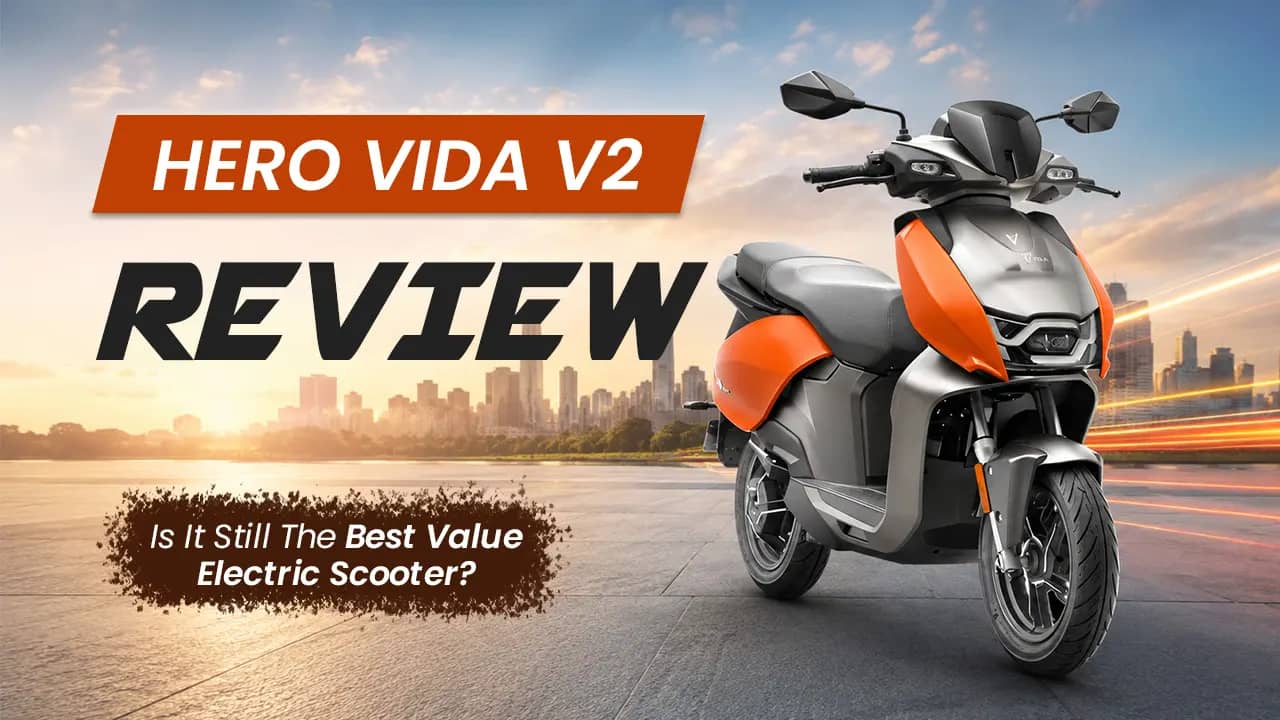
The V2 carries over the V1's split-seat silhouette, quirky LED headlight and uncluttered body panels almost unchanged, so it still stands out at a traffic signal rather than blending into the sea of look-alike commuter scooters. Ground clearance handles moderate speed breakers fine, though riders crossing flooded monsoon stretches or deep potholes should go slower than they would on a petrol scooter, since the floorboard sits lower than on something like the Honda Activa. Underseat boot space comes in at roughly 26 litres, enough for a full-face helmet and a small grocery bag, and the kerb weight of around 124 kg keeps it manageable for shorter riders threading through traffic. Build quality feels solid for the segment, though a few owners flag uneven panel gaps and app glitches that Hero will need to iron out as it chases reliability parity with TVS and Bajaj.
Hero Vida V2 Range And Charging: What The Numbers Mean Daily
The Vida V2 Plus carries a claimed IDC range of 143 km, while the Pro stretches to 165 km on the same test cycle — but real-world Hero Vida V2 range in dense city traffic, with AC running and a pillion onboard, typically settles between 90 and 115 km per full charge. That gap between claimed and real-world figures is normal for the segment, not a red flag specific to Vida. Both battery packs are fully removable, so owners without dedicated parking can pull them out and charge indoors on a standard 5A socket, taking roughly 5 to 6 hours for a full top-up; this single feature solves the biggest objection apartment-dwelling EV buyers in cities like Gurugram and Mumbai actually raise. Hero's expanding fast-charging network also helps top up a depleted pack faster when you're out running errands rather than parked at home overnight.
Riding The Vida V2 In City Traffic
City performance is where the V2 earns its keep. The 6 kW peak motor pulls strongly off the line, hitting 0–40 km/h in under three seconds, genuinely useful for nosing into traffic gaps and clearing Indian intersections before the next wave of two-wheelers arrives. Top speed sits at approximately 85–90 km/h depending on variant, more than enough for city and highway-feeder duty even if it won't chase an Ola S1 Pro on an open stretch. Ride quality over speed breakers and broken tarmac is composed rather than plush, and regenerative braking through the two-way throttle adds a useful layer of control in stop-start traffic without feeling artificial.
Features And Connected Tech
The V2 gets a 7-inch TFT touchscreen with OTA updates, a keyless system, cruise control and a follow-me-home headlight that genuinely helps when locating the scooter in a packed apartment basement at night. Ride modes vary by variant — the Pro adds a Custom mode on top of Eco, Ride and Sport — letting owners trade range for punch depending on the day's commute. Most Vida V2 Pro review videos highlight the same touchscreen-glare issue under harsh Indian summer sun, a small but real annoyance worth knowing before you buy.
Running Cost: Vida V2 Versus A Petrol Scooter
This is the section that actually swings buying decisions. With petrol priced at approximately ₹103 per litre and a typical 110cc petrol scooter returning around 45 km/l, running cost works out to roughly ₹2.30 per km. The Vida V2, by contrast, costs approximately ₹0.20–0.25 per km to run on home electricity, meaning a rider doing 50 km a day saves well over ₹3,000 a month versus a petrol scooter — money that adds up fast against any Hero Vida V2 EMI you're paying. Hero backs the scooter with a comprehensive 5-year warranty plus a separate Hero Vida V2 battery warranty covering the packs against capacity loss, which matters more for resale value than most buyers initially realise.
Hero Vida V2 Review: How It Stacks Up Against The Rivals
| Scooter | Ex-showroom Price (approx.) | Claimed Range | Top Speed |
| Hero Vida V2 (Plus/Pro) | ₹1.15–1.35 lakh | 143–165 km | 85–90 km/h |
| TVS iQube | ₹1.10–1.30 lakh | 100–150 km | 78 km/h |
| Ather Rizta | ₹1.15–1.40 lakh | 123–160 km | 80 km/h |
| Ola S1 Pro | ₹1.30 lakh | 176 km | 117 km/h |
| Bajaj Chetak | ₹1.10–1.20 lakh | 113–126 km | 73 km/h |
Against this set, the V2 doesn't win on any single spec — the Ola S1 Pro is faster, the Ather Rizta has the bigger boot and stronger app ecosystem, and the Bajaj Chetak has a reputation for sturdier metal body panels. What the V2 offers instead is balance: genuine removable-battery convenience, Hero's wide dealer and service network reaching far more towns than most EV-only rivals, and pricing that consistently undercuts the Ather Rizta while sitting close to the TVS iQube. For readers comparing Drivio's coverage of the TVS iQube and Bajaj Chetak, the practical takeaway is that the V2 rewards buyers who value service-network reach and home-charging convenience over outright speed or range bragging rights.
Who Should Buy The Hero Vida V2
This Hero Vida V2 review comes down to one practical question: are you optimising for value and convenience, or for outright performance? Apartment-dwelling daily commuters who need to charge indoors will appreciate the removable battery far more than spec-sheet range numbers. Family buyers wanting a slightly larger footprint and more boot space should look at the Ather Rizta first, and speed-focused buyers will be happier with the Ola S1 Pro. But for a straightforward electric scooter for daily commute use, backed by Hero's service reach and a genuinely competitive on-road price, the V2 earns its place as one of the better value picks in the segment this June. Check the on-road price and EMI for the Hero Vida V2 in your city on Drivio.
Hero Vida V2 review season begins with one number that matters more than any spec sheet: the Vida V2 Plus starts at approximately ₹1.15–1.20 lakh ex-showroom, with the Pro variant priced around ₹1.30–1.35 lakh ex-showroom, depending on the city's EMPS subsidy and registration cost. The Hero Vida V2 on-road price typically lands near ₹1.30 lakh in Delhi and closer to ₹1.35–1.40 lakh in Mumbai for the Plus, while the Pro usually crosses ₹1.50 lakh on-road in both cities once insurance and RTO charges are added.