Royal Enfield Meteor 350 Review: Why Riders Still Choose It for Touring
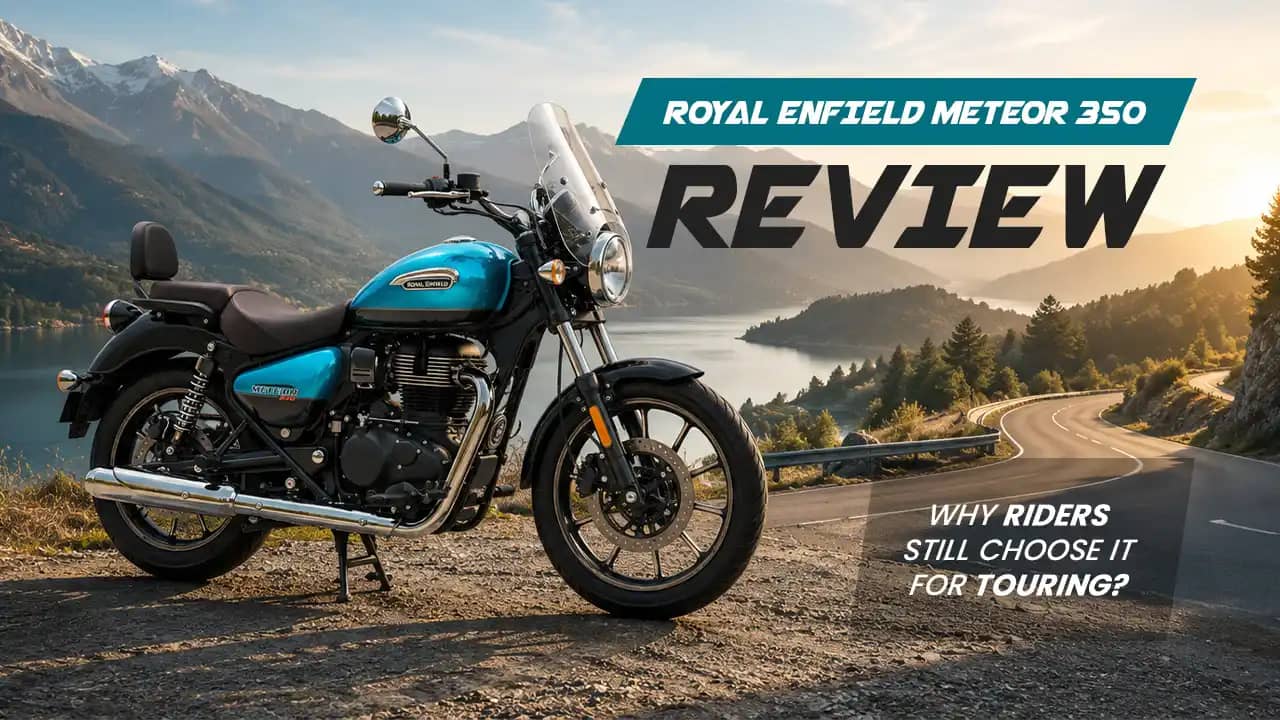
Overview
Royal Enfield Meteor 350 Review: Why Riders Still Choose It for Touring brings key updates for two-wheeler buyers in India. There is a particular kind of riding satisfaction that no spec sheet can adequately capture — the feeling of settling into a cruiser at 6 in the morning, the air
There is a particular kind of riding satisfaction that no spec sheet can adequately capture — the feeling of settling into a cruiser at 6 in the morning, the air cool on your forearms, a highway stretching ahead, and an engine beneath you that simply refuses to feel flustered. Three years since its launch, the Royal Enfield Meteor 350 still delivers exactly this feeling. This Royal Enfield Meteor 350 review is written after putting several hundred kilometers on the bike across a mix of National Highway stretches, state roads, and the kind of broken service roads that northern India does so well.
The Meteor 350 sits at a base ex-showroom price of approximately ₹2.15 lakh, rising to around ₹2.39 lakh for the top-spec Supernova variant. On-road in Delhi, expect to budget between ₹2.50 and ₹2.75 lakh depending on the trim and insurer. For what it offers — a 349cc J-series engine, real cruiser ergonomics, and a level of refinement that surprised even veteran RE owners when it launched — the price has aged well in a segment that has grown more competitive.
In June 2026, the Meteor faces credible rivals, most notably the Honda CB350. But does it remain the benchmark for long-distance comfort in the middleweight segment? The short answer: for most Indian touring riders, yes — and this review explains precisely why.
Riding Comfort on Long Highway Journeys
The Meteor 350's ergonomic package is its most deliberate design choice. The handlebars are wide and pulled back close to the rider, eliminating the reach that turns long rides into a physiotherapy appointment. Footpegs sit slightly forward — not as aggressively laid-back as a cruiser like the Avenger 220, but enough to open up the hip angle and reduce lower-back compression over multi-hour stretches.
The rider triangle, taken as a whole, places the rider in a naturally upright position. Your arms rest at a gentle angle rather than bearing weight, and your spine is allowed to sit tall. After two to three hours in the saddle on a good highway day, the Meteor 350 does not punish you for staying on it. That is not a given at this price point.
The seat itself deserves particular mention. It is wide, well-contoured, and cushioned with enough depth to absorb the kind of micro-vibrations that thin café-racer seats transmit directly to the spine. After three hours in the saddle, the seat remains surprisingly supportive — the foam does not bottom out the way budget cruiser seats often do within the first 150 km. The break between the rider and pillion sections gives the rider a defined seating zone, which helps prevent the gradual forward slide that plagues many single-piece seats on long rides.
Pillion comfort is genuinely good for the segment. The rear seat is elevated but not steeply so, and the grab rail is positioned at a natural height. Pillions on the Meteor report less fatigue than those on narrower-seated rivals, though they share the rider's exposure to windblast on fast highway sections.
Fatigue after 300 km is real on any motorcycle, but the Meteor manages it better than most at this price. The primary complaints from long-distance riders centre on wrist fatigue — not because the bars are uncomfortable, but because the relatively minimal windscreen (on most variants) means the rider's arms do more work in headwinds. More on that in the highway section.
How the Meteor 350 Performs on Indian Highways
The 349cc J-series single-cylinder engine — producing 20.2 bhp and 27 Nm of torque — was engineered specifically for relaxed highway cruising rather than sharp acceleration. This distinction matters enormously on a touring machine. The engine feels happiest between 85 and 95 km/h, where it sits in a long-stroke, low-rpm lope that makes covering distance feel almost effortless.
Push it above 100 km/h and the Meteor obliges, though you will notice the exhaust note shift to a more purposeful cadence. Indicated speeds of 105 to 110 km/h are achievable on a clear expressway, but the engine makes clear that this is not its preferred territory. Unlike many retro motorcycles, the Meteor rarely feels stressed on long highway stretches when ridden at reasonable touring speeds — the key word being reasonable. Riders expecting sportbike urgency will be disappointed; riders who want to cover 500 km without arriving exhausted will find the engine temperament ideal.
Overtaking on NH stretches is where you need to plan ahead rather than react. A roll-on from 70 km/h in fourth gear is adequate for overtaking trucks and slow-moving vehicles. For quicker overtakes — passing a highway bus at 90 km/h, for instance — a downshift to third is advisable. The engine has enough mid-range grunt to make these manoeuvres safe, but the Meteor is not a bike that rewards impulsive throttle decisions at high speeds.
The 5-speed gearbox is a consistent highlight in owner feedback. Shifts are positive and mechanical, with a satisfying feel that many riders describe as 'old-school' in the best sense. False neutrals are rare, and the clutch pull is light enough that urban filtering before and after a highway run does not tire the left hand.
Vibration management is excellent for an air-cooled single of this displacement. At the 80 to 90 km/h cruise range, vibration through the handlebars and pegs is minimal — refined enough that phone mounts and tank bags remain stable, which matters practically for navigation-dependent touring. Above 100 km/h, some vibration enters through the footpegs, but it remains within manageable limits for most riders.
Windblast is the Meteor's most honest limitation on fast highways. Without an aftermarket windscreen, sustained riding above 90 km/h introduces chest and helmet wind buffeting that becomes fatiguing after 90 to 120 minutes. The Stellar variant's taller screen helps modestly. For serious highway touring, a quality aftermarket windshield — widely available for the Meteor's headlight nacelle mounting — transforms the riding experience considerably. This is not a design failure; it is a category trade-off that is true of most cruisers at this price.
Suspension and Ride Quality on Indian Roads
Royal Enfield calibrated the Meteor's suspension with an understanding that its owners would face Indian roads in their full variety — from freshly laid expressway tarmac to state highways that resemble geological surveys in progress. The setup leans toward comfort rather than handling precision, which is exactly the right call for a touring cruiser.
The telescopic front fork absorbs expansion joints and minor road irregularities smoothly. What you feel through the handlebars is a gentle rise and fall rather than a sharp thud — the fork is compliant enough that your grip relaxes rather than tightens over rough sections. This matters on a five-hour ride more than any braking spec.
City potholes receive a more mixed verdict. At low speeds over deep potholes, the suspension bottoms out on sharper impacts if the bike is loaded — rider plus luggage plus pillion. Solo urban riding produces no real complaints, but heavily loaded touring configurations do highlight the limits of the standard spring rates. Riders who regularly tour two-up benefit from increasing rear preload to the second or third position.
The twin rear shock absorbers provide a plush, slightly wallowing ride character that is immediately apparent when moving from a harder-sprung bike. Through the seat, broken state highway surfaces feel processed and cushioned — the kind of ride that lets you relax your lower back rather than brace it. Highway stability at legal cruising speeds is reassuring, with no wobble or nervousness over expansion joints at 90 km/h.
Where the Meteor's suspension requires respect is in fast cornering on patchy roads. The softness that makes it comfortable in a straight line translates to vague feedback when cornering at pace over uneven surfaces. For a rider whose priority is comfort over distance rather than spirited mountain passes, this is an entirely acceptable trade-off. For riders who want both, the CB350 offers a firmer, more communicative chassis — though at the cost of ride compliance on bad roads.
Real-World Mileage and Touring Fuel Cost
ARAI-certified figures for the Meteor 350 sit at approximately 42 km/l, which is a figure achieved under controlled testing conditions. Real-world touring numbers are more useful for planning purposes.
On open highways at a steady 85 to 90 km/h, expect 37 to 42 km/l depending on load, headwind, and gradients. In city traffic — traffic lights, stop-start movement, and sub-40 km/h average speeds — mileage drops to around 30 to 35 km/l. A blended figure for a rider who mixes city commuting with periodic highway touring lands around 35 to 38 km/l, which is realistic and broadly consistent with owner-reported figures across online communities.
For fuel cost estimation at June 2026 petrol prices in Delhi (approximately ₹103 per litre):
• Monthly distance: 1,000 km
• Assumed real-world mileage: 37 km/l
• Fuel required: ~27 litres per month
• Monthly fuel cost: approximately ₹2,781
For a 500 km single-day touring run at highway mileage of 40 km/l, fuel cost works out to roughly ₹1,288 — manageable for the distance covered. The 15-litre fuel tank provides a realistic range of 520 to 560 km on highway fuel economy, making stop planning on national highways straightforward. On a Delhi-Jaipur run or a Chandigarh to Manali segment, the tank needs only one fill midway.
Royal Enfield Meteor 350 vs Honda CB350 for Touring
The Honda CB350 H'Ness is the Meteor's most credible competitor in 2026 — a beautifully engineered machine with Honda's legendary refinement and a slightly more café-inspired aesthetic. Here is how the two compare for touring specifically:
| Feature | Royal Enfield Meteor 350 | Honda CB350 |
| Engine | 349cc, air-cooled single | 348.36cc, air-cooled single |
| Power / Torque | 20.2 bhp / 27 Nm | 21.07 bhp / 30 Nm |
| Kerb Weight | ~191 kg | ~181 kg |
| Seat Height | 765 mm (low, accessible) | 800 mm (taller, sporty) |
| Riding Posture | Relaxed cruiser — wide bars, forward pegs | More upright café-racer lean |
| Highway Comfort | Excellent — designed for touring | Good — firmer, slightly more engaging |
| Seat Cushioning | Wide, plush, well-padded | Narrower, firmer over time |
| Suspension | Telescopic fork + twin rear shock — plush | SFF front fork + monoshock — firmer |
| Pillion Experience | Spacious, comfortable grab rail | Adequate, slightly higher perch |
| Vibration Levels | Very low; refined at cruise speeds | Low; slight buzz above 90 km/h |
| Fuel Economy | 35–40 km/l highway | 38–42 km/l highway |
| Service Network | Extensive — pan-India RE dealerships | Good — but fewer than RE |
| Ex-Showroom Price | ~₹2.15–2.39 lakh (variant-wise) | ~₹2.10–2.30 lakh (variant-wise) |
| Touring Suitability | ★★★★★ — built for the long road | ★★★★☆ — capable but compact |
Verdict on the comparison: for pure long-distance touring comfort, the Meteor 350 wins. Its wider seat, more relaxed ergonomic triangle, and softer suspension calibration make it the better machine for 300 to 500 km days. The CB350 is a superior machine for riders who also want spirited weekend canyon runs and slightly sharper handling — but it extracts a comfort tax over truly long distances. For the committed touring rider in India, the Meteor's ergonomics and suspension tuning are better matched to the task.
Should You Buy the Royal Enfield Meteor 350 in 2026?
The Meteor 350 remains one of the most complete long-distance motorcycles available to Indian riders under ₹3 lakh on-road. It is not the fastest machine in its segment, not the sharpest handler, and not the most fuel-efficient — but for its intended purpose of relaxed, unhurried highway touring, it is difficult to beat.
Buy the Royal Enfield Meteor 350 if:
• You regularly plan 300 to 500 km rides and want to arrive without fatigue rather than with a story
• You prioritise seat and ergonomic comfort over outright performance
• You value a pan-India service network — Royal Enfield's dealer and service presence in smaller towns remains unmatched in the segment
• You are upgrading from a 150 to 200cc commuter and want a significant step up in touring capability without moving to a larger, heavier motorcycle
• You often tour two-up — the Meteor's pillion accommodation is among the best in the segment
Consider alternatives if:
• You ride primarily in the city and use the highway only occasionally — a 150cc or 160cc commuter will serve you better
• You want a motorcycle that rewards enthusiastic riding on ghat roads — the Meteor's soft suspension and relaxed geometry are not designed for this
• You are a shorter rider — while the 765 mm seat height is accessible, the wide tank section can make low-speed manoeuvring uncomfortable for those under 5'4"
• Your commute is stop-start urban traffic daily — the Meteor's weight and cruiser geometry make it harder work in slow traffic than a lighter commuter
On long-term ownership, the Meteor holds up well. The J-series engine has proven itself reliable, service intervals are straightforward, and Royal Enfield's parts availability across India — even in smaller towns along popular touring routes — means a breakdown mid-journey is less daunting than it would be on a more exotic machine.
The dual-channel ABS provides genuine safety confidence on Indian roads where sudden braking on mixed surfaces is common. The Tripper navigation pod (on Stella and Supernova variants) adds usable functionality for route-following without a phone mount cluttering the bars.
Value for money, in June 2026, remains strong. The segment has grown more competitive, but no rival has managed to undercut the Meteor 350 on the specific combination of touring ergonomics, engine refinement, and service accessibility at this price point. It is not the most exciting motorcycle you can buy — it was never meant to be. It is, instead, one of the most trustworthy long-distance companions available to Indian riders who want to see more of the country without arriving broken.
Planning your next touring ride? Check Drivio for detailed Royal Enfield Meteor 350 on-road prices in your city, EMI calculators, and the latest insurance quotes to get road-ready faster.
There is a particular kind of riding satisfaction that no spec sheet can adequately capture — the feeling of settling into a cruiser at 6 in the morning, the air cool on your forearms, a highway stretching ahead, and an engine beneath you that simply refuses to feel flustered. Three years since its launch, the Royal Enfield Meteor 350 still delivers exactly this feeling.
Related Blogs of Bikes Reviews


Related Bikes in India

₹4.13 L* Onwards

₹4.00 L* Onwards

₹2.10 L* Onwards

₹1.66 L* Onwards

₹1.75 L* Onwards

₹3.53 L* Onwards