Aprilia RS 457 vs Yamaha R3 vs Kawasaki Ninja 500: Which Twin Should You Buy?
Overview
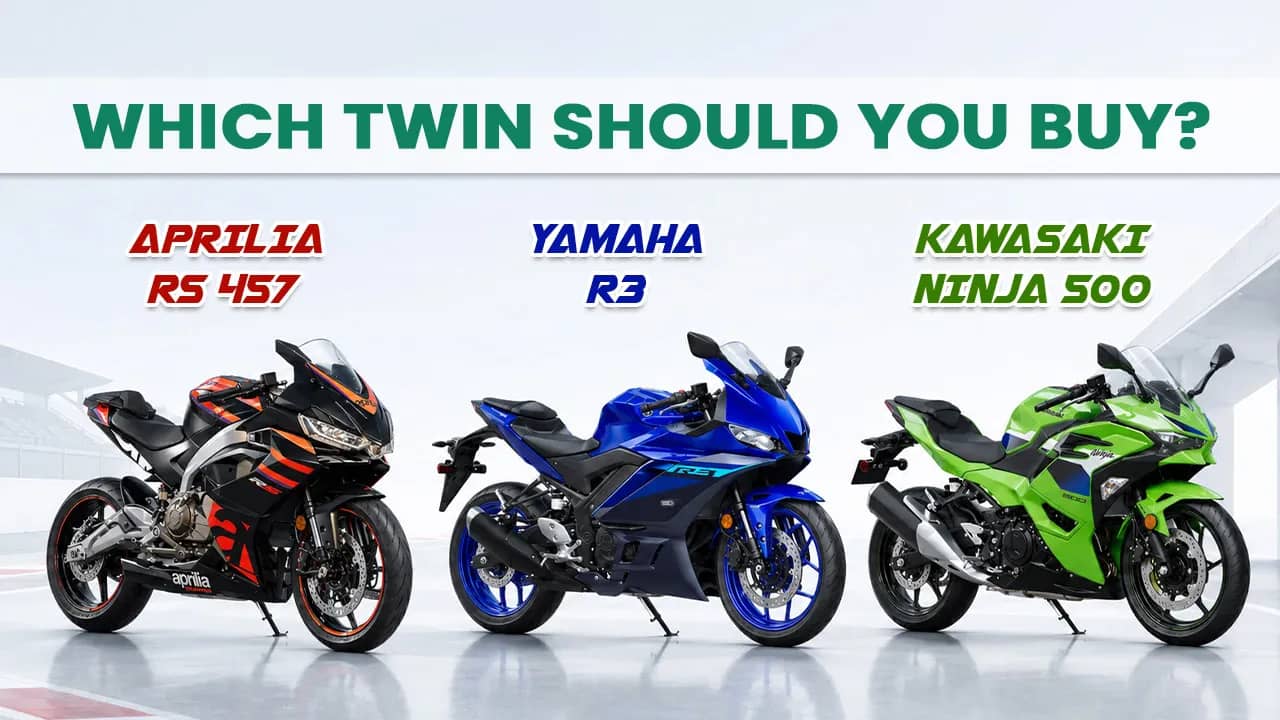
Aprilia RS 457 vs Yamaha R3 vs Kawasaki Ninja 500: Which Twin Should You Buy? brings key updates for two-wheeler buyers in India. The Aprilia RS 457 vs Yamaha R3 vs Kawasaki Ninja 500 question comes up constantly among Indian riders shopping the ₹3.39 lakh to ₹5.76 lakh sport bike bracket
The Aprilia RS 457 vs Yamaha R3 vs Kawasaki Ninja 500 question comes up constantly among Indian riders shopping the ₹3.39 lakh to ₹5.76 lakh sport bike bracket, and the honest answer depends entirely on what you're chasing. The RS 457 is the performance-per-rupee champion at ₹4.22-4.37 lakh ex-showroom, the R3 is the lightest, simplest and now cheapest of the three at ₹3.39 lakh after the recent GST cut on sub-350cc bikes, and the Ninja 500 sits at the top of the pile at ₹5.76 lakh, justified mainly by its bigger 451cc engine and Kawasaki badge. All three are CBU or India-built fully-faired twins, but the price spread between the cheapest and priciest here is nearly ₹2.4 lakh, which is a different motorcycle's worth of difference.
How the engines actually compare on the road
Numbers on a spec sheet rarely tell you how a bike behaves in Delhi traffic at 2pm in May, so here's what matters. The RS 457's 457cc parallel-twin makes 47.6 PS and 43.5 Nm, and it's the only one of the three with a 270-degree crank, which gives it a meatier, more characterful exhaust note and stronger low-rpm pull than its capacity rivals. The Ninja 500's 451cc unit produces 45 PS and 42.6 Nm with a more linear, rev-happy delivery that rewards keeping it spinning rather than short-shifting. The R3 is the outlier at 321cc, 42 PS and just 29.5 Nm — noticeably down on torque, which means more gear changes in stop-go city riding, but it's also the lightest at 169 kg against 175 kg for the Aprilia and 171 kg for the Kawasaki, so it never feels gutless once you're past 6,000 rpm.
Price, on-road cost and EMI breakdown
This is where the gap stops being academic. The RS 457's Delhi on-road price lands close to ₹4.75 lakh once RTO and insurance are added, the R3 comes in around ₹3.85 lakh on-road, and the Ninja 500 crosses ₹6.5 lakh on-road in most metros. Assuming a 20 percent down payment and a 5-year loan at typical two-wheeler finance rates, expect EMIs of roughly ₹7,900-8,000 for the RS 457, around ₹6,400-6,500 for the R3, and close to ₹11,000 for the Ninja 500. That's almost a ₹4,500 monthly gap between the cheapest and most expensive option, which for most buyers in this segment is the difference between affording the bike comfortably and stretching the budget.
| Aprilia RS 457 | Yamaha R3 | Kawasaki Ninja 500 | |
| Engine | 457cc twin, 47.6 PS, 43.5 Nm | 321cc twin, 42 PS, 29.5 Nm | 451cc twin, 45 PS, 42.6 Nm |
| Ex-showroom price | ₹4.22-4.37 lakh | ₹3.39 lakh | ₹5.76 lakh |
| Kerb weight | 175 kg | 169 kg | 171 kg |
| Estimated mileage | ~24 kmpl | ~26 kmpl | ~24 kmpl |
| Monthly fuel cost (900 km) | ~₹3,860 | ~₹3,560 | ~₹3,860 |
City riding, heat and daily usability
None of these are ideal first bikes for someone who only commutes, but if you must, the R3's lighter weight and friendlier low-speed manners make it the easiest to filter through traffic, even though its riding posture is genuinely committed with low clip-ons and rear-set pegs. The RS 457 manages heat reasonably well for a faired twin, though riders in Mumbai and Chennai traffic will still feel radiator warmth on the inner thighs during long signal waits. The Ninja 500 runs the coolest of the three thanks to its more open frame design and is the most forgiving for taller riders, with a seat height that doesn't punish 5'10"+ owners the way some rivals do.
Highway comfort, electronics and braking
On the highway is where the capacity difference actually shows up. The RS 457 and Ninja 500 both cruise at 100-110 kmph with noticeably less strain than the R3, which starts feeling busy past 9,000 rpm on long stretches. The Aprilia pulls ahead on electronics — it's the only one here with switchable traction control, ride-by-wire throttle, three riding modes and an optional bi-directional quickshifter, while both the R3 and Ninja 500 give you nothing beyond dual-channel ABS. Braking hardware is closely matched across all three with disc brakes front and rear, though the RS 457's setup feels the sharpest at speed thanks to its lighter overall package.
Service network, resale and the ownership question
Yamaha and Kawasaki both run mature dealer networks across India built over more than a decade, so parts availability and service turnaround for the R3 and Ninja 500 tend to be more predictable, even though CBU import status keeps spare parts pricier than locally made bikes. Aprilia's after-sales reputation is still being written since the RS 457 is a relatively recent India-made product, and owner forums do flag occasional delays at service centres, though pricing for parts is generally lower given local manufacturing. Resale value currently favours the Ninja 500 and R3 slightly, simply because Kawasaki and Yamaha carry stronger second-hand brand recognition in India than Aprilia does outside enthusiast circles, though that gap is narrowing as the RS 457 racks up more years on Indian roads.
The verdict
If you want the most performance and tech for your rupee, the Aprilia RS 457 is the clear pick — it undercuts the Ninja 500 by over a lakh while matching or beating it on power, electronics and weight. If your priority is the lowest entry cost and a proven, simple Japanese twin with no complications, the Yamaha R3 at ₹3.39 lakh ex-showroom is the sensible choice, especially for riders who'll do more city miles than track days. The Kawasaki Ninja 500 only makes sense if you specifically want the biggest-capacity engine here and the Kawasaki badge matters to you more than value — it's the most expensive bike in this comparison by a wide margin, and you're paying a real premium for it. For weekend canyon runs and the occasional track day, the RS 457's electronics package gives it the edge; for pure highway comfort and bigger-bike feel, the Ninja 500 wins; for budget-conscious buyers who still want a proper faired twin, the R3 remains tough to beat. Check the on-road price and EMI for the Aprilia RS 457, Yamaha R3 and Kawasaki Ninja 500 in your city on Drivio.
The Aprilia RS 457 vs Yamaha R3 vs Kawasaki Ninja 500 question comes up constantly among Indian riders shopping the ₹3.39 lakh to ₹5.76 lakh sport bike bracket, and the honest answer depends entirely on what you're chasing. The RS 457 is the performance-per-rupee champion at ₹4.22-4.37 lakh ex-showroom, the R3 is the lightest, simplest and now cheapest of the three at ₹3.39 lakh after the recent GST cut on sub-350cc bikes, and the Ninja 500 sits at the top of the pile at ₹5.76 lakh, justified mainly by its bigger 451cc engine and Kawasaki badge.