Single-Channel vs Dual-Channel ABS: The Safety Gap Most Riders Never Notice
Overview
Single-Channel vs Dual-Channel ABS: The Safety Gap Most Riders Never Notice brings key updates for two-wheeler buyers in India. The single-channel vs dual-channel ABS debate comes down to one simple question: does your motorcycle protect just the front wheel under hard braking, or both wheels together? Dual-channel ABS works
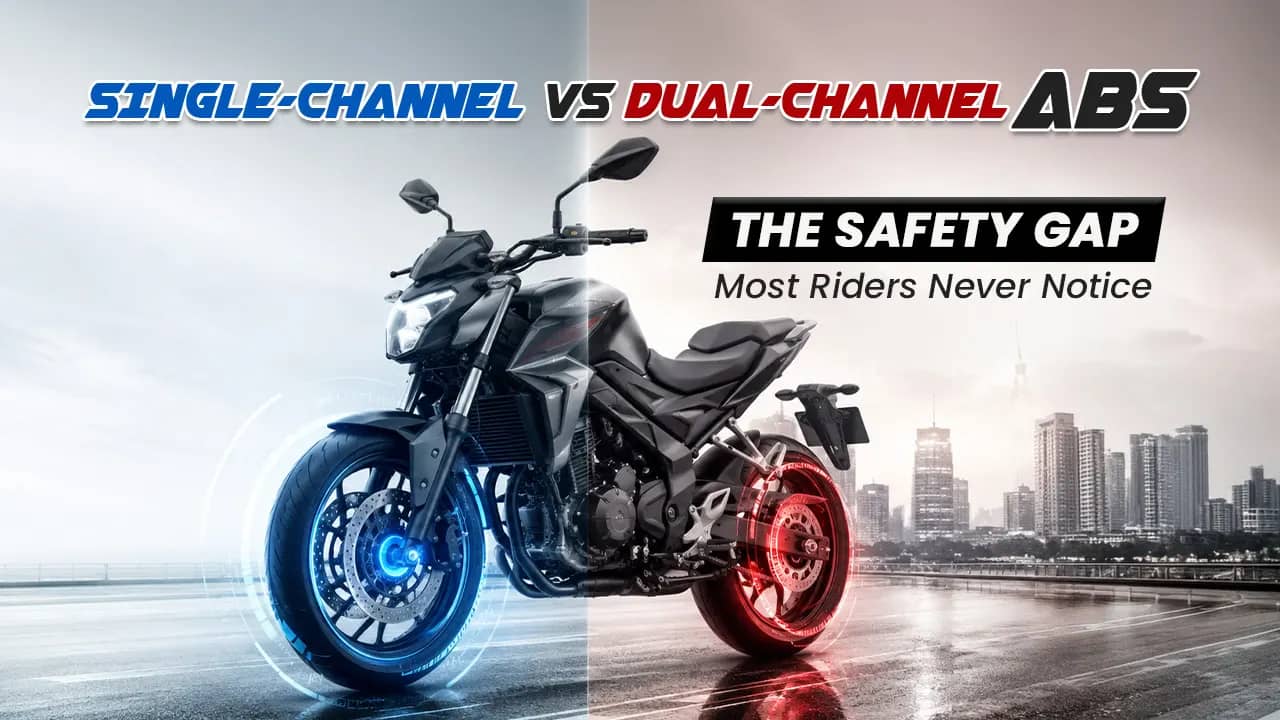
The single-channel vs dual-channel ABS debate comes down to one simple question: does your motorcycle protect just the front wheel under hard braking, or both wheels together? Dual-channel ABS works on the front and rear wheel at the same time, while single-channel ABS usually monitors the front wheel only, leaving the rear wheel without electronic backup. In India, that gap matters the moment a stray dog cuts across a city road, a bus brakes hard ahead of you on a wet flyover, or loose gravel shows up right after a speed breaker. Riders who treat ABS as a checkbox spec often discover its real value only during a panic stop — and by then it's too late to choose the safer system.
How ABS Actually Works on a Motorcycle
Every ABS-equipped bike uses wheel-speed sensors mounted near the front and rear discs to track how fast each wheel is spinning relative to the bike's actual speed. When you brake hard enough that a wheel starts to slow down faster than the motorcycle itself — which is what happens just before it locks up — the ECU and hydraulic modulator step in. The system rapidly releases and reapplies brake pressure several times a second, which is the pulsing you feel through the lever or pedal during a hard stop. This isn't about making the brakes stronger; ABS as a safety feature exists purely to stop wheel lock-up so the rider doesn't lose the front end or have the rear wheel skid sideways.
Single-Channel ABS and Where It Falls Short
Single-channel ABS bikes apply this lock-up protection only to the front wheel, since that's where most of a motorcycle's braking force is generated — typically 70% or more, depending on weight distribution and riding posture. This is genuinely useful protection: a locked front wheel is the single biggest reason riders crash during emergency braking, so front wheel ABS alone already removes the most dangerous failure mode. The catch is the rear wheel, which gets no electronic help. Brake too hard on the rear pedal during a sudden stop in city traffic, and rear wheel lock-up can still kick the back end out, especially on wet tarmac or loose surfaces. Bikes like the entry-level variants of the TVS Apache RTR 160 4V and several commuter motorcycles in this segment use single-channel setups to keep prices accessible, and for mostly low-speed city riding, this remains an acceptable trade-off.
Dual-Channel ABS and Why It Changes the Equation
Dual-channel ABS bikes extend the same lock-up protection to the rear wheel, so both ends of the motorcycle stay controllable under hard braking. This becomes especially valuable in situations a single-channel system can't fully cover: panic braking with a pillion on board, where the extra weight shifts braking dynamics; emergency stops at highway speeds, where rear instability is amplified; and wet flyovers or monsoon city streets, where rear wheel lock-up is far easier to trigger. Motorcycles such as the Bajaj Pulsar NS200 and the KTM 200 Duke pair dual-channel ABS with dual disc brakes on higher trims, giving riders consistent control whether they're filtering through traffic or braking hard from 100kmph on the highway. None of this means the bike stops faster — dual-channel ABS doesn't shorten braking distance on its own. What it does is keep both wheels rolling instead of skidding, which is what actually lets a rider hold a straight line during an emergency stop.
Single-Channel vs Dual-Channel ABS: A Quick Comparison
| Factor | Single-Channel ABS | Dual-Channel ABS |
| Wheel protection | Front wheel only | Front and rear wheel |
| Safety in panic braking | Prevents front lock-up | Prevents lock-up on both wheels |
| Wet road confidence | Moderate | Higher |
| Highway use | Limited reassurance | Better suited |
| Cost | Lower | Higher |
| Best suited for | City commuting, budget bikes | Highway riders, pillion riding, faster bikes |
Which ABS Is Better for Indian Roads?
For pure city commuting — short hops to work, college runs, stop-and-go traffic — single-channel ABS bikes cover the most common emergency: a sudden traffic cut forcing a hard front brake. Most riders in this category rarely cross 80kmph, and the cost saving on a budget motorcycle is real money that matters when on-road price calculations already include insurance, RTO charges, and handling fees. A bike priced at ₹1.60 lakh ex-showroom can cross ₹1.85 lakh on-road in Delhi or Mumbai once these are added, so every spec choice has a direct EMI impact.
The picture changes for anyone doing regular highway stretches, riding through the monsoon, or routinely carrying a pillion. Here, rear wheel lock-up becomes a real risk during sudden braking from higher speeds, and the single-channel vs dual-channel ABS decision stops being about budget and starts being about control. A highway rider braking hard at 100kmph with a pillion is exposed to exactly the scenario dual-channel ABS is built for. Motorcycles like the Yamaha MT-15 and the Royal Enfield Hunter 350 in their dual-channel variants are popular precisely with this rider profile — people who want one bike for both daily commuting and occasional long rides.
Matching the System to the Rider
A college student riding 15km a day in city traffic doesn't need the same braking setup as a working professional doing a 200km weekend ride to the hills. Commuter riders and budget-conscious buyers can reasonably stick with single-channel ABS and still get genuine protection against the most common crash cause. Highway riders, pillion riders, and anyone shopping in the performance segment above 150cc should treat dual-channel ABS as close to non-negotiable, since the cost difference is usually a few thousand rupees against a meaningfully safer braking setup. It's also worth remembering that no ABS system defeats physics — worn tyres, poor braking technique, and a bad road surface still affect stopping distance regardless of which system is fitted. Some adventure-focused dual-channel bikes even let riders switch off rear ABS for off-road use, where a controlled rear slide is sometimes preferable to a fully electronic intervention, though this remains a niche use case for most Indian buyers.
By June 2026, motorcycle ABS in India has stopped being a premium add-on and become close to standard across most motorcycle segments above 125cc, with petrol prices hovering around ₹103/litre adding further weight to getting the ownership math right before committing to a model. Choose single-channel ABS only if your budget is tight and your riding stays mostly within city limits at moderate speeds. Choose dual-channel ABS if your bike is powerful, sees highway use, gets ridden in the rain, or regularly carries a pillion. If you are comparing bikes like the Pulsar NS200, Apache RTR 160 4V or Yamaha MT-15, check the on-road price and EMI for your shortlisted bike in your city on Drivio.
The single-channel vs dual-channel ABS debate comes down to one simple question: does your motorcycle protect just the front wheel under hard braking, or both wheels together? Dual-channel ABS works on the front and rear wheel at the same time, while single-channel ABS usually monitors the front wheel only, leaving the rear wheel without electronic backup.