Royal Enfield Sherpa 450 Engine: Specs, Performance and Why It Matters
Overview
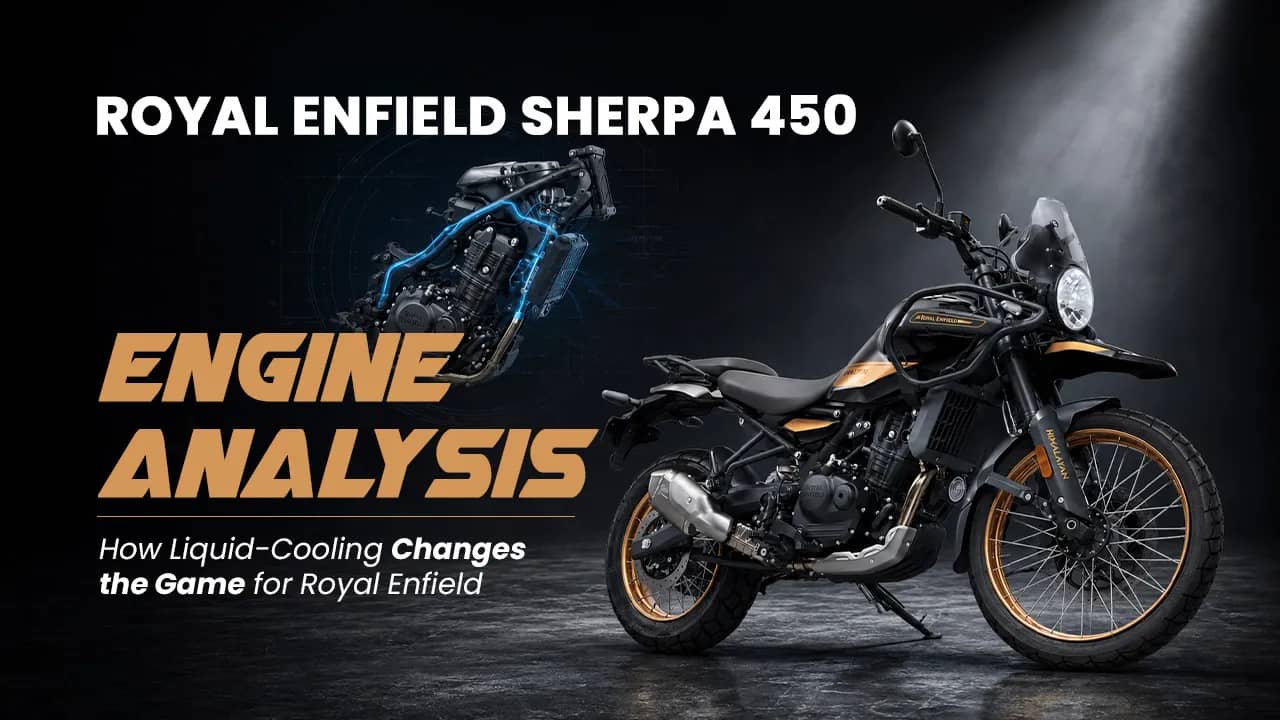
Royal Enfield Sherpa 450 Engine: Specs, Performance and Why It Matters brings key updates for two-wheeler buyers in India. The Royal Enfield Sherpa 450 engine marks the most significant mechanical shift the Chennai-based manufacturer has made in decades of building single-cylinder motorcycles, and it's the reason the new-generation Himalayan
The Royal Enfield Sherpa 450 engine marks the most significant mechanical shift the Chennai-based manufacturer has made in decades of building single-cylinder motorcycles, and it's the reason the new-generation Himalayan 450 rides nothing like an Enfield used to. This is Royal Enfield's first modern liquid-cooled single, and it sits at the heart of a bike that has quietly rewritten what an Enfield can do on Indian roads. In India, the Himalayan 450 is priced between ₹3.05 lakh and ₹3.37 lakh ex-showroom across its variants, which works out to roughly ₹3.45 lakh to ₹3.90 lakh on-road in Delhi and ₹3.65 lakh to ₹4 lakh on-road in Mumbai once RTO and insurance are added. That's a real jump over the outgoing Himalayan 411, but the engine underneath is what makes riders willing to pay it.
Royal Enfield Sherpa 450 Engine: Why This Motor Matters in India
For a brand built on the reputation of air-cooled thumpers, switching to liquid cooling wasn't a cosmetic update — it was a rebuild from the crankcase up. The Sherpa 450 replaces the long-serving LS410 unit and brings Royal Enfield into territory previously occupied by KTM, Triumph and Honda's small-capacity adventure bikes. For Indian riders, that matters because the old air/oil-cooled formula struggled the moment traffic, altitude or distance stacked up against it. The Sherpa 450 was built specifically to handle Indian conditions: stop-start city commutes, long highway stretches, and the kind of mountain climbs that cook an engine if it isn't managed properly.
Where the Himalayan 450 Engine Fits in RE's Lineup
The Sherpa 450 isn't a one-off. It now powers the Himalayan 450 and has already been adapted for the Guerrilla 450, signaling that Royal Enfield intends to build its next generation of mid-size motorcycles around this same liquid-cooled architecture rather than treating it as a special case.
How Liquid-Cooling Changes Royal Enfield's Traditional Formula
Heat management is the real story here. Air-cooled and air/oil-cooled engines rely on airflow and a finite amount of oil circulation to shed heat, which works fine at sustained speed but falls apart in Delhi or Bengaluru traffic where the bike barely moves for long stretches. Liquid cooling in motorcycles solves this by circulating coolant through a radiator that keeps cylinder temperatures stable regardless of road speed. On the Himalayan 450, that translates to less heat radiating into the rider's legs during a traffic jam, more consistent power delivery on a hill climb, and far less risk of the engine running hot on a long Ladakh or Spiti run. The older Himalayan 411's engine, in contrast, could feel strained on sustained highway stretches and showed its limits once altitude or heat entered the equation.
Sherpa 450 Engine Specs and Real-World Performance
The numbers explain why this engine feels like a different animal. It's a 452cc single-cylinder, liquid-cooled, DOHC engine producing 39.47 bhp (40 PS) at 8,000 rpm and 40 Nm of torque at 5,500 rpm, paired with a 6-speed gearbox and a slip-and-assist clutch that lightens the clutch lever and smooths out aggressive downshifts. Royal Enfield has also given it ride-by-wire throttle with Eco and Performance ride modes, the former softening response for city use and fuel efficiency, the latter unlocking the engine's full character. On the road, the Sherpa 450 revs out further and pulls harder through the mid-range than any previous RE single, with enough top-end to make 100-110 kmph cruising feel relaxed rather than strained — something the old Himalayan struggled with on flat highway stretches.
How It Compares With Himalayan 411, KTM 390 Adventure and Triumph Scrambler 400 X
Against the Himalayan 411's old engine — roughly 24-25 bhp and around 32 Nm from an air/oil-cooled design — the Sherpa 450's jump in power, refinement, cooling and gearbox quality isn't a minor update, it's a generational leap. Highway ability alone separates the two bikes by a wide margin. The comparison against rivals is more nuanced after 2026's GST-driven engine downsizing across the segment. The KTM 390 Adventure's base variant now runs a smaller 349cc engine (41.5 PS, 33.5 Nm) to stay in a lower tax bracket, with the older, sharper 399cc unit reserved for the Adventure X and R trims. The Triumph Scrambler 400 X went through the same downsizing, dropping from its 398cc engine to a 349cc unit producing around 36.5 bhp. Both rivals still feel quicker and more eager to rev than the Sherpa 450, which trades outright aggression for a broader, more adventure-focused spread of power. The Sherpa 450 isn't trying to out-sprint KTM's engine — it's built for sustained range, load-carrying and rough-road tractability instead.
Mileage, Fuel Cost and Ownership Relevance
Real-world mileage on the Sherpa 450 typically falls between 28 and 32 kmpl, depending on whether you're riding in Eco or Performance mode and how much city traffic versus highway riding you're doing. With petrol around ₹103 per litre in most Indian cities, someone covering 1,000 km a month would spend somewhere between ₹3,200 and ₹3,700 on fuel, depending on which end of that mileage range they land on. That's a reasonable number for a bike in this performance bracket, though it's worth setting expectations: refinement at idle, long-term heat feel in stop-go traffic, and service costs tied to a liquid-cooling system are all things that matter more to owners three years in than they do on a test ride.
Verdict: Is the Sherpa 450 Engine the Right Direction for Royal Enfield?
The Sherpa 450 is the right call for Royal Enfield, and it's not a flawless one. Riders upgrading from a Himalayan 411 or any older RE single will feel an immediate, obvious improvement in highway composure, cooling and outright usability. Riders coming from a KTM 390 Adventure or Triumph Scrambler 400 X looking for outright punch should know the Sherpa 450 isn't chasing that character — it's built for range and rideability over raw aggression, and that's a fair trade for most adventure-touring buyers in India. Anyone cross-shopping this segment should also look at Drivio's detailed Himalayan 450 coverage and our KTM 390 Adventure breakdown for a fuller picture before deciding. Check the on-road price and EMI for the Royal Enfield Himalayan 450 in your city on Drivio.
The Royal Enfield Sherpa 450 engine marks the most significant mechanical shift the Chennai-based manufacturer has made in decades of building single-cylinder motorcycles, and it's the reason the new-generation Himalayan 450 rides nothing like an Enfield used to. This is Royal Enfield's first modern liquid-cooled single, and it sits at the heart of a bike that has quietly rewritten what an Enfield can do on Indian roads.
Related Blogs of Featured Stories


Related Bikes in India

₹4.13 L* Onwards

₹4.00 L* Onwards

₹2.10 L* Onwards

₹1.66 L* Onwards

₹1.75 L* Onwards

₹3.53 L* Onwards