Bajaj Freedom CNG Sales Crash: What's Actually Going Wrong in 2026
Overview
Bajaj Freedom CNG Sales Crash: What's Actually Going Wrong in 2026 details recent electric two-wheeler market trends, highlighting monthly registration growth figures, shifting brand market shares, and key adoption milestones across the Indian EV industry.
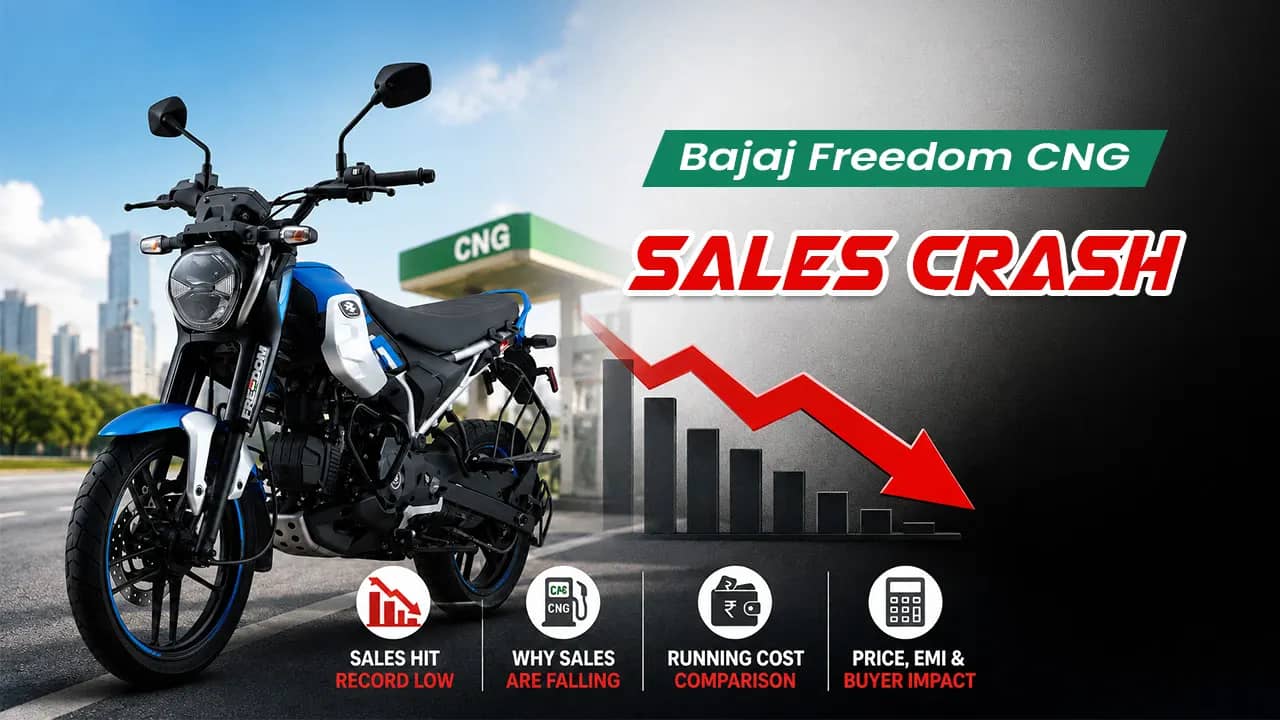
The Bajaj Freedom CNG sales crash has turned India's most talked-about two-wheeler launch of 2024 into one of its most closely watched sales slumps of 2026. Retail numbers on the Vahan portal show just 1,210 units sold in May 2026, the lowest since the bike went on sale, and a steep fall from the 12,167 units it moved at its festive peak in November 2025. Priced between roughly ₹95,000 and ₹1,10,000 ex-showroom depending on variant, the Freedom 125 was pitched as the bike that would make CNG mainstream for Indian commuters. Two years in, the numbers say otherwise.
How Bad Is the Bajaj Freedom CNG Sales Crash, Really?
Put the figures side by side and the drop is hard to argue with. Bajaj Auto's own launch-year run saw the Freedom 125 cross 40,000 cumulative units within six months, riding a wave of curiosity and over 30,000 pre-launch enquiries. Cumulative retail sales now stand near 87,998 units as of early June 2026 — respectable for a genuinely new fuel category, but a long way short of the trajectory those early months suggested. Maharashtra and Gujarat, the two states where CNG infrastructure was already dense before launch, still account for roughly a third of all sales between them. That concentration is itself a clue: outside strong CNG-pump states, the Freedom 125 has never really taken off the way Bajaj hoped.
Why Bajaj Freedom CNG Sales Are Falling — The Real Reason
Bajaj Auto's own leadership has been candid about this. Joint managing director Rakesh Sharma told analysts in May that the price gap between CNG and petrol had "changed to some extent," and that's an understatement. When the Freedom 125 launched in July 2024, CNG cost around ₹75 a kilogram against petrol at roughly ₹107 a litre — a ₹32 gap that made the running-cost pitch almost impossible to ignore. By May 2026, CNG had climbed to about ₹86 a kilogram while petrol in Mumbai touched ₹111.21, shrinking that gap to roughly ₹25. A 15 percent rise in CNG prices over 23 months has quietly eaten into the one advantage this bike was built around.
It isn't only pricing. CNG pump density is still far behind petrol's, and riders switching fuels for the first time have to relearn refuelling habits and hunt for stations that aren't always on their daily route. Add to this a market that's shifted hard toward electric two-wheelers — up 63 percent year-on-year in May 2026 — and newer flex-fuel petrol bikes like Hero's Splendor+ and HF Deluxe, both priced over ₹25,000 below the Freedom 125 and compatible with ethanol blends without needing new infrastructure at all. The Freedom 125 is being squeezed from both the cheap-petrol side and the electric side at once.
Specs, Price and Range: What You're Actually Buying
Underneath the sales story is a genuinely well-engineered commuter. The Freedom 125 runs a 125cc air-cooled single making 9.5 hp and 9.7 Nm, paired to a five-speed gearbox, with a factory-fitted CNG cylinder backed by a 2-litre petrol reserve tank for when CNG runs dry. Combined range across both fuels stretches to around 330 km, and Bajaj's own tests put city mileage near 94-100 km/kg on CNG — genuinely strong numbers on paper. The bike also carries the distinction of being the world's first ground-up CNG motorcycle, not a retrofitted one, which matters for long-term reliability and insurance classification.
CNG vs Petrol: The Real Monthly Running Cost for a Delhi or Mumbai Rider
Here's where the numbers matter more than the headline crash. A rider covering around 900 km a month on the Freedom 125's CNG mode, at roughly 94 km/kg and ₹86 a kilogram, spends close to ₹823 on fuel. A comparable petrol commuter — say a Hero Splendor Plus or TVS Radeon doing about 60 kmpl at ₹103 a litre — would burn through roughly ₹1,545 for the same distance. That's still a saving of around ₹700 a month for the Freedom rider, which sounds meaningful until you factor in the higher upfront price and the time cost of hunting for a CNG pump on a bad day. The saving is real, but it's roughly half of what it was at launch, and that shrinking gap is precisely what's showing up in the sales charts.
EMI, Down Payment and Whether the Freedom 125 Still Makes Financial Sense
On-road pricing in Delhi or Mumbai for the Freedom 125 typically lands between ₹1.15 lakh and ₹1.25 lakh after registration and insurance, against ₹85,000-95,000 on-road for rivals like the Honda Shine 100 or Bajaj Platina 110. On a typical 20 percent down payment and a three-year loan at around 12 percent interest, EMIs on the Freedom 125 work out to roughly ₹3,000-3,300 a month. That's a few hundred rupees more than financing a straight petrol commuter, and buyers now have to ask whether a ₹700 monthly fuel saving justifies that gap — a calculation that looked far easier to answer in 2024 than it does today.
Should You Buy, Wait, or Choose a Petrol Alternative?
If you're a daily office commuter or delivery rider in Mumbai, Pune, Ahmedabad, or another city with dense CNG infrastructure, the Freedom 125 still makes sense financially over a three-to-four-year ownership period, even with the narrower savings margin. If you live somewhere with patchy CNG availability, or you value convenience over marginal fuel savings, a flex-fuel or standard petrol commuter will serve you better right now without the refuelling hassle. Existing owners have little to worry about mechanically — Bajaj has stood by the product and continues investing in it — but resale value is worth watching closely as the used-CNG-bike market is still thin. For most first-time buyers on the fence, waiting a few months to see whether CNG pricing stabilises isn't unreasonable.
Check the on-road price and EMI for the Bajaj Freedom CNG in your city on Drivio.
The Bajaj Freedom CNG sales crash has turned India's most talked-about two-wheeler launch of 2024 into one of its most closely watched sales slumps of 2026. Retail numbers on the Vahan portal show just 1,210 units sold in May 2026, the lowest since the bike went on sale, and a steep fall from the 12,167 units it moved at its festive peak in November 2025.