New Delhi


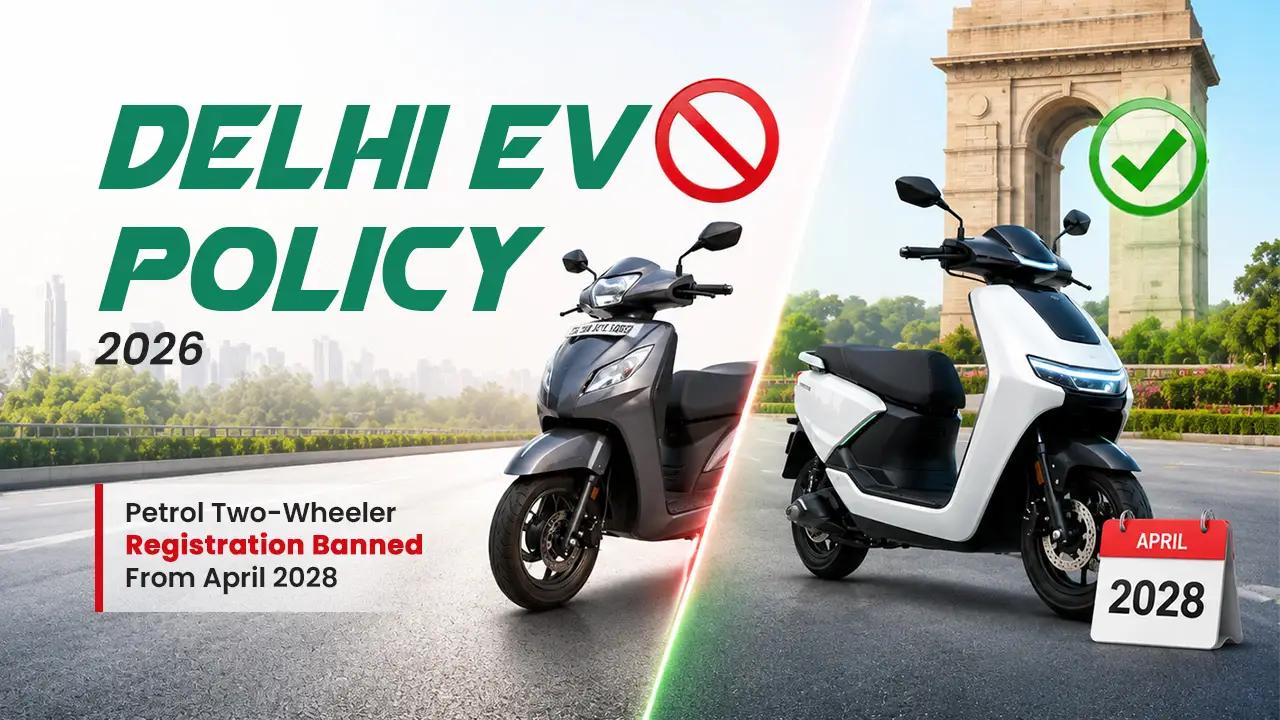

Delhi EV Policy 2026: Petrol Two-Wheeler Registration Banned From April 2028 — Full Breakdown
Featured Stories by Drivio | 4 Jul 2026
Delhi EV Policy 2026 has confirmed that no new petrol-powered motorcycle or scooter can be registered in the national capital from April 1, 2028. The Delhi Cabinet cleared the policy this week, and it comes into force from July 1, 2026, running until March 2030. If you ride a petrol two-wheeler in Delhi or are planning to buy one, the immediate question isn't whether EVs are the future — it's what this registration cutoff actually means for you, your existing bike, and your next purchase decision.
What The Petrol Two-Wheeler Ban Actually Covers
The word "ban" gets thrown around loosely, so it's worth being precise. From April 1, 2028, the Delhi transport department will stop issuing new registrations for petrol and CNG motorcycles and scooters. After that date, only electric two-wheelers will be eligible for fresh registration in Delhi. This is a registration ban, not a road-use ban — a distinction that changes everything for someone who already owns a bike.
Existing petrol two-wheelers already registered in Delhi are not affected. You can keep riding your Activa, Splendor or Pulsar as long as it's roadworthy and passes the usual pollution and fitness checks. The government has been explicit that the rule is prospective, not retrospective — nobody's existing vehicle gets deregistered or forced off the road because of this policy. Even used petrol two-wheeler sales within Delhi should continue, since resale doesn't count as a new registration, though buyers should track how the used market values petrol bikes as 2028 approaches.
Who This Actually Changes Things For
The bigger shift is for dealers, fleet operators and anyone buying a two-wheeler for the first time after the deadline. Delhi is also phasing out new petrol and CNG three-wheeler registrations from January 1, 2027, which suggests commercial and delivery fleets are the government's primary pressure point before the two-wheeler deadline lands. If you run a delivery fleet or manage staff transport on two-wheelers, replacement cycles need to be planned around April 2028, not after it.
Subsidy Structure Under EV Policy 2026
To soften the transition, the policy backs a purchase subsidy for electric two-wheelers priced under ₹2.25 lakh ex-showroom. Buyers get ₹10,000 per kWh of battery capacity in the first year, capped at ₹30,000. That drops to ₹6,600 per kWh (max ₹20,000) in year two, and ₹3,300 per kWh (max ₹10,000) in year three. There's also a separate ₹10,000 scrappage incentive if you trade in a BS-IV or older petrol two-wheeler for an electric one. All payouts route through Direct Benefit Transfer, and electric two-wheelers get a full road tax and registration fee waiver through the policy period.
That front-loaded subsidy structure is deliberate — it rewards buyers who switch early rather than waiting until the 2028 deadline forces the issue. If EV scooter finance is on your radar, the math genuinely favours moving sooner rather than later, since the subsidy shrinks every year the policy runs.
Petrol Vs Electric Scooter Cost In Delhi, Post-Policy
Here's where the decision gets concrete. Petrol in Delhi runs around ₹103/litre. A typical petrol scooter returning 50 kmpl costs roughly ₹2.06 per km to run. An electric scooter, charged at home on a standard domestic tariff, generally works out to somewhere between 30 and 40 paise per km depending on battery efficiency — a gap of nearly six times per kilometre.
For a Delhi commuter covering 30 km a day, that's the difference between spending around ₹1,850 a month on petrol versus roughly ₹300–₹400 a month on electricity. Over three years of daily commuting, that gap alone can exceed ₹50,000 — before accounting for the lower service costs EVs typically carry, since they skip engine oil changes and have fewer moving parts.
On upfront price, petrol scooters in Delhi still undercut electric ones before subsidy — a 110cc petrol scooter typically lands between ₹75,000 and ₹95,000 on-road, while a comparable electric scooter sits between ₹1 lakh and ₹1.3 lakh before incentives. Factor in the ₹30,000 first-year subsidy plus the road tax waiver, and the effective on-road price gap narrows to roughly ₹15,000–₹20,000 — a difference that a 12-month EMI on a two-wheeler loan can largely absorb.
| Factor | Petrol Scooter | Electric Scooter (Yr 1 subsidy) |
| On-road price | ₹75,000–₹95,000 | ₹70,000–₹1 lakh (post-subsidy) |
| Running cost/km | ~₹2.06 | ~₹0.30–0.40 |
| Monthly cost (30 km/day) | ~₹1,850 | ~₹300–400 |
| Registration after Apr 2028 | Not permitted (new) | Permitted |
What Should Delhi Buyers Actually Do
If you already own a petrol two-wheeler, there's no reason to panic-sell it. It stays legal, insurable and usable well past 2028. The calculation changes only if you're buying new. Through 2026 and 2027, a petrol two-wheeler remains a completely valid choice if EV charging near your home or office is inconvenient — plenty of Delhi apartment complexes still don't have dedicated charging points, and that infrastructure gap is real, not hypothetical.
But if you're a high-mileage rider, especially someone doing daily commutes over 20-25 km, the fuel savings alone justify checking EV scooter EMI options now rather than waiting. The subsidy is highest in year one and drops every year after, so the financial case for switching only gets weaker the longer you wait — the opposite of how most people assume policy deadlines work. Anyone planning to keep a two-wheeler for five-plus years should also weigh resale value: a petrol scooter bought in 2027 will be competing against a shrinking population of new petrol buyers by the time you go to sell it.
Delhi is the first Indian state to put a hard registration deadline on petrol two-wheelers, and other states — Karnataka and Maharashtra have both floated similar EV-first frameworks — are watching how this rolls out before committing to their own timelines. For now, the rule is clear, the incentives are real, and the deadline is fixed. Check the on-road price and EMI for electric scooters and petrol two-wheelers in your city on Drivio.