New Delhi


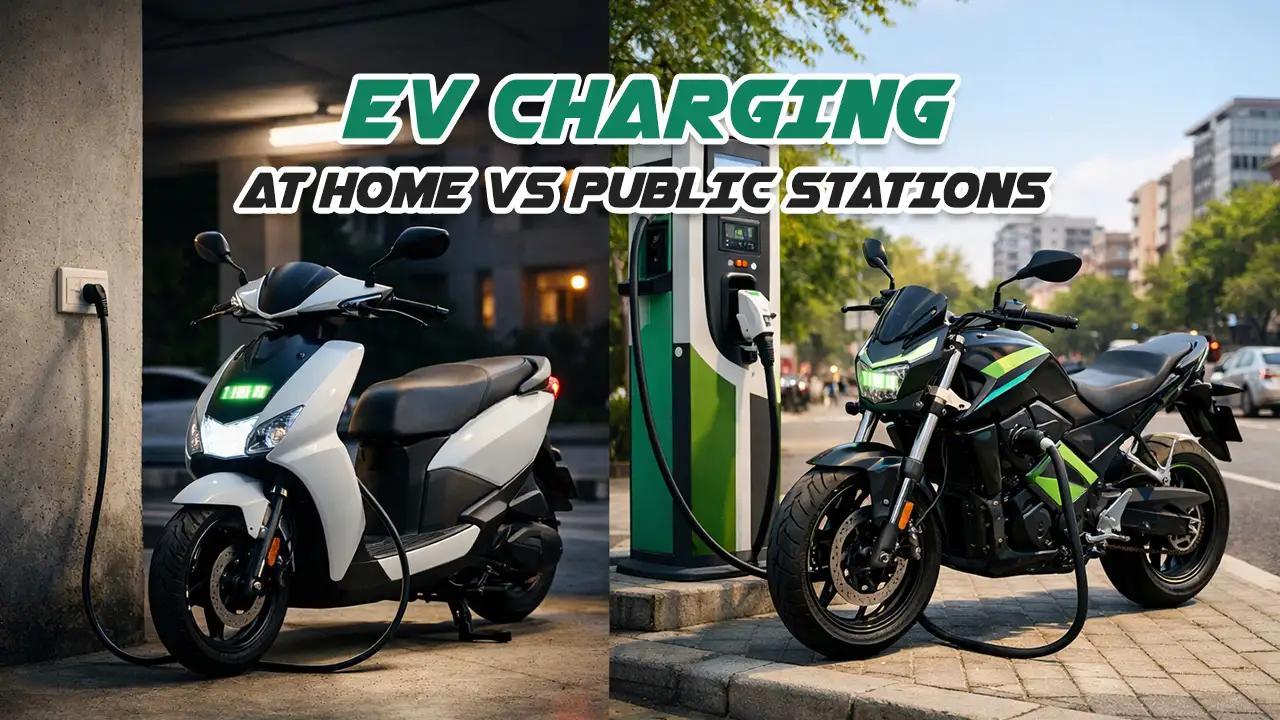

Ev Charging At Home Vs Public Stations For Electric Two-wheelers (india 2026)
Featured Stories by Drivio | 7 Feb 2026
For electric two-wheelers in India, the debate around EV charging at home vs. public stations is about daily convenience versus emergency flexibility. In 2026, home charging remains the most economical and practical solution for electric scooters and bikes, costing around Rs. 0.40 to Rs. 0.70 per km. Public charging stations, where available, cost between Rs. 1.20 and Rs. 1.50 per km.
The verdict is simple: home charging is the backbone of EV two-wheeler ownership, while public chargers act as support infrastructure for longer rides, commercial usage, or range anxiety situations.
The EV Two-Wheeler Landscape in India (2026)
India’s electric two-wheeler ecosystem in 2026 is shaped by the PM E-DRIVE (PM Electric Drive Revolution in Innovative Vehicle Enhancement) scheme, which focuses heavily on EV adoption and charging infrastructure. While public charging is primarily designed for four-wheelers, over 29,000 public charging points now support two-wheelers either through standard AC sockets or dedicated low-power connectors.
With de-licensing of charging stations and reduced benchmark prices for chargers (cut by up to 28% in early 2026), private players and fuel stations have begun integrating EV two-wheeler-friendly charging points. For scooter and bike users, this means easier access—but home charging still dominates daily usage.
Battery, Range & Performance (Two-Wheeler Focus)
Charging efficiency for electric scooters and bikes depends on battery size, chemistry, and charger type.
Battery: Most electric two-wheelers in 2026 use Lithium Iron Phosphate (LFP) batteries due to better thermal stability and longer life in Indian weather conditions. These batteries usually carry IP67-rated protection against dust and water.
Typical Battery Capacity: • Electric Scooters: 2.5 kWh – 4.0 kWh • Electric Motorcycles: 4.0 kWh – 6.0 kWh
Range: Real-world riding conditions significantly affect range.
IDC Claimed Range: • Scooters: 120 – 160 km • Electric Bikes: 150 – 200 km
Real-World Range: • City Mode: 90 – 120 km (scooters), 110 – 150 km (bikes) • Sport Mode with pillion & AC-equivalent loads: 70 – 100 km
Motor Performance: Most premium EV two-wheelers deliver: • Power: 6 kW – 12 kW • Torque: 22 Nm – 40 Nm • Top Speed: 80 – 120 km/h
Charging Types:
Home Charging (AC): Uses a standard 5A or 15A household socket or a dedicated wall charger (0.8 kW – 1.5 kW). A full charge takes 4 to 6 hours and is the safest method for battery longevity.
Public Charging: Primarily AC-based for two-wheelers (2 kW – 3.3 kW). DC fast charging is still rare for two-wheelers and mainly limited to fleet or swapping ecosystems. Frequent fast charging can increase battery degradation by around 10–12% over five years.
Detailed Cost & Charging Comparison Table
Parameter | Home Charging (AC) | Public Charging
Setup / Usage Cost | Rs. 0 – Rs. 5,000 (one-time) | Rs. 12 – Rs. 20 per kWh
Electricity Rate | Rs. 6 – Rs. 9 per unit | Rs. 12 – Rs. 20 per unit
Cost per km | Rs. 0.40 – Rs. 0.70 | Rs. 1.20 – Rs. 1.50
Charging Time (0–100%) | 4 – 6 hours | 1.5 – 3 hours
Battery Impact | Minimal degradation | Moderate heat stress
Warranty Impact | Fully compliant | Excessive fast charging may affect claims
PM E-DRIVE Benefit | Indirect | Infrastructure-focused subsidy
Features & Charging Technology (2026)
Charging technology for EV two-wheelers has matured rapidly. Smart home chargers now offer scheduled charging, auto cut-off, surge protection, and mobile app monitoring. Many state electricity boards provide lower night-time tariffs between 11 PM and 6 AM.
Public chargers increasingly support QR-based payments, real-time availability tracking, and CMS (Charging Management Systems). Battery swapping networks have also expanded, especially for delivery riders and commercial scooter fleets.
Real-World Ownership Experience
For most Indian riders, EV two-wheelers are charged overnight at home. Regenerative braking in city traffic can improve range by 8–12%, especially in scooters.
Monthly Cost Example: If you ride 1,200 km per month: • Home charging cost: Rs. 500 – Rs. 850 • Public charging only: Rs. 1,500 – Rs. 1,800
Home charging requires proper earthing and surge protection, particularly during monsoons. OEM-supported chargers and authorized installation significantly reduce long-term issues.
Pros and Cons
Pros of Home Charging: • Lowest possible running cost • Charge overnight with zero effort • Better battery life due to slow charging • No dependency on public infrastructure
Cons of Home Charging: • Needs dedicated parking or power access • Not useful for emergency top-ups outside home
Pros of Public Charging: • Useful for long rides and commercial use • Backup option when home charging is unavailable • Expanding rapidly in urban areas
Cons of Public Charging: • Higher cost per km • Limited two-wheeler-specific fast chargers • Waiting time and availability issues
Final Verdict (Two-Wheeler Buyers)
For electric scooters and bikes in India, charging at home is not optional—it is essential. To achieve the promised ultra-low running cost of under Rs. 1 per km, home charging should cover at least 85–90% of your usage.
Public charging should be treated as a secondary option for flexibility, long-distance rides, or commercial needs. Relying entirely on public charging can increase costs and reduce battery health over time.
For the average Indian EV two-wheeler owner in 2026, the ideal approach follows the 90/10 rule: 90% home charging for savings and battery life, 10% public charging for convenience and peace of mind.