EV Scooter Catches Fire: What Actually Happens — And Is It More Dangerous Than Petrol?
Overview
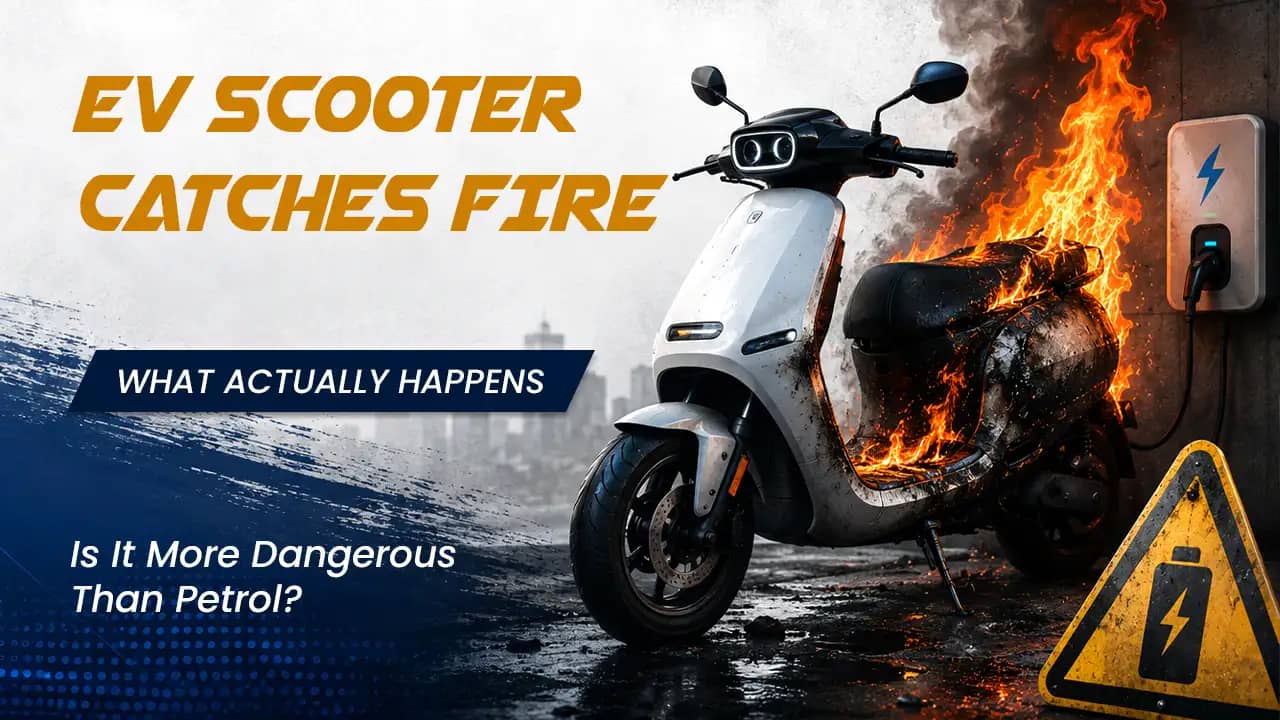
EV Scooter Catches Fire: What Actually Happens — And Is It More Dangerous Than Petrol? brings key updates for two-wheeler buyers in India. An EV scooter catches fire differently from a petrol scooter — and understanding that difference could matter more than any spec sheet before you buy one. In India's EV market,
An EV scooter catches fire differently from a petrol scooter — and understanding that difference could matter more than any spec sheet before you buy one. In India's EV market, which crossed 2 million two-wheeler sales by early 2026, fire incidents have triggered genuine anxiety among apartment dwellers, first-time buyers, and fleet operators alike. Whether you're charging an Ola S1 Pro in a Mumbai basement or parking an Ather 450X through a Delhi summer, the question isn't just theoretical. It's a real ownership concern.
Why Electric Scooters Catch Fire
The short answer is chemistry. Lithium-ion cells store enormous amounts of energy in a compact space, and when that energy escapes uncontrollably, the result is what engineers call thermal runaway — a self-sustaining chain reaction where rising heat triggers more heat, until the battery vents, ignites, and in worst cases, explodes.
Thermal runaway typically starts from one of three triggers: mechanical damage to cells (from a crash or road debris), overcharging due to a faulty or aftermarket charger, or internal cell degradation — particularly in battery packs that use substandard cells or lack adequate battery management system (BMS) protection. The BMS is the brain of the battery; it monitors voltage, temperature, and charge state across every cell. When it fails or is bypassed — as happens with cheap third-party chargers and extension cords — the risk increases sharply.
In Indian conditions, the triggers are even more specific. Charging overnight on an overloaded domestic circuit using a thin extension cord is common across urban apartments. Batteries exposed to peak summer temperatures — 45–48°C in Delhi and Rajasthan — experience accelerated degradation if the scooter lacks active thermal management. The TVS iQube and Bajaj Chetak have both invested in enclosed battery architecture partly for this reason, but the wider market still carries lower-specification packs from smaller manufacturers.
What Physically Happens When a Lithium Battery Ignites
The sequence is fast and toxic. Cells begin venting — releasing flammable gases like hydrogen and methane before any visible fire appears. This venting phase can last seconds to minutes. Once ignition occurs, the fire burns at temperatures exceeding 600°C and releases hydrogen fluoride and other toxic fumes, which are far more immediately dangerous than the flames themselves. The chain reaction spreads cell-to-cell through the pack, making suppression extremely difficult once fully involved.
Water is not useless on a lithium fire — contrary to popular belief — but it must be applied in large volumes continuously to cool the cells. A standard fire extinguisher will suppress visible flames temporarily but rarely stops thermal runaway from spreading internally. Indian fire departments are increasingly trained for this, but response times in dense residential areas remain a critical variable.
The advised evacuation distance for a fully burning EV scooter is at least 15 metres. Do not attempt to move the scooter once smoke or heat is visible. Leave the area, call emergency services, and alert neighbouring parking bays. These are not panic responses — they are the appropriate ones.
Are EV Scooters More Dangerous Than Petrol Scooters?
This is the comparison most buyers are silently making, and the data — where it exists — is less alarming than viral videos suggest. Reported EV fire incidents remain relatively rare compared to total electric two-wheeler sales in India, and petrol scooters have their own well-documented fire history that rarely trends on social media.
A petrol scooter fire usually originates from fuel leaks near hot engine components, crash damage rupturing the fuel tank, or carburettor overflow near ignition sources. These fires ignite quickly — petrol vapour has a very low flash point — but they also burn out faster and respond to conventional fire suppression immediately. The explosion risk in a petrol scooter comes primarily from the tank in a post-crash scenario, not from parking or charging.
The key difference is where in the ownership cycle the risk is highest. Petrol fires are almost exclusively crash-related or maintenance-neglect related. EV battery fires have an additional risk window: stationary charging, particularly overnight and unattended. That distinction matters in apartment buildings where residents share basement parking and single-phase wiring is already at capacity during summer.
Neither vehicle type is categorically more dangerous. They carry different risk profiles across different scenarios.
What Reputable Manufacturers Are Doing About It
The better-known brands have moved aggressively on battery safety since the incident clusters of 2022–23 prompted government intervention. AIS-156, India's battery safety standard for electric vehicles, mandates specific thermal stability, vibration resistance, and short-circuit protection requirements. Most established manufacturers now comply — or are in the process of full compliance.
Several manufacturers have shifted to LFP (lithium iron phosphate) chemistry, which is inherently more thermally stable than the older NMC formulations. LFP cells are harder to push into thermal runaway and don't release oxygen during decomposition the way NMC does, which significantly reduces fire intensity. The trade-off is lower energy density — meaning slightly heavier packs for the same range — but most buyers will accept that.
Battery isolation systems, which physically disconnect the pack from all circuits during a detected fault, are now standard on premium scooters. IP67 water resistance ratings — a topic Drivio has covered extensively in real-world monsoon tests — also matter here: water ingress into cells or BMS electronics is a genuine ignition trigger during Mumbai's flooding events, and unsealed connectors remain a weakness in entry-level offerings.
Battery warranties have become a meaningful market differentiator as a result of these concerns. Eight-year or 80,000-kilometre warranties, now offered by several manufacturers, implicitly signal confidence in pack longevity — and most cover thermal damage under abnormal charging conditions.
Insurance, Parking, and the Practical Concerns Nobody Answers
Most comprehensive EV insurance policies in India now include fire damage coverage, but exclusions for "negligent charging" — undefined in most policy documents — are worth reading carefully. More practically, several residential housing societies have begun restricting basement EV charging following fire incidents, creating a real ownership friction point that buyers in high-rise buildings should factor in before purchase.
If basement charging is unavailable, portable charging infrastructure and dedicated ground-floor EV parking bays are emerging as solutions, but adoption remains uneven across cities.
Should Indian Buyers Actually Be Worried?
Worried enough to make informed choices — not worried enough to avoid EVs altogether. The fires that make headlines share a consistent profile: cheap battery packs, bypassed BMS, aftermarket chargers, or vehicles assembled outside the AIS-156 compliance framework. That profile is shrinking as regulatory enforcement tightens and market consolidation pushes out the weakest manufacturers.
Buyers who stick to established brands, use only the manufacturer-supplied charger, avoid overnight charging on overloaded circuits, and park away from enclosed flammable spaces are operating within a genuinely low risk envelope. The same discipline applied to petrol scooter maintenance — not ignoring fuel leaks, keeping the tank sealed after a fall — reduces fire risk there too. Neither vehicle type forgives negligence.
The EV scooter as a category is not a fire hazard. Specific battery chemistries, specific charging habits, and specific build-quality tiers carry fire risk. Knowing the difference is the real safety upgrade.
For the right buyer — commuting under 60 kilometres daily in an urban environment, with access to legitimate charging infrastructure — an EV scooter from a compliant manufacturer remains one of the most practical and cost-efficient choices available in India right now. Check the latest on-road prices, battery warranty coverage, and EMI options for electric scooters on Drivio.
An EV scooter catches fire differently from a petrol scooter — and understanding that difference could matter more than any spec sheet before you buy one. In India's EV market, which crossed 2 million two-wheeler sales by early 2026, fire incidents have triggered genuine anxiety among apartment dwellers, first-time buyers, and fleet operators alike.