Why Every New Bike Is Launching at Exactly 349cc in 2026 — The GST Loophole Explained
Overview
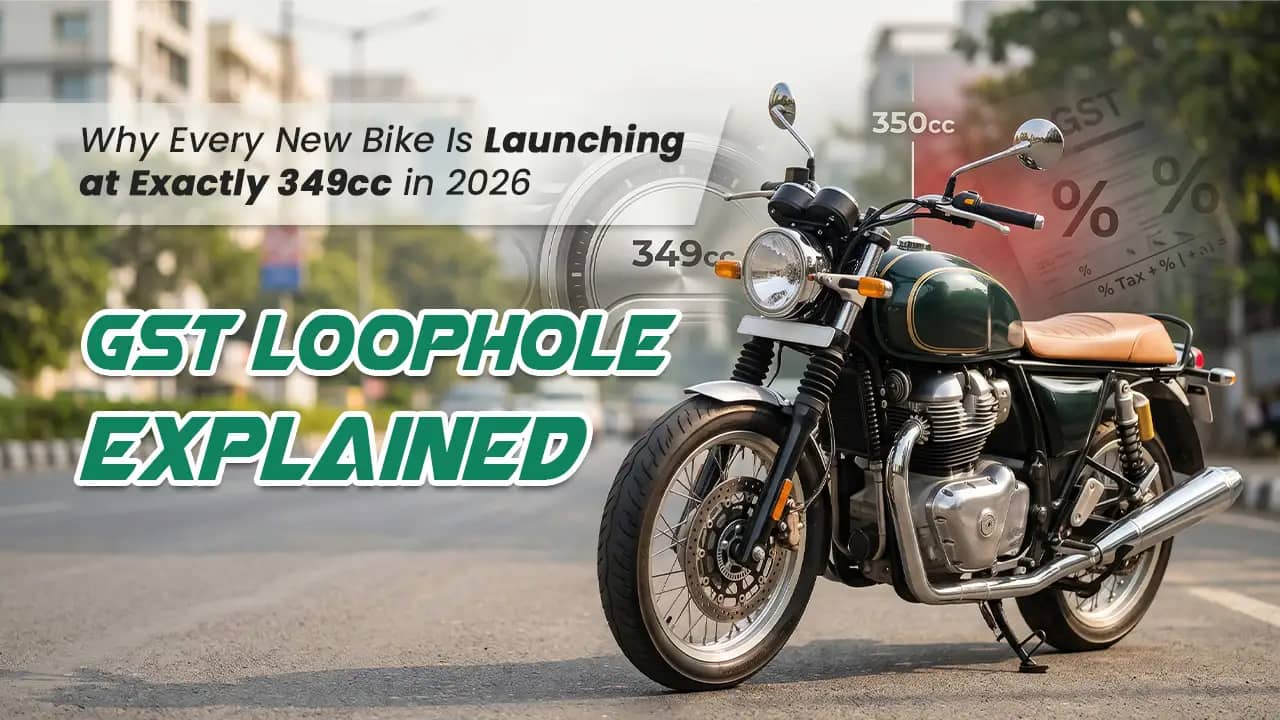
Why Every New Bike Is Launching at Exactly 349cc in 2026 — The GST Loophole Explained brings key updates for two-wheeler buyers in India. The 349cc bikes GST loophole has become one of the most discussed trends in India’s motorcycle industry in 2026. Several manufacturers are introducing motorcycles with engine capacities just below 350cc,
The 349cc bikes GST loophole has become one of the most discussed trends in India’s motorcycle industry in 2026. Several manufacturers are introducing motorcycles with engine capacities just below 350cc, allowing them to remain in a lower GST category and offer more competitive ex-showroom prices.
This is not an accidental engineering coincidence. Engine capacity now influences taxation, pricing, financing and product positioning almost as much as performance. For manufacturers competing in India’s fast-growing ₹2 lakh to ₹3 lakh premium motorcycle segment, staying below the 350cc threshold can make a major difference.
Why Are So Many Motorcycles Exactly 349cc?
Motorcycles with engine capacities of up to 350cc attract a lower GST rate than motorcycles that exceed the threshold. Under the current tax structure referenced by manufacturers and buyers, motorcycles up to 350cc attract 18% GST, while models above 350cc attract 40% GST.
That means a motorcycle with a 349cc engine can fall into a considerably lower tax bracket than one with a 351cc engine, despite the difference in displacement being almost meaningless in everyday riding.
This is why 349cc has emerged as a commercially attractive engine size. It gives manufacturers enough displacement to offer strong torque and premium-bike performance while keeping the motorcycle within a more affordable tax category.
The term “GST loophole” is widely used, but it is not technically a loophole in the illegal or unintended sense. Manufacturers are simply designing products according to the existing tax structure, just as carmakers have historically developed vehicles around length and engine-capacity-based taxation rules.
How GST on Motorcycles Affects the Final Price
GST is applied before expenses such as registration, road tax, insurance and dealer-level charges are added. As a result, a higher tax rate increases the motorcycle’s ex-showroom price, which then affects several other ownership costs.
A higher ex-showroom price usually means a larger financing requirement, higher monthly instalments and a more expensive insurance policy. Road tax may also increase because many states calculate it as a percentage of the vehicle’s value.
Consider a motorcycle with a pre-tax manufacturer value of ₹1.45 lakh. At 18% GST, its price would rise to approximately ₹1.71 lakh before other applicable charges. At 40% GST, the same base value would result in a price of around ₹2.03 lakh.
That creates a difference of roughly ₹32,000 before registration and insurance are included. Once the complete on-road price is calculated, the buyer may end up paying an even larger amount.
For a customer financing the motorcycle over three to five years, this difference can translate into several hundred rupees of additional EMI every month.
Why Manufacturers Prefer Staying Below 350cc
Engine capacity is no longer determined only by the amount of power a manufacturer wants to produce. It has also become a product-planning and pricing decision.
A company may be capable of launching a 375cc or 400cc motorcycle, but the higher tax burden can push that bike into a significantly more expensive segment. Reducing the displacement to around 349cc allows the brand to target a wider group of customers without necessarily sacrificing the performance required for normal city and highway riding.
A lower tax burden allows manufacturers to advertise a more attractive starting price. It can also create space for better equipment, premium variants and accessories without pushing the final price beyond the customer’s budget.
For Indian buyers, the difference between a ₹2.25 lakh motorcycle and a ₹2.75 lakh motorcycle can influence the entire purchase decision. It may determine whether the customer can make the required down payment, obtain loan approval or manage the monthly EMI comfortably.
In many cases, buyers are more willing to accept a small reduction in peak horsepower than pay an additional ₹30,000 to ₹60,000 for a slightly larger engine.
Why Royal Enfield Uses a 349cc Engine
The question of why the Royal Enfield engine is 349cc is frequently linked to taxation, although the company’s J-series engine was introduced before the latest tax discussions became a major industry topic.
Royal Enfield’s 349cc single-cylinder engine currently powers some of the company’s most popular motorcycles, including the Classic 350, Hunter 350, Bullet 350 and Meteor 350. Although these motorcycles use the “350” badge for branding, the actual engine displacement is 349cc.
Manufacturers commonly round displacement figures when naming motorcycles. A 349cc motorcycle can therefore be marketed as a 350 without changing its legal or technical engine-capacity classification.
The J-series engine produces approximately 20.2 bhp and 27 Nm of torque. Rather than chasing high-revving performance, it focuses on smooth low-end response, relaxed cruising and accessible power delivery.
Its displacement now places Royal Enfield in a particularly advantageous position. The company can continue offering the traditional feel and torque associated with a midsize motorcycle while keeping prices competitive within India’s largest premium-motorcycle category.
Other Brands Are Moving Towards the Same Formula
Royal Enfield is not the only manufacturer operating close to the 350cc threshold. The sub-350cc segment is becoming increasingly important for brands attempting to combine premium positioning with mass-market affordability.
Honda’s H’ness CB350, for example, uses a 348.36cc engine. Despite being marketed as a 350cc motorcycle, its actual displacement remains below the threshold.
Other manufacturers are also reportedly exploring redesigned or downsized engines for India-specific models. Rather than bringing an existing international 400cc motorcycle to India unchanged, a company may develop a smaller-capacity version that can be positioned more competitively.
This strategy is especially relevant for brands such as Triumph and KTM, which compete in performance-oriented segments where a large increase in price can quickly reduce demand.
For manufacturers, the objective is not simply to produce the largest possible engine. It is to deliver the most desirable combination of performance, price, equipment and taxation for the intended market.
The Real Difference Between 349cc and 350cc-Plus Bikes
The 349cc vs 350cc tax difference may be substantial, but the real-world performance difference between two similarly engineered motorcycles can be much smaller.
Engine displacement alone does not determine how fast or responsive a motorcycle feels. Compression ratio, engine tuning, bore and stroke, valve timing, gear ratios, kerb weight and ECU calibration can all influence performance.
A lightweight and well-tuned 349cc motorcycle may feel quicker in city traffic than a heavier 400cc motorcycle. It may also deliver better low-speed tractability and fuel efficiency, making it more suitable for everyday Indian riding conditions.
Larger engines generally have the potential to produce more power and stronger top-end acceleration. However, that advantage matters most when the motorcycle is regularly used for high-speed touring, overtaking on open highways or performance riding.
For commuters and occasional weekend riders, manageable torque, smooth throttle response and lower running costs may be more valuable than a small increase in peak horsepower.
Designing a 349cc Engine Is Not a Simple Software Change
Reducing an engine from approximately 400cc to 349cc is not as simple as modifying the motorcycle’s ECU. Engine displacement is determined physically by the bore and stroke of the cylinder.
Manufacturers may need to redesign the crankshaft, piston movement, combustion chamber, valve timing, cooling system and fuel mapping. These changes can affect power delivery, vibration, emissions and long-term reliability.
A revised engine must also undergo fresh testing, emissions certification and homologation before it can be sold. This requires engineering investment and development time.
However, the potential tax advantage can justify that investment. If a redesigned engine allows a manufacturer to reduce the motorcycle’s price by tens of thousands of rupees, the model may attract substantially more customers over its product lifecycle.
The result is a motorcycle shaped by both engineering requirements and taxation strategy.
How the Lower GST Rate Affects EMI and Ownership Costs
The effect of the 350cc bike GST rate in India extends beyond the showroom price. A lower ex-showroom price reduces the amount a customer needs to borrow, assuming the same down-payment percentage.
For example, a ₹30,000 reduction in the financed amount can lower the EMI noticeably over a five-year tenure. The exact saving will depend on the interest rate, loan duration and down payment, but the customer benefits throughout the repayment period.
Insurance is also linked to the vehicle’s insured declared value. A less expensive motorcycle will generally cost less to insure than an otherwise similar model with a significantly higher ex-showroom price.
Lower acquisition costs can also support resale demand. Used-bike buyers are often attracted to motorcycles that offer affordable parts, manageable insurance and a large service network. Popular sub-350cc motorcycles may therefore retain strong demand in the pre-owned market.
However, resale value still depends on brand reputation, condition, service history, reliability and local demand. Engine capacity alone does not guarantee strong resale performance.
Does a 349cc Motorcycle Deliver Better Fuel Efficiency?
A 349cc motorcycle may offer better fuel efficiency than a more powerful 400cc model, but displacement is not the only factor involved.
Motorcycle weight, gearing, aerodynamics, riding speed and engine tuning can have a major impact on fuel consumption. A relaxed, long-stroke engine ridden smoothly may return respectable mileage, while an aggressively tuned engine of similar capacity may consume considerably more fuel.
The rider’s behaviour is equally important. Frequent hard acceleration, high-speed cruising and stop-and-go traffic can reduce mileage regardless of engine size.
Nevertheless, motorcycles in the 349cc category are often tuned for accessible torque rather than extreme performance. This can make them more practical for daily commuting and occasional touring, particularly for riders upgrading from 150cc or 200cc motorcycles.
Who Should Buy a 349cc Motorcycle?
A 349cc motorcycle makes the strongest case for riders who want a premium riding experience without entering the higher ownership-cost bracket associated with more powerful machines.
These motorcycles are particularly suitable for city commuting, weekend rides and moderate highway touring. They generally offer more torque and stability than smaller commuter motorcycles while remaining manageable in traffic.
Buyers working with a budget below ₹3 lakh may also find the segment attractive because the lower tax impact can keep down payments and EMIs within reach.
A motorcycle above 350cc may still be the better choice for riders who regularly tour at higher speeds, carry a pillion with luggage or prioritise acceleration and top-end performance.
The right decision should be based on actual riding requirements rather than the number printed on the fuel tank.
Are There Any Disadvantages to 349cc Motorcycles?
The main compromise is that a smaller-capacity engine may produce less peak power than a comparable 400cc unit. This difference can become noticeable during fast highway overtakes or sustained high-speed riding.
Some enthusiasts may also feel that a tax-focused engine limits the motorcycle’s performance potential. A larger engine can provide manufacturers with more flexibility to produce higher power without using aggressive tuning.
However, the practical impact depends on the motorcycle. A well-engineered 349cc model can still provide enough performance for most Indian road conditions.
Buyers should compare power, torque, kerb weight, gearing and real-world rideability instead of assuming that every larger engine is automatically better.
Is 349cc Really a GST Loophole?
Calling it a loophole makes the strategy sound more controversial than it actually is. Manufacturers are not avoiding tax illegally. They are designing motorcycles that qualify for an established product category.
The 350cc threshold is a clear regulatory boundary. As long as a motorcycle’s certified displacement remains within the lower category, the applicable tax treatment is legitimate.
The more accurate description would be tax-efficient product engineering. Manufacturers study regulations, customer budgets and market demand before deciding how a motorcycle should be developed.
The same approach is used across the automotive industry whenever vehicle dimensions, engine capacities or emissions rules affect pricing.
Final Verdict
The increasing number of 349cc motorcycles in India is not a coincidence. The difference between the GST applied to motorcycles below and above the 350cc threshold has made engine capacity a crucial commercial decision.
By keeping displacement around 349cc, manufacturers can offer premium-looking motorcycles with usable performance while maintaining a lower ex-showroom price. Buyers benefit through more affordable EMIs, lower insurance costs and a reduced overall purchase burden.
Larger engines will continue to appeal to enthusiasts who want stronger acceleration and better high-speed performance. However, for commuters, first-time premium-bike buyers and weekend riders, a modern 349cc motorcycle can deliver a more balanced combination of performance, efficiency and affordability.
Engine capacity should never be the only consideration when choosing a motorcycle. Buyers should also evaluate service availability, reliability, comfort, fuel efficiency, features, financing costs and resale demand before making a final decision.
The 349cc bikes GST loophole has become one of the most discussed trends in India’s motorcycle industry in 2026. Several manufacturers are introducing motorcycles with engine capacities just below 350cc, allowing them to remain in a lower GST category and offer more competitive ex-showroom prices.