Should You Buy a Petrol Bike Before Delhi's 2028 Deadline? Here's the Real Math
Overview
Should You Buy a Petrol Bike Before Delhi's 2028 Deadline? Here's the Real Math brings key updates for two-wheeler buyers in India. Buying a petrol bike before Delhi's 2028 deadline has turned from a lifestyle choice into a spreadsheet problem. The Delhi Cabinet has confirmed that new petrol and CNG two-wheeler registrations
Buying a petrol bike before Delhi's 2028 deadline has turned from a lifestyle choice into a spreadsheet problem. The Delhi Cabinet has confirmed that new petrol and CNG two-wheeler registrations end on April 1, 2028, and right now a commuter favourite like the TVS Raider 125 costs ₹95,611 on-road in the city. That leaves buyers roughly 21 months of certainty before the rules shift — but the date isn't really the number that decides anything here. What decides it is whether the EMI, fuel bill and resale value on a petrol bike still beat an electric scooter in a city that's throwing ₹15,000 crore at EV adoption over the next four years.
What the April 2028 Deadline Actually Changes
Start with what this ban doesn't do, because most people get it wrong. It doesn't touch bikes already on the road, and it doesn't stop anyone from registering a new petrol bike right up to March 31, 2028. Delhi's transport department has been explicit: existing petrol two-wheelers can be driven for their full legal lifespan, no forced retirement, no retroactive scrapping. What actually ends is the ability to walk into a dealership after April 1, 2028 and register a brand-new petrol scooter or motorcycle. Commercial riders got hit earlier — aggregator fleets in Delhi already can't add new petrol or diesel two-wheelers, with BS6 units allowed only as a transition concession until December 2026. For a private buyer, though, the deadline is a countdown on choice, not a countdown on usage.
The Petrol Math: Raider 125 vs an Equivalent EV
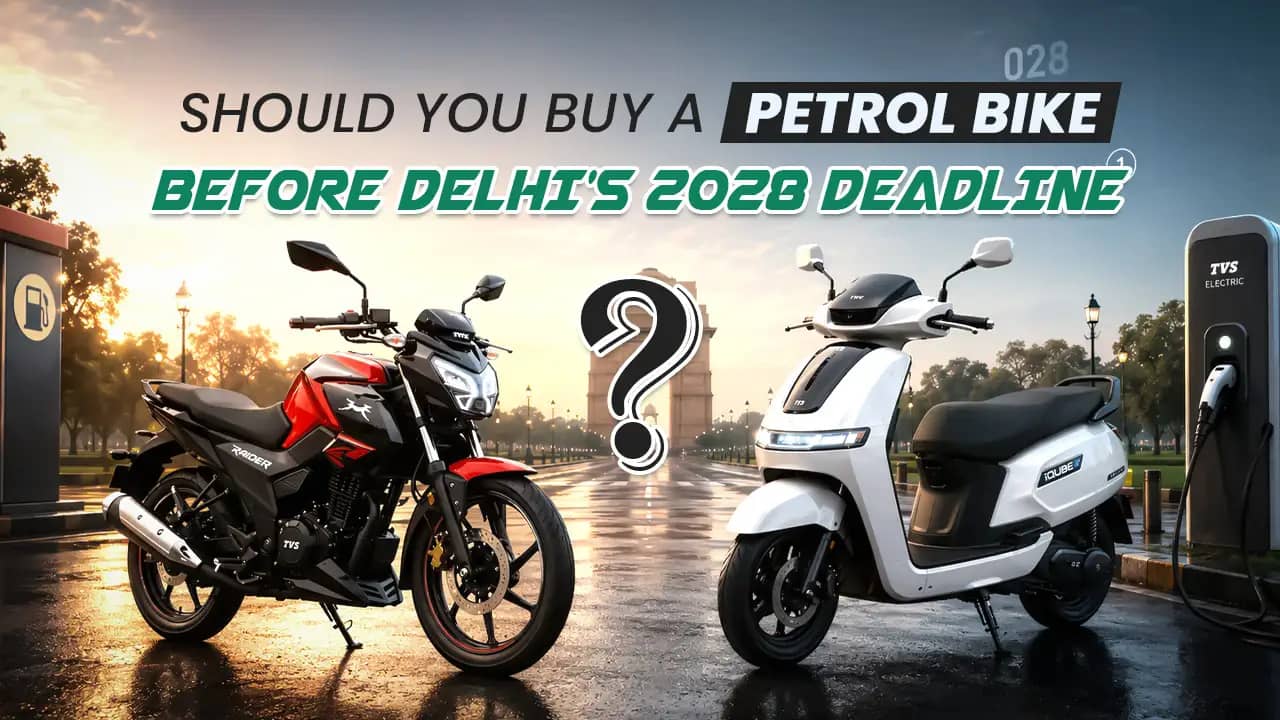
Take the Raider 125 as the reference point, since it sits in the segment most first-time and college-age buyers actually shop in. At ₹95,611 on-road in Delhi, with a 20% down payment (₹19,122) financed over 60 months at 11% interest, the EMI works out to roughly ₹1,663 a month, with total interest of about ₹23,300 over the loan. Fuel-wise, the Raider's 124.8cc engine claims 56.7 kmpl on ARAI's test cycle, but city riding brings that closer to 50-55 kmpl. A rider covering 20km a day for 26 riding days — about 520km a month — burns roughly 9.5 litres. At ₹103 a litre for petrol in Delhi, that's close to ₹975 a month just in fuel, before servicing.
Compare that against the TVS iQube, priced from ₹1,18,068 on-road in Delhi for the base 2.2kWh variant. The same 20% down payment (₹23,614) over 60 months at 11% pushes the EMI to about ₹2,054 a month — roughly ₹390 more than the Raider every month. But running costs flip hard in the EV's favour: TVS quotes a charging cost near ₹0.16 per km on the larger-battery iQube variants, which puts that same 520km monthly commute at under ₹85 in electricity. Servicing tells a similar story. A petrol commuter typically needs three to four dealer visits by the 10,000km mark — oil changes, chain adjustment, minor wear parts — running close to ₹3,000-3,500 total. An electric scooter has no engine oil, no clutch, no gearbox to service, and owners commonly report maintenance closer to ₹1,000-1,500 over the same distance.
| TVS Raider 125 (Petrol) | TVS iQube (EV) | |
| On-road price, Delhi | ₹95,611 | ₹1,18,068 |
| EMI (20% down, 60mo, 11%) | ~₹1,663/month | ~₹2,054/month |
| Running cost (520km/month) | ~₹975 (fuel) | ~₹85 (charging) |
| Service cost by 10,000km | ~₹3,000-3,500 | ~₹1,000-1,500 |
What This Actually Means If You're Buying Before 2028
Run the two side by side over a year and the petrol bike's lower purchase EMI gets eaten almost entirely by its running cost — the Raider costs about ₹390 less a month to finance but roughly ₹890 more a month to fuel, so the EV pulls ahead on total monthly outgo within the first year of ownership. Where petrol still wins is upfront cash, resale familiarity, and range — nobody's doing a 200km weekend ride on a base electric scooter without planning a charging stop. The 2028 deadline doesn't erase that trade-off, it just puts a shelf life on when you can still choose the petrol side of it as a first-time buyer in Delhi.
If your riding is mostly intra-city — office commutes, college runs, errands under 50km a day — the running-cost gap alone makes the EV argument hard to ignore, deadline or not. If you need weekend highway range, carry a pillion regularly over longer distances, or simply want a bike you can sell in any city in India without worrying about battery health, buying a petrol bike before Delhi's 2028 deadline still makes practical sense, and 21 months is enough runway to do it without panic-buying. What doesn't make sense is treating the ban date itself as the deciding factor, when the real numbers — EMI, fuel, and service cost — are what actually show up in your bank account every month.
Riders comparing this segment closely might also want to look at how the TVS iQube stacks up against the Bajaj Chetak C3501, or where the Hero Vida V2 fits for buyers wanting a lower entry price into electric. Check the on-road price and EMI for the Raider 125 or its EV alternatives in your city on Drivio.
Buying a petrol bike before Delhi's 2028 deadline has turned from a lifestyle choice into a spreadsheet problem. The Delhi Cabinet has confirmed that new petrol and CNG two-wheeler registrations end on April 1, 2028, and right now a commuter favourite like the TVS Raider 125 costs ₹95,611 on-road in the city.