New Delhi



GST 2.0, One Year On: How Much Cheaper Are Bikes and Scooters Really Getting in 2026?
Featured Stories by Drivio | 13 Jul 2026
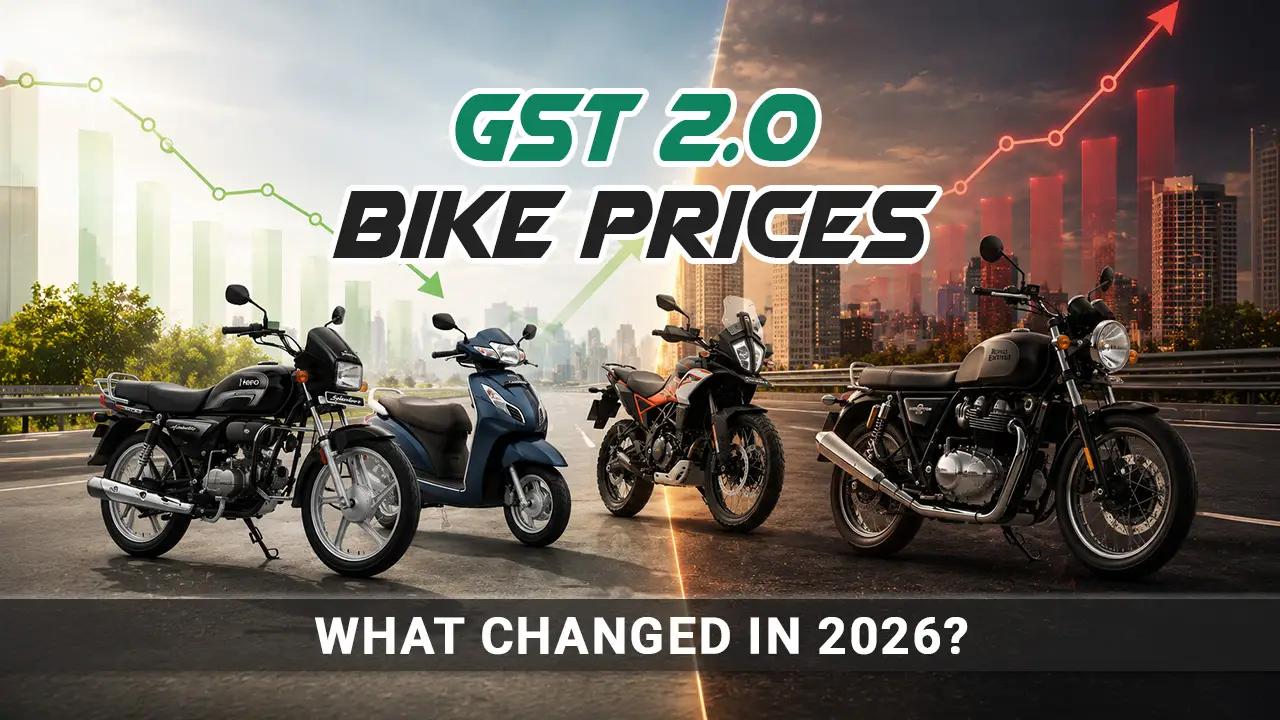
GST 2.0 bike prices in India have settled into a clear, lopsided pattern ten months after the reform took effect, and it isn't the uniform "everything got cheaper" story most headlines promised back in September 2025. A Hero Splendor+ now costs ₹79,426 ex-showroom in Delhi, about ₹6,820 less than before the change. A Royal Enfield Interceptor 650, bought at the same showroom on the same day, now costs close to ₹20,000 more. Same tax reform, opposite outcomes. Which side you land on depends entirely on your engine's cubic capacity.
What the GST Council Actually Changed on 22 September 2025
The 56th GST Council meeting collapsed the old 28 percent slab, plus cess on bigger bikes, into two clean brackets. Two-wheelers up to 350cc dropped from 28 percent to 18 percent GST. Anything above 350cc jumped to a flat 40 percent, up from an effective rate closer to 31 percent once the old compensation cess was folded in. Electric two-wheelers were left untouched at 5 percent, which sounds like a footnote until you run the fuel-versus-charging math, more on that below. Close to 98 percent of India's two-wheeler market sits under 350cc, so on paper this was built as relief for the commuter majority and a penalty on premium touring machines.
GST 2.0 Bike Prices in India: Which Models Actually Got Cheaper
Hero MotoCorp passed on the full tax benefit, and its price list is the cleanest before-and-after available. The Splendor+ dropped ₹6,820, the HF Deluxe fell ₹5,805, the Xtreme 125R dropped ₹8,010, and the Karizma 210 saw the largest cut on any Hero model at ₹15,743. Scooters moved too — the Destini 125 fell ₹7,197, the Pleasure+ dropped ₹6,417. On the Activa-versus-Jupiter commuter fight, the pecking order barely shifted: an Activa 110 still runs ₹74,369 to ₹87,693 ex-showroom Delhi against a TVS Jupiter 110 at ₹72,400 to ₹85,400, with Jupiter continuing to undercut Activa by a few thousand rupees across variants even after both brands applied their cuts.
| Model | New Ex-Showroom Price (Delhi) | Change vs Pre-GST 2.0 |
| Hero Splendor+ | ₹79,426 | -₹6,820 |
| Honda Activa 110 | ₹74,369–₹87,693 | approx -₹2,000 to -₹5,000 |
| TVS Jupiter 110 | ₹72,400–₹85,400 | approx -₹2,000 to -₹5,000 |
| Royal Enfield Super Meteor 650 (top trim) | above ₹4 lakh | approx +₹30,000 |
| KTM 390 Adventure (350cc variant) | ₹2.82 lakh | new model, engineered to fit the 18% slab |
The Flip Side: Royal Enfield, Kawasaki and Suzuki Buyers Are Paying More
Royal Enfield's 350cc range — Hunter, Classic, Bullet, Meteor, Goan Classic — got cheaper, now starting between ₹1.38 lakh and ₹2.20 lakh depending on variant. Step past 350cc, though, and the story flips hard. The Himalayan 450, the Guerrilla 450, the Scram 440, and the entire 650cc twin range now sit in the 40 percent bracket, with hikes running ₹15,000 to nearly ₹26,000. The Super Meteor 650's top trim has crossed ₹4 lakh, roughly ₹30,000 costlier than before the reform. Kawasaki and Suzuki got hit harder still — the Ninja 650, Versys 650 and Z900 climbed ₹47,000 to ₹80,000, and Suzuki's Hayabusa is now over ₹1.16 lakh dearer than it was last August.
The more interesting reaction came from KTM. Rather than absorb the 40 percent slab on its 399cc engine, the company re-engineered the 390 Adventure down to a 349.32cc unit, just under the cutoff, and launched it in April 2026 at ₹2.82 lakh ex-showroom, undercutting the Royal Enfield Himalayan 450 (₹3.55 lakh, taxed at 40 percent) by more than ₹70,000. Triumph is understood to be running a similar playbook on parts of its 400cc range. This is the quiet second act of GST 2.0: manufacturers re-engineering displacement specifically to stay inside the cheaper bracket, a dynamic that simply didn't exist under the old flat 28 percent structure.
What GST 2.0 Bike Prices Mean for Your EMI and Fuel Bill
Take the new Splendor+ at ₹79,426 ex-showroom. On a standard 20 percent down payment, 60-month tenure, 11 percent interest structure, that works out to roughly ₹15,885 upfront and an EMI close to ₹1,380 a month, about ₹140 less than the same loan would have cost on the pre-GST 2.0 price. Ride it for daily commuting, say 1,200km a month, and real-world mileage closer to 65kmpl (well short of the claimed 80kmpl figure) puts the fuel bill at roughly ₹1,900 a month at ₹103 a litre. Switch that same commute to an electric scooter like the TVS iQube or Ather 450X, still taxed at 5 percent and untouched by any of this reform, and the equivalent charging cost usually lands under ₹400 a month. Ten months into GST 2.0, the bigger financial story for commuters isn't the tax slab at all. It's how far petrol two-wheelers now trail EVs on running cost, even before the ex-showroom gap comes into it.
If you're commuting on anything under 350cc, Splendor, Activa, Jupiter, Xtreme territory, GST 2.0 is straightforwardly good news, and it's worth cross-checking that against Drivio's coverage of the Ather 450X and iQube on running cost alone. If your budget was aimed at a Himalayan 450 or a 650cc twin, the math has gotten worse, not better, and the downsized KTM 390 Adventure deserves a look before you sign on the higher-taxed alternative. Either way, don't trust last year's ex-showroom number. Check the current on-road price and EMI for the exact model and variant you want on Drivio before you commit.