I'm Scared to Buy an EV — 7 Real Risks of Owning an Electric Scooter in India Today
Overview
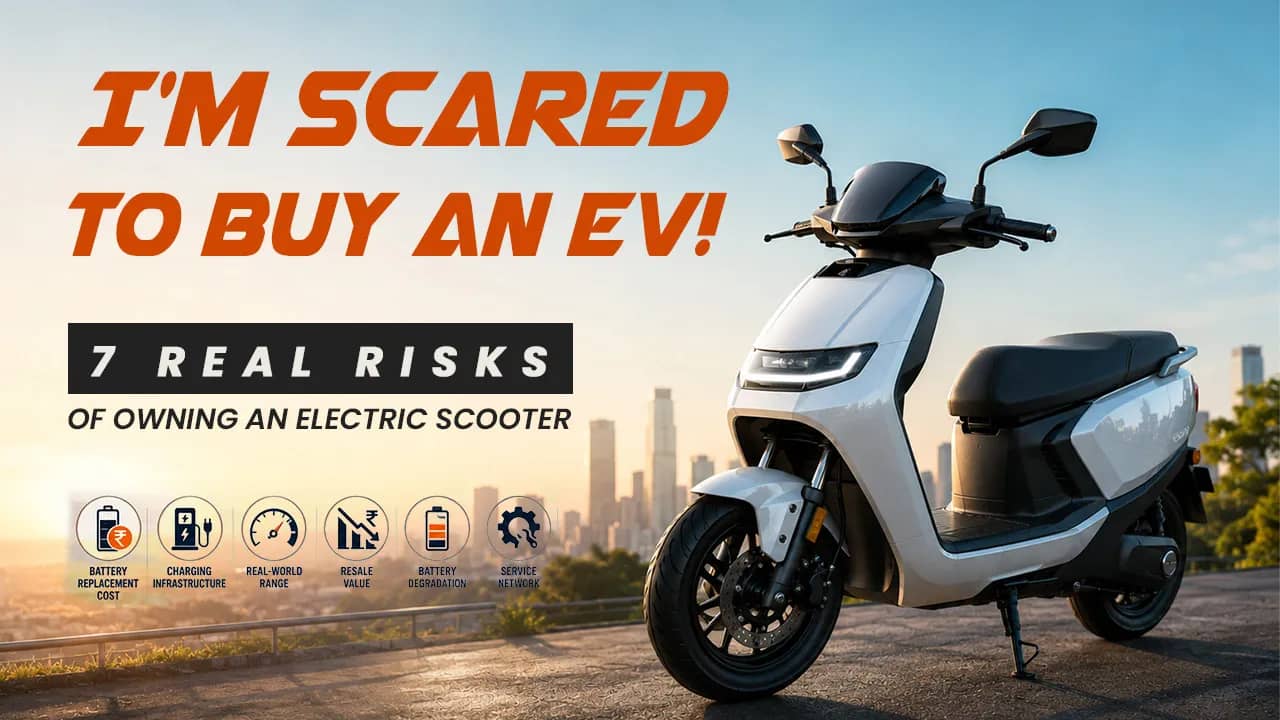
I'm Scared to Buy an EV — 7 Real Risks of Owning an Electric Scooter in India Today brings key updates for two-wheeler buyers in India. You've done your research. You've watched the YouTube reviews, scrolled through the comparisons, maybe even test-rode one at a showroom. And yet — something keeps stopping you. It's not that
You've done your research. You've watched the YouTube reviews, scrolled through the comparisons, maybe even test-rode one at a showroom. And yet — something keeps stopping you.
It's not that you don't believe in EVs. You probably do. It's the nagging questions that nobody answers honestly. What happens when the battery dies after five years? What if there's no service centre in my city? What about those fire videos?
In 2026, India's electric scooter market has genuinely matured. Sales crossed 1.2 million units in 2025. Brands like TVS, Ather, and Bajaj are on their second and third-generation products. But maturity doesn't mean perfection — and some of the fears Indian buyers carry are completely valid, while others are outdated myths dressed up as wisdom.
This article doesn't sell you on EVs. It gives you an honest breakdown of the seven real risks of owning an electric scooter in India today — who faces them most, how serious each one actually is, and what you can do to protect yourself.
Risk 1: The Battery Replacement Cost Might Hit You Hard
Why the concern exists: The battery is the single most expensive component of any electric scooter. When early buyers started asking "what happens when the battery dies?" they got vague answers from brands and alarming numbers from the internet.
Is this concern real today? Yes — and it deserves to be taken seriously. In 2026, a full battery pack replacement at an authorised service centre costs approximately ₹55,000–₹75,000 for mid-range models like the Ather 450X and TVS iQube, and can climb to ₹87,500–₹1,15,000 for larger-battery scooters like the Ola S1 Pro and TVS iQube ST. Battery replacement costs currently range between ₹15,000 and ₹22,000 per kWh depending on chemistry, which means a 3 kWh pack in Delhi can cost ₹55,000–₹65,000 out of pocket. These costs have dropped roughly 22% since 2024 due to localised lithium-ion cell production under the PLI scheme — but they are not yet trivial.
The important nuance: Most modern lithium-ion batteries are rated for 5–8 years or 50,000–80,000 km under normal usage. If you ride 30–40 km per day, you're unlikely to face a battery replacement within the first 5–6 years of ownership. Battery-as-a-Service (BaaS) models — currently offered by select brands — let you buy the scooter without the battery and pay a monthly subscription instead, effectively eliminating the replacement cost risk.
Also note: battery replacement subsidies are not available under the PM E-DRIVE scheme. Whatever subsidy reduces your upfront cost does not apply when you return for a battery swap.
Who is most affected: Riders covering 60–80 km daily (fleet operators, delivery riders) face battery replacements every 4–5 years. At that pace, the total cost calculation changes significantly.
How to reduce this risk:
- Choose brands with at least a 3-year / 30,000 km battery warranty (most mainstream brands offer this)
- Prefer LFP (Lithium Iron Phosphate) chemistry — it lasts 3,000+ charge cycles versus 1,200–1,500 for NMC
- Explore BaaS variants if your brand offers them
- For high daily mileage, calculate the 5-year total cost including one battery replacement before buying
Risk 2: Charging Infrastructure Is Still Patchy Outside Major Cities
Why the concern exists: India's public charging network is growing, but its distribution remains deeply uneven. For a buyer in Bengaluru or Pune, the concern is minimal. For someone in Satna, Raichur, or Motihari — it's real.
Is this concern real today? Partially. India crossed 29,000+ public EV charging stations nationwide by early 2026, a fivefold increase from 2022. Tata Power EZ Charge operates 500+ stations across 120+ cities. Cities are genuinely improving — charging at malls, offices, and apartment parking lots is becoming normal in metros and Tier-2 cities.
However, the situation in Tier-3 towns and rural areas remains thin. Qualified EV technicians and authorised spare parts distribution are reportedly sparse outside the top 50 cities. For someone who regularly travels inter-city through smaller towns, relying on public charging infrastructure is still a gamble.
The practical reality: About 95% of EV scooter owners in India charge at home overnight using a standard 15A socket or a dedicated home charger. For most urban and semi-urban riders with fixed home charging, the public infrastructure gap barely matters. The risk becomes significant when you need emergency top-ups mid-route or when your area has frequent power cuts that disrupt overnight charging routines.
Most EV scooters charge 0–80% in 4–6 hours on a standard portable charger. Premium models with fast charging (like the Ather 450X via the Ather Grid) can reach 80% in under 2 hours at compatible stations.
Who is most affected: Riders in Tier-3 cities and smaller towns; anyone who frequently travels inter-city; households with unstable electricity supply.
How to reduce this risk:
- Confirm dealer and charging network presence in your specific town before buying
- Invest in a dedicated 5A–15A home charger setup for reliability
- Choose scooters with portable chargers that work on standard sockets
- If you travel inter-city often, map charging stops in advance using brand apps
Risk 3: Real-World Range Falls Short of What the Brochure Claims
Why the concern exists: Every EV advertisement leads with range. "176 km on a single charge!" sounds impressive — until you discover that number was measured under controlled lab conditions, not Bengaluru traffic in 38°C heat with a pillion.
Is this concern real today? Absolutely. Real-world range in Indian city conditions is typically 25–40% lower than ARAI/IDC certified figures. A scooter claiming 120 km IDC will generally deliver 85–95 km with an adult rider, mixed traffic, and occasional pillion load. Some owners report closer to 70% of claimed range under normal conditions; others with aggressive riding styles see as low as 60%.
Factors that erode range in India: stop-and-go traffic, frequent acceleration, riding in Eco mode vs Sport mode, high ambient temperatures, battery age, and tyre pressure. An air-conditioned showroom demo is nothing like your actual commute.
The good news: premium models in 2026 are catching up. Scooters like the Ola S1 Pro Plus (5.2 kWh), Simple One Gen 2 (5 kWh), and TVS iQube ST (5.3 kWh) are now delivering genuine real-world ranges of 150 km+, making range anxiety largely irrelevant for those willing to spend. Even the TVS iQube ST has earned a reputation for accuracy between its claimed and actual figures. For the average 25–35 km daily commute, however, nearly every mainstream EV scooter available today is sufficient — even accounting for the real-world gap.
Who is most affected: Riders with commutes over 60 km daily; those without home charging who depend on top-ups; buyers who pick a scooter with just barely enough claimed range for their needs without buffer.
How to reduce this risk:
- Treat claimed range as a ceiling, not a promise. Plan around 65–75% of IDC figures
- Always buy a scooter with at least 30–40% more claimed range than your daily requirement
- Test ride in your actual city conditions, not just the showroom's smooth road
- Use Eco mode for regular commuting; reserve Sport mode for when you need it
Risk 4: Resale Value Is Uncertain and Often Disappointing
Why the concern exists: Used petrol scooters have decades of established market data. A 2019 Honda Activa's price on OLX is predictable. A 2022 Ola S1 Pro? Much less so — and buyers in the used market know it.
Is this concern real today? This is one of the most legitimate and underappreciated risks of early EV ownership in India. EV scooters tend to depreciate faster than their petrol counterparts, primarily because battery health is invisible to the naked eye and there is no standardised diagnostic system for second-hand EV batteries. As the first mainstream EV cohorts from 2020–2023 begin entering the secondary market from 2026 onwards, residual values will increasingly be shaped by battery health certifications, software support, and brand trust — none of which are consistently available yet.
Petrol scooters generally hold their value better in the second-hand market due to established service networks and straightforward mechanical inspection. For some EV brands with trust issues — notably Ola Electric, which has faced service complaints — used prices suffer more than average.
The absence of standardised battery health diagnostics creates genuine uncertainty for buyers, sellers, and insurers. Until battery State-of-Health (SoH) certifications become standard at the point of resale, pricing used EVs remains more guesswork than science.
Who is most affected: Anyone planning to sell their scooter within 3–4 years; buyers in smaller cities with thinner used EV markets; owners of lesser-known or startup EV brands.
How to reduce this risk:
- Choose brands with strong service networks and brand equity (TVS, Bajaj, Ather, Hero) — they hold resale value better
- Maintain your service records diligently; a documented service history helps at the time of resale
- Keep the battery in good health — avoid deep discharges and extreme heat exposure
- This risk is less of a concern if you plan to ride the scooter for 6–8 years and are not buying primarily as an investment
Risk 5: Battery Degradation Changes Your Experience Over Time
Why the concern exists: Unlike a petrol engine that either works or doesn't, a lithium-ion battery degrades gradually and silently. The 120 km range you enjoyed in year one quietly becomes 95 km by year four — without any warning light or dramatic failure.
Is this concern real today? Yes, but it is often overstated. Most EV batteries retain 70–80% of their original capacity even after several years of regular use. For a rider doing 30 km daily on a scooter with a 100 km real-world range, retaining 75% capacity still leaves 75 km of usable range — comfortably more than needed.
Degradation accelerates under specific conditions: frequent DC fast charging (which generates more heat), consistently charging to 100% and discharging to 0%, high ambient temperatures (a real factor in Indian summers), and poor battery management by the onboard BMS. LFP (Lithium Iron Phosphate) batteries, now preferred by most Indian EV brands including Bajaj Chetak, Ather, and TVS, are more thermally stable and degrade more slowly than older NMC chemistry.
In real-world terms, a city rider in Nagpur or Hyderabad doing 35 km daily will notice meaningful degradation around years 5–7. A delivery rider doing 80 km daily may see it sooner.
Who is most affected: High-mileage riders (60+ km daily); riders in extreme-heat cities; anyone who habitually charges to 100% and leaves the scooter in direct sunlight.
How to reduce this risk:
- Charge to 80–90% for daily use; avoid full charges unless you need maximum range that day
- Avoid prolonged parking in direct sunlight
- Use standard AC charging for daily top-ups; reserve fast charging for when you genuinely need it
- Choose LFP battery variants wherever available
Risk 6: Service Network and Repair Availability Can Let You Down
Why the concern exists: A petrol scooter can be fixed at virtually any roadside mechanic in India — even in villages. An EV scooter cannot. It needs brand-specific software tools, trained technicians, and authorised spare parts.
Is this concern real today? For riders outside the top 50 cities: genuinely yes. Qualified EV technicians, high-voltage-trained service staff, and authorised spare part distribution remain thin in Tier-3 and rural markets. A software glitch on an Ola S1 Pro cannot be resolved by the local mechanic who services Activas. Some early EV brand owners have reported week-long waits for service appointments, doorstep pickup delays, and unavailability of parts — experiences that petrol scooter owners simply do not face.
The gap is narrowing. Established brands like TVS, Bajaj, and Hero have leveraged their existing dealer networks to extend EV servicing across hundreds of towns. TVS iQube and Bajaj Chetak owners in most Tier-2 cities are reasonably served. Ather Grid and Ather service centres now operate in over 150 cities. But for newer, smaller EV brands — especially those that relied on subsidies to drive sales and are now struggling financially — service reliability is a genuine concern.
The risk is less about the scooter failing and more about how long it stays off-road when it does.
Who is most affected: Riders in Tier-3 cities and smaller towns; buyers of startup or lesser-known EV brands; anyone with a single scooter as their primary vehicle.
How to reduce this risk:
- Before buying, physically visit the nearest authorised service centre — don't just check the brand's website
- Check Google Maps reviews for the service centre in your city specifically
- Choose brands with legacy dealer networks: TVS, Bajaj, Hero, Ather
- Ask the dealer directly: "What is the average waiting time for a service appointment right now?"
Risk 7: Safety Concerns — Fire Risk, Water Damage, and Accident Behaviour
Why the concern exists: In 2021–2022, a spate of high-profile EV scooter fires in India — some fatal — landed on every news channel. The images of scooters engulfed in flames created fear that hasn't fully gone away.
Is this concern real today? The fire risk was real in 2022. Poorly made battery packs from some manufacturers, combined with Indian summer heat and inadequate Battery Management Systems, led to genuine disasters.
Since then, the Ministry of Road Transport directed investigations by the Centre for Fire, Explosive and Environment Safety (CFEES) under DRDO. Regulations were tightened considerably. Battery packs now require more rigorous certification before they can be sold. Major brands shifted to LFP chemistry, which is significantly more thermally stable than older NMC cells. IP67 and IP68 water-dust protection ratings are now standard on most mainstream models.
The turning point, as many industry observers noted, was that instead of slowing EV adoption, India used the crisis to strengthen the regulatory framework — which is how industries mature.
What the risk looks like now: Thermal runaway — the chain reaction where a damaged or overcharged battery heats uncontrollably — remains a physical possibility in any lithium-ion device, including EVs, smartphones, and laptops. The risk is not zero. However, with established brands running certified LFP packs and proper BMS, the probability of a spontaneous fire under normal usage is very low. The higher risks come from using counterfeit chargers, modifying the battery, charging in extreme heat without ventilation, or buying from an uncertified low-cost brand.
Water damage is a related concern in India's monsoon season. Most premium EV scooters now carry IP67 or IP68 ratings, meaning they can handle heavy rain and shallow waterlogging. This is less of a concern than it was in 2020–2022, but riders should still avoid deep waterlogging (18 inches+), which can damage any scooter — petrol or electric.
Who is most affected: Buyers of low-cost, uncertified EV brands; riders who charge in poorly ventilated enclosed spaces; owners who use third-party or counterfeit chargers.
How to reduce this risk:
- Only buy from brands with certified battery packs (look for AIS 156 Phase II compliance)
- Always use the original OEM charger
- Charge in a ventilated area, ideally outdoors or in an open garage
- Never leave the scooter charging unattended overnight in an enclosed room
- Do not purchase from brands that cannot show battery certification documentation
EV Scooter Risks vs Petrol Scooter Risks: An Honest Comparison
Before concluding it's safer to stick with petrol, it's worth being honest about what petrol scooters actually cost in risk and money.
A Honda Activa 125 or TVS Jupiter owner faces a fundamentally different risk profile — not a risk-free one.
| Risk Factor | Electric Scooter | Honda Activa 125 / TVS Jupiter |
| Fuel cost per 100 km | ₹30–₹50 (electricity) | ₹150–₹180 (petrol at ₹100+/litre) |
| Annual maintenance | ₹1,200–₹2,500 | ₹3,500–₹6,000 |
| Major replacement cost | Battery: ₹55,000–₹75,000 (after 7–8 yrs) | Engine overhaul: ₹8,000–₹20,000 (after 5–6 yrs) |
| Resale value clarity | Uncertain (battery health unknown) | Well-established, predictable |
| Service availability | Thin in Tier-3 towns | Near-universal, any mechanic |
| Fire risk | Low with certified brands | Petrol fires and fuel leaks are possible (less viral but real) |
| Range anxiety | Exists (planning required) | None — petrol available everywhere |
| Running cost savings | Substantial (₹25,000–₹35,000/year for avg rider) | Higher ongoing fuel spend |
The honest picture: petrol scooters win clearly on resale value predictability, serviceability everywhere in India, and zero range planning. EVs win substantially on running costs — saving an average city rider ₹25,000–₹35,000 annually in fuel — and increasingly on reliability once you're within a good service network.
Neither is obsolete. Neither is perfect. The right choice depends on where you live, how you ride, and what you can afford if something goes wrong.
Who Should Buy an EV Scooter Right Now
Buy an EV scooter today if:
- Your daily commute is under 50 km in a metro or large Tier-2 city
- You have reliable home charging (a 15A socket is enough)
- You choose an established brand with a service centre in your city (TVS, Bajaj, Ather, Hero, Ola in well-served locations)
- You plan to ride the same scooter for 5+ years — the fuel savings compound significantly
- You have a secondary vehicle or are not entirely dependent on the scooter every single day
Wait or stick with petrol if:
- You live in a Tier-3 town or rural area with no authorised service centre nearby
- Your commute regularly exceeds 80 km daily
- You plan to resell the scooter within 2–3 years
- You travel long inter-city distances frequently without predictable charging access
- Budget is extremely tight and an unexpected ₹60,000+ battery issue would be a genuine financial crisis
The Verdict: Should a Typical Indian Commuter Be Scared in 2026?
No — but they should be informed, not fearless.
For a rider in a metro or major Tier-2 city, doing 25–50 km daily, with home charging available, and choosing a brand like TVS iQube, Bajaj Chetak, Ather 450X, or Hero Vida: the electric scooter in 2026 is a financially sensible, increasingly reliable choice. The fear of battery replacement is valid but manageable. The range anxiety is real but solvable with the right model and habits. The safety concerns from 2022 have been substantially addressed by regulation and better technology.
The concerns that remain genuinely unsolved — resale value uncertainty and thin service networks in smaller towns — are real and should shape your buying decision, not just your anxiety.
Being scared is the wrong emotion. Being careful is the right one. The difference is that fear stops you from buying at all; care helps you buy the right scooter from the right brand in the right city for the right reasons.
In 2026, India's electric scooter market has genuinely matured. Sales crossed 1.2 million units in 2025. Brands like TVS, Ather, and Bajaj are on their second and third-generation products. But maturity doesn't mean perfection — and some of the fears Indian buyers carry are completely valid, while others are outdated myths dressed up as wisdom.