Is Buying an Electric Scooter in India Actually Cheaper in 2026? Honest 3-Year Cost Breakdown
Overview
Is Buying an Electric Scooter in India Actually Cheaper in 2026? Honest 3-Year Cost Breakdown brings key updates for two-wheeler buyers in India. Electric scooter ownership cost in India has finally reached a tipping point where the numbers genuinely favour going electric — but only if you're the right kind of rider. With
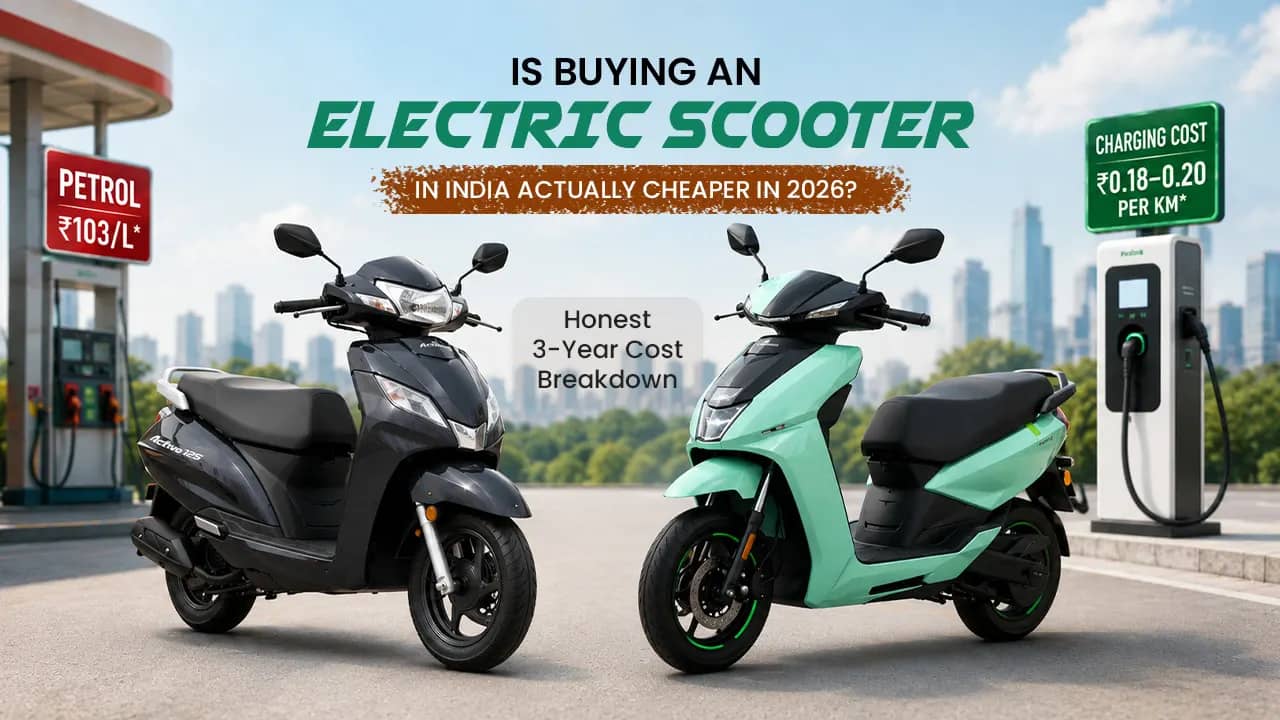
Electric scooter ownership cost in India has finally reached a tipping point where the numbers genuinely favour going electric — but only if you're the right kind of rider. With petrol sitting at roughly ₹103 per litre in most metros as of May 2026, and home electricity tariffs averaging ₹6–8 per unit across Delhi, Bengaluru, and Pune, a daily commuter covering 1,000–1,200 km a month can realistically save ₹40,000 to ₹55,000 over three years by switching from a petrol scooter to an electric one. That's not a marketing claim — it's arithmetic.
The Fuel vs Electricity Calculation Nobody Does Honestly
A Honda Activa 125 returns about 50 km per litre in real-world, stop-go urban traffic. At ₹103/litre, you're spending roughly ₹2.06 per km. Multiply that across 1,100 km a month and the monthly fuel bill lands at approximately ₹2,266. Over three years, that's nearly ₹81,600 on petrol alone — before servicing, oil changes, or air filter replacements.
Now compare that EV scooter running cost. A TVS iQube ST, for instance, consumes around 25–28 Wh per km in real-world city riding. At ₹7 per unit, that works out to roughly ₹0.18–0.20 per km — a staggering difference. Monthly charging for 1,100 km costs around ₹200–220. Over three years: approximately ₹7,700–8,000 on electricity. That's a fuel saving of over ₹70,000 — before you even count oil changes.
What Real-World Range Actually Looks Like
The IDC range figures manufacturers quote are next to useless for planning purposes. The TVS iQube ST claims 100 km, but Bengaluru commuters report consistent 70–80 km in mixed conditions. The Ather 450X promises 85 km but real-world figures in Mumbai traffic hover around 65–75 km depending on riding mode and AC usage in summer. For someone doing 35–40 km daily on a round-trip commute, both scooters handle daily riding comfortably with a single overnight charge. Problems begin if your commute exceeds 60 km each way — in which case range anxiety is legitimate, not imagined.
Honda Activa 125 vs Ather 450X: Three-Year Cost Breakdown
This is the comparison most buyers actually need. The Honda Activa 125 FI Drum starts at approximately ₹80,000 ex-showroom in Delhi, putting it on-road at roughly ₹90,000–92,000 with insurance and registration. The Ather 450X (Gen 3) starts around ₹1,35,000 ex-showroom in Delhi after FAME subsidies, landing at roughly ₹1,45,000–1,48,000 on-road.
| Cost Head | Honda Activa 125 (3 Years) | Ather 450X (3 Years) |
| Purchase Price (on-road, Delhi) | ₹91,000 | ₹1,46,000 |
| Fuel / Electricity | ₹81,600 | ₹8,000 |
| Servicing & Labour | ₹18,000 | ₹6,000 |
| Insurance (3 years) | ₹12,000 | ₹15,000 |
| Tyres & Consumables | ₹4,500 | ₹4,000 |
| Total 3-Year Cost | ₹2,07,100 | ₹1,79,000 |
The Ather 450X works out roughly ₹28,000 cheaper over three years despite costing ₹55,000 more upfront. That gap closes further if petrol rises, which it has reliably done every 18–24 months.
Servicing: The Underrated Advantage of Going Electric
Petrol scooter servicing is a consistent cost that owners underestimate. Engine oil changes every 3,000 km, air filter cleaning, spark plug replacement, carburettor or injector cleaning — the Activa 125 realistically costs ₹5,000–6,000 annually in authorised service centres. The Ather 450X, like most well-engineered electric scooters, has no engine oil, no air filter, no spark plugs, and far fewer moving parts. Annual servicing involves brake inspection, tyre rotation, and a software update — total cost around ₹1,500–2,000 per year. Delivery riders using the Bajaj Chetak or Ola S1 Pro consistently cite low maintenance as one of the most tangible financial benefits over their first two years.
The Battery Question Everyone Is Afraid to Ask
Battery replacement cost remains the biggest psychological barrier to EV adoption in India, and it's worth addressing directly. Most manufacturers offer 5-year or 80,000 km battery warranties, whichever comes first. The Ather 450X's 2.9 kWh lithium-ion battery is covered for capacity retention down to 70% of rated range. After warranty, a replacement battery is expected to cost ₹25,000–40,000 based on current pricing trends — though based on current ownership trends, most batteries retain above 80% capacity well beyond five years in Indian conditions if thermal management is not abused.
The honest concern isn't sudden battery death — it's gradual range degradation. An Ather that does 70 km on day one may do 60 km after three years of daily use. That's still sufficient for most city commuters. Where it becomes a real issue is for delivery riders doing 150+ km daily in peak summer heat, where thermal stress on the lithium-ion pack accelerates capacity fade. If that's your use case, factor in a potential battery top-up cost into your EV scooter savings calculation.
Charging Practicality for Apartment Residents
This is where the honest trade-offs live. If you have a dedicated parking spot with an accessible power socket, charging an EV scooter overnight via portable charger is genuinely effortless. The iQube ST charges fully in under five hours from a standard 15A socket — most owners plug in before sleeping and leave for work with a full pack. The Ather 450X supports fast charging at Ather Grid points (now present in 100+ cities), getting to 80% in roughly 50 minutes.
The challenge is for apartment residents without assigned parking — those relying on shared basement parking or street parking have reported real friction, and it's not a problem that charging infrastructure fully solves yet. EV charging cost in India is low, but access to that charging remains uneven. Buyers in independent houses or gated societies with power outlets in parking areas have a significant advantage over those in older apartment buildings.
Who Actually Benefits Most From an Electric Scooter
Office commuters covering 25–50 km daily in Bengaluru, Delhi NCR, Pune, or Hyderabad are the clearest winners. Their riding pattern — predictable distances, home charging overnight, slow city speeds that benefit from regenerative braking — is almost perfectly matched to current EV scooter capabilities. The cost per km electric scooter advantage is largest for this group, and the charging inconvenience is essentially zero.
College students and delivery riders in the 80–120 km daily range also benefit, provided they have reliable charging access. Delivery platforms are increasingly investing in charging infrastructure at their hubs, making EVs practical for gig workers in larger cities.
The buyer who should genuinely pause before going electric in 2026: someone who regularly makes intercity trips of 80–150 km, relies on quick refuelling stops, or lives in a Tier-3 city with sparse charging infrastructure and no private parking. For highway use, the best electric scooter for daily commute is simply not designed for sustained 80 kmph riding — range drops sharply, and the charging network outside metros remains patchy.
The Honest Verdict
The petrol scooter vs electric scooter cost debate has a clear answer for city commuters: electric wins over three years, often by ₹25,000–50,000 depending on riding intensity. The upfront premium is real, but it erodes steadily with every litre of petrol you don't buy. Electric scooter ownership cost in India is lower over a 3-year horizon for anyone riding more than 800 km a month within a city.
That said, if your usage is infrequent, you lack private charging, or you frequently travel between cities, a petrol scooter like the Honda Activa 125 or Suzuki Access 125 remains more practical and less stressful to own. The infrastructure gap is narrowing but it isn't gone yet.
For daily urban commuters who are done doing the mental maths, the answer is already clear. Check the on-road price and EMI options for the latest electric scooters in your city on Drivio.
Electric scooter ownership cost in India has finally reached a tipping point where the numbers genuinely favour going electric — but only if you're the right kind of rider. With petrol sitting at roughly ₹103 per litre in most metros as of May 2026, and home electricity tariffs averaging ₹6–8 per unit across Delhi, Bengaluru, and Pune, a daily commuter covering 1,000–1,200 km a month can realistically save ₹40,000 to ₹55,000 over three years by switching from a petrol scooter to an electric one. That's not a marketing claim — it's arithmetic.