New Delhi


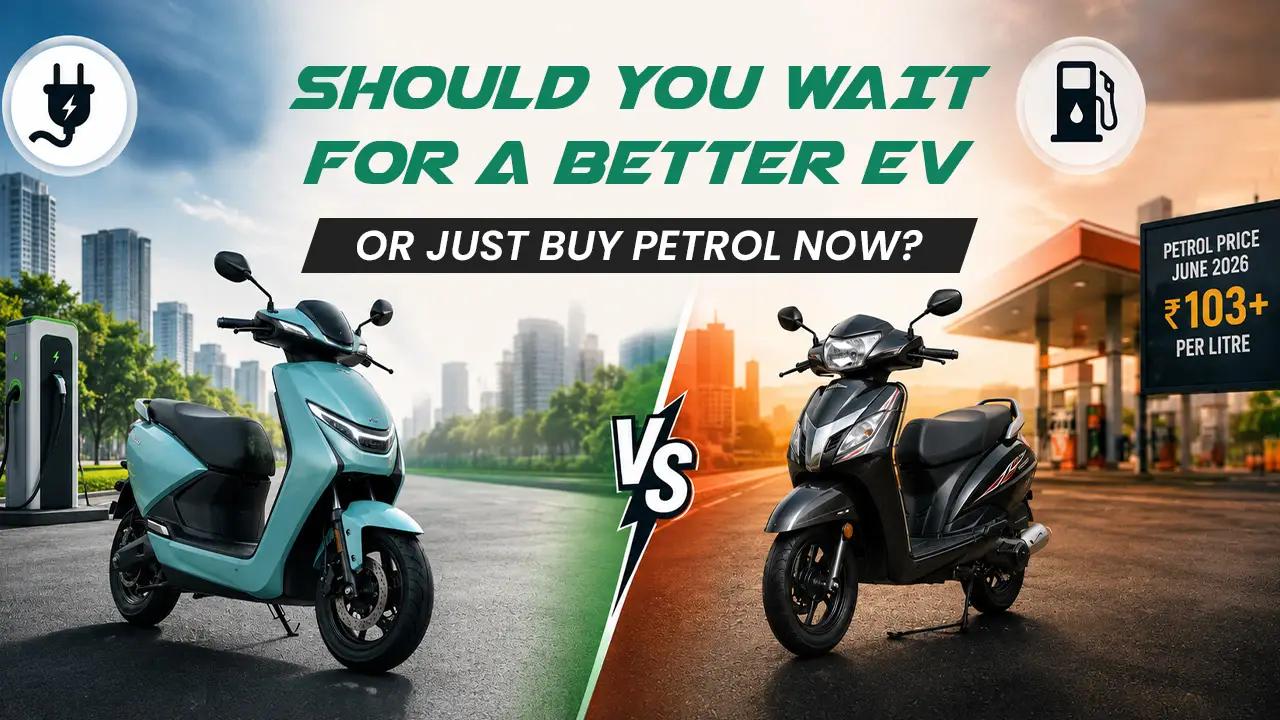

Should You Wait for a Better EV or Just Buy Petrol Now?
Featured Stories by Drivio | 8 Jun 2026
Honest Advice for Indian Buyers — June 2026
Should you wait for a better EV or buy petrol now is the question thousands of Indian buyers are genuinely wrestling with in June 2026. Petrol prices have climbed past ₹102 per litre in Delhi and beyond ₹111 in Mumbai, while the electric scooter segment has matured enough to offer real-world options from brands like TVS, Ola, Ather, and Bajaj. At the same time, the fear of buying something that becomes outdated within three years is keeping plenty of riders at the dealership fence. The honest answer is that there is no single correct choice — but there is a right choice for your specific situation.
How Fast Are EVs Actually Improving?
Battery technology in India's two-wheeler segment has made steady, meaningful progress over the past two years — but it has not been the overnight transformation that marketing campaigns tend to suggest. The average claimed range on a mainstream electric scooter has gone from around 80–100 km in 2023 to 150–200+ km IDC in 2026. Real-world range, accounting for Indian traffic, rider weight, and riding modes, typically lands at 60–70% of the IDC figure. A scooter claiming 200 km usually delivers around 130–145 km in everyday riding conditions.
Fast-charging has also improved noticeably. Several models now support charging from 0 to 80% in under an hour through fast chargers, while expanding public charging networks are making top-ups more convenient. What has not changed dramatically is the underlying battery chemistry. Most scooters still use NMC or LFP lithium-ion cells, while solid-state batteries remain years away from mass production and even further away from affordable Indian two-wheelers.
Software over-the-air updates have become a genuine differentiator. Brands such as Ather and Ola regularly push feature upgrades and efficiency improvements remotely, meaning a scooter purchased today can continue improving over time. This reduces the fear of obsolescence because the hardware is no longer the final version of the product.
Expect steady improvements in range, charging speed, and software during the next 12–24 months. However, buyers should not expect range to suddenly double or prices to collapse overnight.
The Real Cost Difference in India
With petrol averaging around ₹103 per litre across major Indian cities in June 2026, the running-cost advantage of EVs has become difficult to ignore.
A typical 125cc petrol scooter delivering 45–50 kmpl costs roughly ₹2.10–₹2.45 per kilometre to run. An electric scooter charged at home using domestic electricity priced around ₹7–₹8 per unit typically costs ₹0.20–₹0.35 per kilometre.
For a rider covering 40 km per day, or approximately 1,200 km per month, the monthly fuel bill for a petrol scooter comes to roughly ₹2,500–₹3,000. Charging an electric scooter for the same distance costs approximately ₹240–₹420 per month.
Annual savings can range between ₹25,000 and ₹32,000. Over five years, that translates to fuel savings of ₹1.25 lakh to ₹1.6 lakh before considering the lower maintenance requirements of an EV.
Buy EV Now vs Buy Petrol Now
| Factor | Buy EV Now | Buy Petrol Now |
| Running Cost | Very Low (~₹0.25/km) | High (~₹2.2/km) |
| Convenience | Excellent with home charging | Refuel anywhere in minutes |
| Resale | Improving | Well established |
| Long-Term Savings | Strong | Limited |
| Technology Risk | Moderate | Low |
Will Today's EVs Become Outdated Quickly?
This concern is understandable, but the reality is more reassuring.
Modern electric scooters from established manufacturers are unlikely to become obsolete in the way early smartphones did. Battery warranties typically range from three to eight years, depending on the brand and model. Many modern battery packs are designed to withstand thousands of charging cycles, which translates into many years of regular usage.
Software updates also extend the useful life of an EV. New ride modes, navigation improvements, battery management enhancements, and feature additions can be delivered remotely without requiring a new vehicle.
Resale value remains an area where petrol vehicles currently hold an advantage. The used EV market is still developing, and resale values can vary significantly between brands. However, buyers planning to keep their vehicle for five years or longer are less affected because the running-cost savings often outweigh resale concerns.
Many first-time EV buyers discover that waiting for the next better model becomes an endless cycle. There will always be another launch six months away. The technology has matured enough that a quality EV purchased in 2026 should remain relevant for years.
When Waiting Makes Sense
Waiting can be the smarter choice for certain buyers.
If you regularly ride more than 150 km per day, current EV options may still require careful charging planning. Riders travelling across multiple cities or spending long hours on highways may benefit from waiting for future products with greater range and faster charging.
Buyers without home charging access should also think carefully. Apartment charging challenges remain a reality in many Indian cities. If charging depends entirely on public infrastructure, the ownership experience can become less convenient.
Premium motorcycle enthusiasts may find that the electric motorcycle segment still lacks the variety available in petrol-powered performance bikes. While products such as the Ultraviolette F77 have demonstrated what is possible, the category is still developing.
Highway touring riders also continue to enjoy greater flexibility with petrol-powered motorcycles, especially in regions where EV charging infrastructure India is still limited.
When Buying Now Makes Sense
For many buyers, waiting offers little practical benefit.
Daily commuters travelling 30–60 km per day are already perfectly suited to electric ownership. On Indian city roads, EVs perform particularly well because stop-start traffic allows regenerative braking systems to recover energy.
Delivery riders and gig-economy workers often see the biggest financial benefits. Someone riding 80–100 km daily can save thousands of rupees every month by switching from petrol to electric.
High fuel-spend households are another strong candidate. Many riders who switch discover that the increase in their electricity bill is far smaller than expected, while the reduction in petrol expenses is immediate.
In actual ownership, buyers with home charging access and a nearby service network often find that today's EVs already meet all their practical requirements.
EV vs Petrol Bike India: Which Side Is Winning in 2026?
The EV vs petrol bike India debate is becoming less about performance and more about suitability.
Petrol vehicles remain dominant, particularly in rural markets, touring segments, and higher-capacity motorcycles. They offer unmatched refuelling convenience and a mature resale ecosystem.
However, electric two-wheelers are gaining momentum rapidly in urban India. Manufacturers continue investing heavily in battery technology, software ecosystems, charging networks, and service infrastructure. Major brands such as TVS, Bajaj, Hero MotoCorp, Ola, and Ather are treating electrification as a long-term business priority rather than an experiment.
Charging infrastructure continues to expand across major cities, shopping centres, office complexes, and highways. While gaps remain outside urban centres, the direction of the market is increasingly clear.
The electric two-wheeler future India appears strong, particularly for commuter scooters and urban mobility solutions. Petrol vehicles will remain relevant for years, but the strongest growth is occurring on the electric side.
The Verdict
Should you wait for a better EV or buy petrol now? For most urban Indian commuters, buying an EV in 2026 makes more sense than waiting for future technology.
Current electric scooters already offer meaningful running-cost savings, adequate range for daily use, improving service support, and increasingly mature technology. Waiting only makes sense if you lack home charging, regularly cover very long distances, or are specifically looking for a premium electric motorcycle that has not yet reached the market.
For everyone else, delaying the decision often means spending more on fuel while waiting for improvements that are likely to be incremental rather than transformative.
Before making a decision, check the latest on-road prices and EMI options for both EVs and petrol two-wheelers in your city on Drivio.