Top 5 Two-Wheelers Between ₹80,000 and ₹1 Lakh in India (2026)
Overview
Top 5 Two-Wheelers Between ₹80,000 and ₹1 Lakh in India (2026) brings key updates for two-wheeler buyers in India. The best two-wheelers between ₹80,000 and ₹1 lakh represent the single most contested price bracket in the Indian two-wheeler market in 2026. This ₹80,000–₹1 lakh range sits at the exact
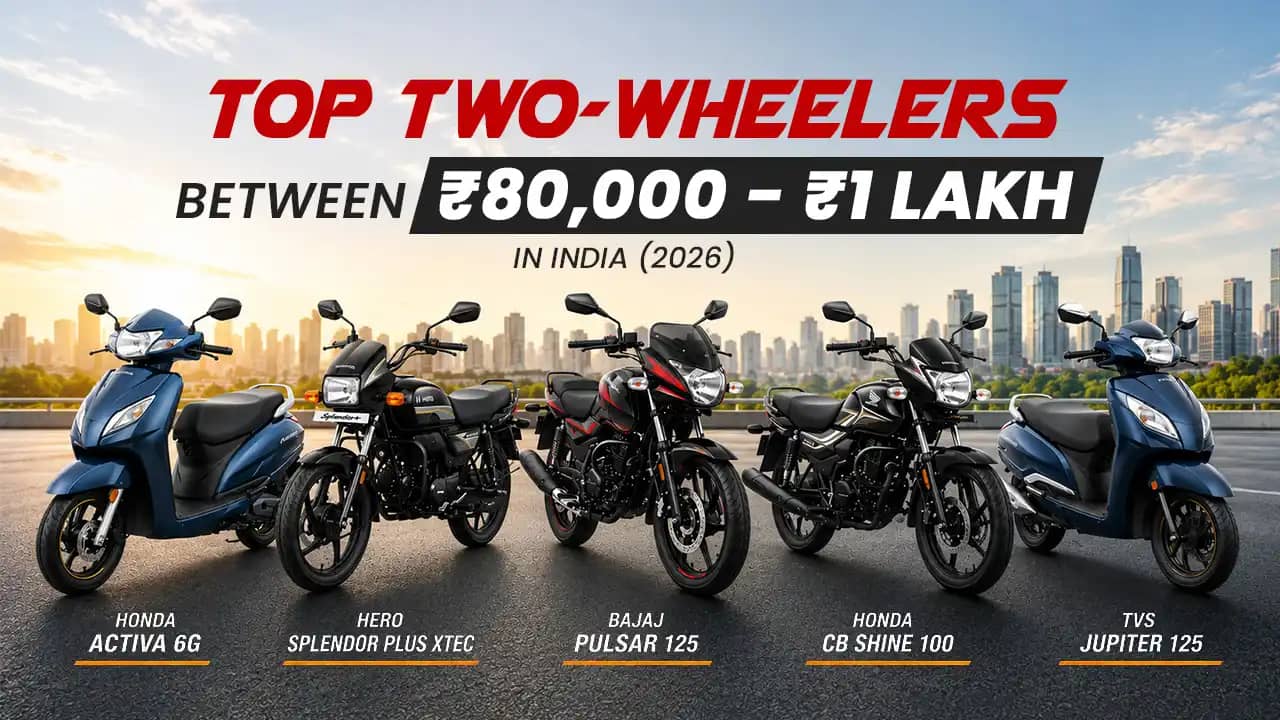
The best two-wheelers between ₹80,000 and ₹1 lakh represent the single most contested price bracket in the Indian two-wheeler market in 2026. This ₹80,000–₹1 lakh range sits at the exact intersection of aspiration and affordability — where buyers want more than a bare-bones commuter but cannot yet justify moving into the ₹1.10–1.30 lakh segment. Fuel prices hovering around ₹103 per litre in most Indian cities have sharpened the demand for vehicles that balance daily running economics with a reasonable degree of refinement. Five models currently dominate genuine purchase intent in this bracket: the Honda Activa 6G, Hero Splendor Plus Xtec, Bajaj Pulsar 125, Honda CB Shine 100, and TVS Jupiter 125. Here is how each performs when you remove the marketing layer and examine what daily ownership actually costs.
Honda Activa 6G
Ex-showroom: ₹79,900 | On-road (approx.): ₹90,000–₹94,000
Engine: 109.51cc | Power: 7.79 bhp | Torque: 9.79 Nm | Claimed mileage: 60 kmpl | Real-world: 48–52 kmpl
The Activa 6G is the benchmark against which every urban scooter in India is measured. Its fuel-injected 109.51cc single-cylinder engine starts immediately even in cold mornings, pulls cleanly through bumper-to-bumper traffic, and does not require gear changes — which is the primary reason it continues to outsell every alternative in the sub-₹1 lakh segment. The telescopic forks at the front improve ride quality over broken city surfaces noticeably compared to older Honda scooter setups, and the combined braking system reduces stopping distances without drama.
In daily urban use, the Activa 6G feels planted and predictable. It is not a fast scooter — highway use above 70 km/h exposes the engine's limitation, with vibrations building and pace flattening. For commuters riding primarily within city limits, that limitation never surfaces. The Honda service network — the widest in India — means maintenance is never complicated, and spare parts remain among the cheapest in this segment. Monthly fuel cost at 1,000 km: approximately ₹2,135 at 48 kmpl real-world return.
Best suited for: Urban riders who prioritise reliability, resale value, and effortless daily operation over performance.
Hero Splendor Plus Xtec
Ex-showroom: ₹83,200 | On-road (approx.): ₹93,500–₹97,000
Engine: 97.2cc | Power: 7.91 bhp | Torque: 8.05 Nm | Claimed mileage: 80 kmpl | Real-world: 62–66 kmpl
The Splendor Plus Xtec is unambiguously the best mileage bike under ₹1 lakh available in India today. That is not a contested point. The fuel-injected 97.2cc engine is tuned for economy above everything else — acceleration is gentle, top speed plateaus around 90 km/h, but fuel consumption in real-world city and semi-highway mixed use returns figures in the 62–66 kmpl range consistently. At ₹103 per litre and 1,000 km monthly use, that translates to a monthly fuel bill of approximately ₹1,606 — the lowest in this comparison by a significant margin.
The Xtec variant adds a digital instrument cluster, Bluetooth connectivity, and USB charging, which gives it a degree of modernity the base variant lacks. The side-stand engine cut-off is standard — a safety feature that matters more than buyers realise until they attempt to ride away with the stand down. Service costs are low, the Hero network covers even tier-3 towns, and annual maintenance stays well under ₹3,000 for most riders.
Best suited for: Riders for whom monthly fuel savings are the primary purchase criterion, or anyone clocking above 1,200 km per month.
Bajaj Pulsar 125
Ex-showroom: ₹88,500 | On-road (approx.): ₹99,000–₹1,02,500
Engine: 124.4cc | Power: 11.64 bhp | Torque: 10.8 Nm | Claimed mileage: 65 kmpl | Real-world: 50–55 kmpl
The Pulsar 125 is the performance outlier in this group. Its 124.4cc fuel-injected engine produces 11.64 bhp — substantially more than anything else here — and the character of the engine rewards riders who use the throttle confidently. City traffic feels brisk rather than laboured, and short highway stints up to 90 km/h are notably more comfortable than on the 100cc options.
The tradeoff is economy. Real-world mileage of 50–55 kmpl is respectable but not class-leading, and at ₹103 per litre that puts monthly fuel cost at roughly ₹1,930–₹2,060. The disc brake variant offers significantly shorter stopping distances and is worth the marginal price premium over the drum variant. Build quality on the Pulsar 125 has improved meaningfully in the last two generations, though Bajaj's service network still trails Honda's in parts availability in smaller cities.
Best suited for: Younger riders who commute in a mix of city and highway, and who find the Splendor-type engine character too sedate for their daily pace.
Honda CB Shine 100
Ex-showroom: ₹83,600 | On-road (approx.): ₹93,800–₹97,500
Engine: 97.2cc | Power: 7.68 bhp | Torque: 8.05 Nm | Claimed mileage: 65 kmpl | Real-world: 58–63 kmpl
The CB Shine 100 represents Honda's answer to the Splendor's dominance in the 100cc commuter space. The fuel-injected 97.2cc engine is smoother at idle than the Hero unit, with a refinement level closer to a 125cc motorcycle than most 100cc offerings. Real-world mileage of 58–63 kmpl puts monthly fuel expenditure at approximately ₹1,635–₹1,775 — within ₹170 of the Splendor at realistic riding conditions.
The telescopic front forks absorb city road imperfections well, and the digital-analogue instrument cluster reads clearly in bright Indian sunlight. Honda's build quality and the depth of its service network mean that long-term ownership anxiety stays low. The Shine 100 is the low-maintenance bike India's reliability-focused buyers have been waiting for in the 100cc space. Its one limitation: it does not feel particularly exciting to ride, which matters to some buyers and not at all to others.
Best suited for: Commuters who want near-Splendor economy with Honda's reliability reputation and a slightly more refined riding experience.
TVS Jupiter 125
Ex-showroom: ₹95,400 | On-road (approx.): ₹1,06,000–₹1,10,000
Engine: 124.8cc | Power: 8.15 bhp | Torque: 10.5 Nm | Claimed mileage: 56 kmpl | Real-world: 48–52 kmpl
The TVS Jupiter 125 is the premium scooter under ₹1 lakh that pushes closest to the top of this budget. Its 124.8cc fuel-injected engine gives it meaningfully more pulling power than the Activa 6G in geared urban traffic — it holds speed on flyovers without effort and handles pillion loads without the characteristic Activa-at-full-load strain. The disc brake variant brakes with confidence, and TVS has fitted the Jupiter 125 with a digital instrument cluster, external fuel cap, and under-seat storage of 21 litres — practical details that matter in daily use.
The on-road price approaches or crosses ₹1 lakh in most Indian cities, which technically places it at the ceiling of this comparison. Monthly fuel cost mirrors the Activa 6G at approximately ₹2,135. TVS service network coverage has improved considerably across metro and tier-2 cities, though it remains thinner than Honda's in rural areas. As a value for money bike in India's premium scooter space, the Jupiter 125 is genuinely compelling for urban households.
Best suited for: Urban family riders who want a more capable scooter than the Activa 6G and can absorb a slightly higher purchase cost.
Quick Comparison: Five Strongest Options Under ₹1 Lakh
| Vehicle | Ex-Showroom | Engine | Power | Torque | Real Mileage | Best For |
| Honda Activa 6G | ₹79,900 | 109.51cc | 7.79 bhp | 9.79 Nm | 48–52 kmpl | Urban daily commute |
| Hero Splendor Plus Xtec | ₹83,200 | 97.2cc | 7.91 bhp | 8.05 Nm | 62–66 kmpl | Budget-conscious, max mileage |
| Bajaj Pulsar 125 | ₹88,500 | 124.4cc | 11.64 bhp | 10.8 Nm | 50–55 kmpl | Style-conscious rider |
| Honda CB Shine 100 | ₹83,600 | 97.2cc | 7.68 bhp | 8.05 Nm | 58–63 kmpl | Reliability seekers |
| TVS Jupiter 125 | ₹95,400 | 124.8cc | 8.15 bhp | 10.5 Nm | 48–52 kmpl | Premium scooter feel |
Running Cost Reality Check
Using ₹103 per litre and 1,000 km of monthly riding, here is what fuel actually costs across three of the five vehicles:
Hero Splendor Plus Xtec at 64 kmpl real-world: ₹1,609/month
Honda CB Shine 100 at 61 kmpl: ₹1,689/month
Bajaj Pulsar 125 at 52 kmpl: ₹1,981/month
Over 36 months — the typical ownership period before a first upgrade — the Splendor Plus Xtec rider saves approximately ₹13,392 in fuel alone compared to the Pulsar 125 owner, assuming equal usage. That is a material saving that justifies the lower purchase price even before accounting for lower maintenance costs on the 97.2cc engine.
Which One Gives the Best Value for Money?
Value for money in the Indian context means total cost of ownership, not just ex-showroom price. The Hero Splendor Plus Xtec delivers the lowest running costs in the segment, the widest service availability, and strong resale values in tier-2 and tier-3 markets. The Honda CB Shine 100 offers near-identical running costs with the added benefit of Honda's brand perception — which translates directly to better resale in urban markets.
The Bajaj Pulsar 125 makes a value argument on performance terms — you get 125cc power at a price that until recently required stepping up to the 150cc segment. But its higher fuel costs and marginally elevated service bills across a three-year ownership cycle narrow that advantage. The Honda Activa 6G retains exceptional resale value — typically ₹55,000–₹65,000 after two years in most Indian cities — which partially offsets its higher initial price point versus the 100cc commuters.
The TVS Jupiter 125 is the most capable scooter in this list, but its on-road price frequently crosses ₹1 lakh, which requires acknowledging it sits at the absolute ceiling of this comparison rather than comfortably within it.
Which Two-Wheeler Should You Actually Buy?
1 — Hero Splendor Plus Xtec. Overall winner. If minimising total cost of ownership is the primary criterion — and for most Indian buyers with monthly distances of 800–1,200 km it should be — nothing in this price band beats it. The mileage figures are genuinely class-leading, the service network reaches further than any competitor, and the Xtec variant's digital features remove the "boring commuter" stigma that held the Splendor back with younger buyers. Buy it if you ride daily, watch fuel bills, or live outside a metro. Avoid it if performance and visual aggression are non-negotiable.
2 — Honda CB Shine 100. The refinement advantage over the Splendor is real and noticeable daily. If you split time between city and short highway stretches, and want Honda's long-term reliability reputation with near-identical economy, this is the alternative to shortlist.
3 — Honda Activa 6G. Still the benchmark urban scooter in India. If you need a gearless vehicle, want Honda's brand backing and resale, and ride primarily within city limits, the Activa 6G remains the most rational purchase. The ₹79,900 ex-showroom entry point makes it the most accessible option here.
4 — Bajaj Pulsar 125. For the rider who genuinely uses the performance and accepts the slightly higher running costs, the Pulsar 125 delivers an experience the economy bikes cannot. It is a specific recommendation for a specific buyer rather than a general winner.
5 — TVS Jupiter 125. Technically the most capable scooter in this group, but its on-road price pushes it beyond the ₹1 lakh ceiling in most states. Worth considering if your budget stretches to ₹1.10 lakh on-road, but that is a different buying conversation.
The Indian commuter motorcycle market in mid-2026 is well-served in this price range, but the Hero Splendor Plus Xtec remains the most defensible recommendation for the broadest category of buyers — those who want the lowest total cost of ownership without sacrificing modern features. Check the latest on-road price, finance offers, and EMI options for your preferred two-wheeler on Drivio before making a final decision.
The best two-wheelers between ₹80,000 and ₹1 lakh represent the single most contested price bracket in the Indian two-wheeler market in 2026. This ₹80,000–₹1 lakh range sits at the exact intersection of aspiration and affordability — where buyers want more than a bare-bones commuter but cannot yet justify moving into the ₹1.10–1.30 lakh segment.